Designing the AI Stack of 2026: MCP & Context-Driven Execution
On this page
Enterprise AI is entering a new phase; one defined not by what systems can generate, but by how effectively they can reason and act. Over the past two years, organizations have made significant investments in models, orchestration frameworks, and data infrastructure. These layers have advanced rapidly, enabling AI systems to produce insights, automate workflows, and support decision-making at scale. Yet for all this progress, a fundamental limitation persists.
Most AI systems still operate without a coherent understanding of the business context in which decisions are made. This is not because enterprises lack data. On the contrary, most organizations are rich in signals across sales, marketing, product, and customer interactions. The challenge is that these signals remain fragmented, inconsistently defined, and difficult to reason across. As a result, critical questions, those that cut across functions, time horizons, and customer journeys, remain difficult to answer, and even harder to act on.
In this issue of RevSure Horizons, we explore how the AI stack is evolving to address this limitation through the emergence of the context layer, and how Model Context Protocol (MCP) is enabling a new class of systems that can reason across unified context and drive coordinated execution.
HBR: The Shift Toward Context-Driven AI
This emerging focus on context is not isolated. It reflects a broader shift in how leading institutions and research bodies are thinking about enterprise AI. Harvard Business Review has recently argued that as access to foundation models becomes increasingly standardized, competitive advantage will no longer come from the models themselves, but from how effectively organizations embed them within their unique business context. In this view, context is not a supporting layer, but the primary differentiator in how AI systems create value.
This is precisely the gap emerging architectures are beginning to address, and where Model Context Protocol (MCP) becomes critical.
MCP as the Context Layer for Reasoning Systems
As AI systems evolve from isolated tools into embedded decision-making systems, they require more than access to data or the ability to execute workflows. They require a structured, governed way to understand the state of the business in real time and reason across it.
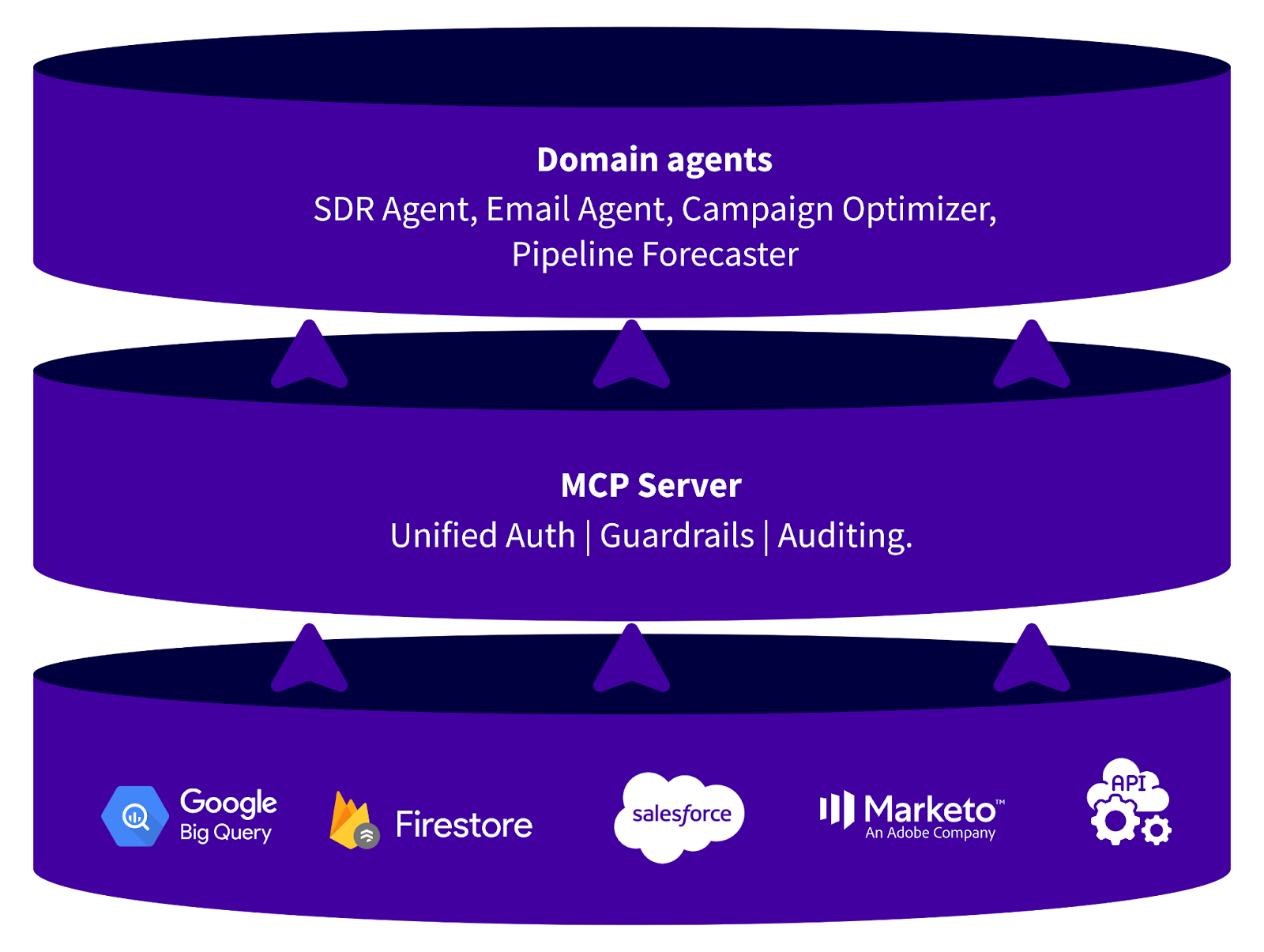
MCP introduces this capability as a distinct layer in the AI stack. Positioned between data systems and execution layers, MCP transforms fragmented signals into a unified, continuously updated representation of the business. It enables systems to access context not as disconnected records, but as a coherent structure that preserves relationships across customer behavior, account progression, engagement patterns, and commercial outcomes.
This fundamentally changes how systems operate.
Instead of querying individual datasets or relying on predefined dashboards, models can interact with context directly, exploring it through natural language and reasoning across multiple dimensions simultaneously.
When MCP Meets RevSure and Claude
The practical impact of MCP becomes clearer when applied to real-world systems.
The impact of MCP becomes most evident when it operates on a unified and governed data foundation. RevSure provides this foundation by harmonizing signals across CRM, marketing automation, product usage, pipeline systems, and customer interactions into a structured GTM data layer. This includes consistent entity definitions, relationship mapping across accounts and opportunities, and a semantic model that preserves buyer journey context over time. As a result, MCP operates on data that is normalized, connected, and contextually meaningful.
MCP exposes this context through a standardized interface that reasoning systems such as Claude can access. Instead of querying isolated datasets or predefined dashboards, the model interacts with a unified representation of the business, retrieving and combining signals across time, engagement, pipeline state, and account relationships.
This enables a different class of queries, such as:
- Comparing current opportunities against historical closed-won patterns
- Identifying reactivation signals in previously closed-lost accounts
- Evaluating tradeoffs between pipeline generation and revenue outcomes
- Reconstructing full-funnel buyer journeys across touchpoints
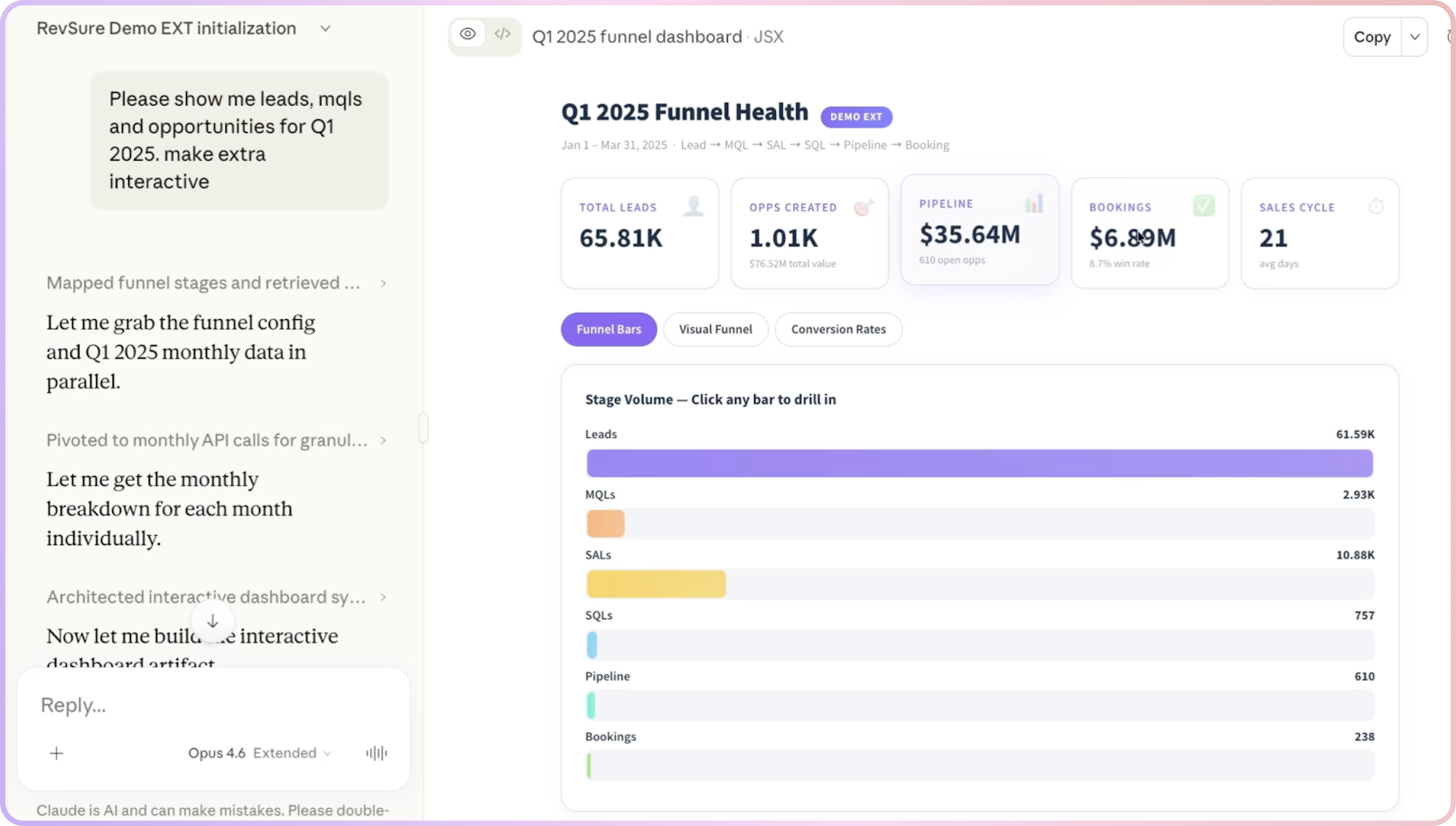
These queries are dynamically decomposed into multi-step operations over the context layer.
The outputs reflect this structure. Rather than static summaries, the system generates:
- Ranked account and opportunity scorecards
- Comparative cohort analyses across segments and timeframes
- Temporal views of engagement and pipeline progression
- Decision-oriented models that highlight tradeoffs and gaps
Because MCP maintains continuity of context, analyses can be iterated, refined, and extended without resetting the workflow.
From a systems perspective, this represents a shift from query-based retrieval to context-driven reasoning. MCP provides the context layer, RevSure ensures data integrity and semantic consistency, and Claude performs multi-step reasoning across that foundation.
In effect, MCP shifts enterprise systems from answering questions to forming structured, context-aware perspectives that can directly inform action.
From the Blog | When Context Meets Execution
As AI systems evolve, the gap between data and decision-making is becoming increasingly pronounced. In our latest blog, we examine how MCP bridges this divide by enabling AI systems to operate on a trusted, unified GTM context rather than isolated data points.
The piece explores how structured context, reasoning layers, and governed execution come together to support systems that move beyond insight generation toward consistent, real-world action across the funnel.
On-Demand | RevSure Product Updates: March Release
RevSure’s March 2026 release focuses on strengthening the connection between GTM data, context, and execution. In this session, the product team walks through how RevSure captures buyer signals from emails and meetings, structures them into account and opportunity context, and activates them across pipeline workflows. It also highlights MCP-driven capabilities for analysis and execution across the unified GTM data layer.
Key areas include signal capture and enrichment, buyer intelligence and deal scoring, data unification, and agentic workflows for prospecting, outreach, and deal prioritization.

Live Session | MCP + Claude for Cross-Functional GTM Analysis
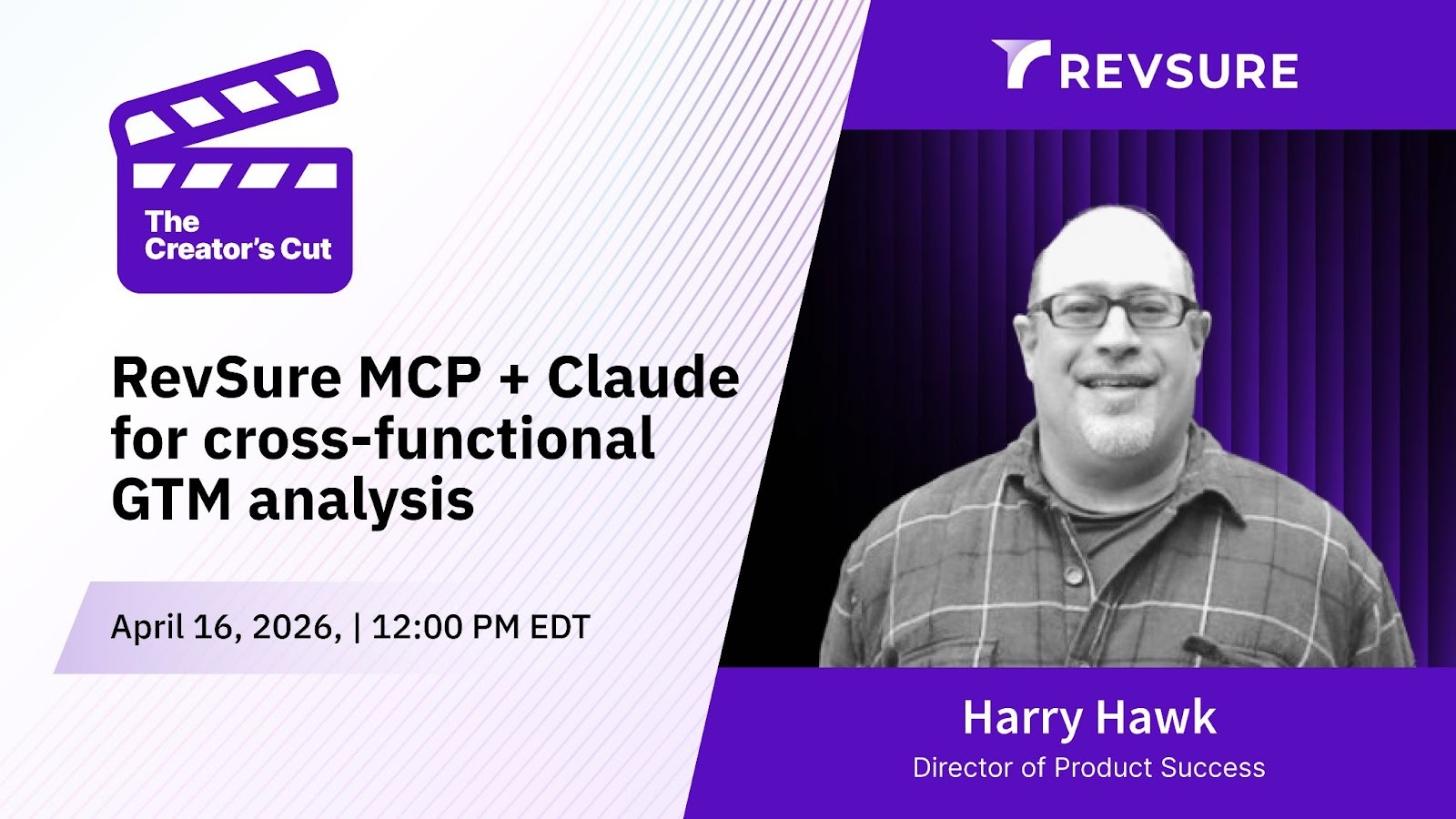
Join Harry Hawk for a live session on how RevSure MCP and Claude enable cross-functional reasoning across sales, marketing, and product data, without relying on predefined reports or disconnected dashboards. The session will demonstrate how teams can query unified GTM context in natural language, generate ranked analyses and comparative models, benchmark live pipeline against historical patterns, and evaluate tradeoffs across pipeline and revenue outcomes in real time.
The Strategic Implication: Context and Reasoning as the New Advantage
As the AI stack continues to mature, access to individual components is becoming increasingly standardized. Models are rapidly commoditizing, orchestration frameworks are widely available, and data infrastructure is no longer a meaningful source of differentiation for most enterprises.
The point of leverage is shifting. It is no longer defined by the capability of individual systems, but by how effectively those systems are connected, grounded in context, and able to reason across it. Enterprises that can unify their data into a coherent context layer and enable systems to operate on that context dynamically will be able to make better decisions, respond faster to changing conditions, and execute with greater consistency across functions.
Those that cannot will continue to rely on fragmented views of the business, regardless of how advanced their models or tooling may be. This marks a transition from systems of intelligence to systems of understanding.
In that shift, MCP represents more than an architectural improvement. It reflects a broader movement toward AI systems that are capable not only of generating outputs, but of forming structured, context-aware perspectives that can be acted upon with confidence.