Managing AI as a Workforce: Control, Accountability & Governance
On this page
For the past few years, AI has been positioned as a productivity layer- helping teams write faster, summarize better, and operate more efficiently within existing workflows. That phase delivered meaningful gains, but it did not fundamentally change how work was structured.
That is no longer the case.
AI is now participating directly in execution- qualifying buyers, progressing conversations, supporting demos, and making decisions across the revenue lifecycle. This represents a structural shift in how go-to-market work gets done.
As a result, the central question for leaders is no longer whether AI can help. It is whether organizations are prepared to control, govern, and take accountability for AI as a workforce.
In this issue of RevSure Horizons, we explore a fundamental shift underway in go-to-market: the transition from using AI as a tool to managing it as part of the workforce.
From Assistive AI to Workforce Systems
The transition from assistive AI to agentic execution introduces a new level of complexity that most organizations are underprepared for.
In an assistive model, AI operates at the edges of work. Humans remain the primary decision-makers, with AI augmenting their capabilities. In an agentic model, AI takes on defined portions of execution, acting autonomously within boundaries and interacting across systems, channels, and customer touchpoints.
This creates a fundamentally different operating environment.
Organizations are no longer optimizing workflows alone. They are redistributing work across a system composed of humans and agents, each contributing to execution in real time. What was previously a linear process is becoming a distributed system of decision-making and action.
Insights from the HSE CEO Panel at Agentic OS Summit
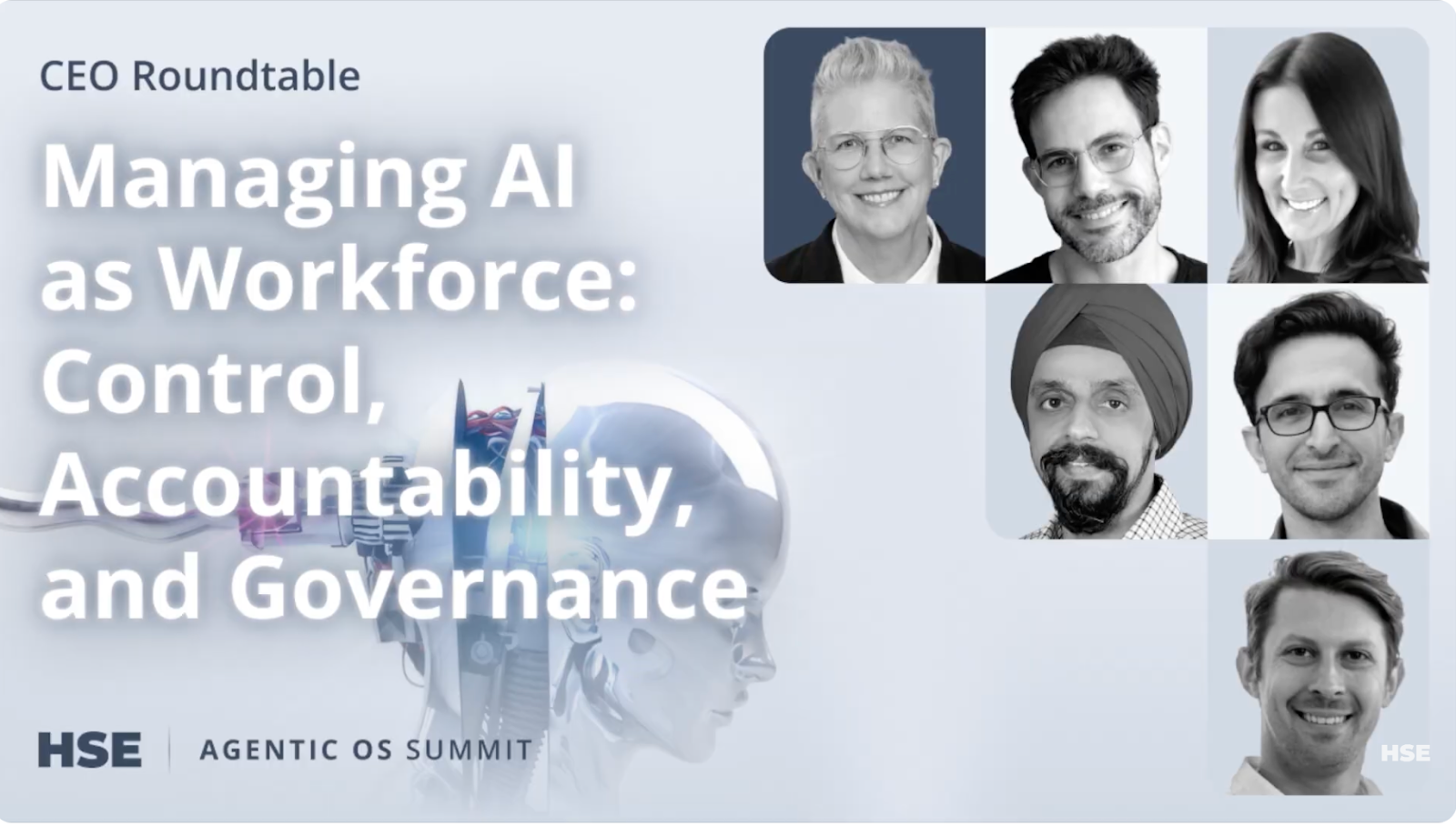
These themes were explored in depth at the Hard Skill Exchange (HSE) CEO Panel on “Managing AI as Workforce: Control, Accountability, and Governance” at the Agentic OS Summit, where Deepinder Dhingra, Founder & CEO of RevSure, joined other industry leaders to discuss what it takes to operationalize AI at scale.
One of the clearest takeaways from the discussion is that organizations are not deploying a single agent, but rather a network of agents operating across the entire buyer journey. These agents interact across inbound, outbound, product-led, and sales-led motions, often simultaneously.
As Deepinder highlighted, the challenge is not deploying these agents, but ensuring they operate as a coordinated system on a shared context, rather than as isolated point solutions. This is where most companies get it wrong.
They are repeating the SaaS playbook, moving from fragmented tools to fragmented agents, without addressing the underlying system design problem.
To go deeper into how leading CEOs are thinking about AI as a workforce, watch the HSE CEO Panel: Managing AI as Workforce.
The Real Constraint: Control, Not Capability
A consistent theme across the panel was that capability is no longer the bottleneck. The real challenge is control.
The moment AI begins to act, organizations must answer a new class of questions:
- Who owns the agent and is accountable for its outcomes?
- What decisions is it allowed to make, and under what constraints?
- How are actions coordinated across multiple agents operating simultaneously?
These are not purely technical concerns. They are operational and organizational in nature. Many companies are already experiencing a new form of fragmentation. What was once a proliferation of SaaS tools is now becoming a proliferation of agents, often deployed independently, without shared context or governance.
Why Shared Context Becomes Foundational
One of the most important insights from the discussion is that shared context is the foundation of any effective agentic system.
In traditional GTM architectures, context is fragmented across systems- CRM, marketing automation, sales engagement, and customer success platforms. Each function operates on a partial view of the customer. When agents are introduced into this environment, fragmentation becomes exponentially more problematic.
Agents operating without shared context cannot maintain continuity across the buyer journey. They cannot align decisions across touchpoints, and they cannot operate in a way that reflects the full state of the customer relationship.
A unified context layer like in RevSure, by contrast, allows agents to operate with a consistent understanding of the customer, the account, and the broader go-to-market motion. It enables coordination across functions and ensures that execution is aligned rather than disjointed.

This is the difference between deploying agents and building a system.
The Emergence of the Control Plane
As AI becomes embedded in execution, the role of humans within go-to-market organizations is also evolving.
As Deepinder noted during the panel, the role of the human is shifting from execution to defining, designing, and monitoring the system itself. This represents the emergence of a control plane model.
In this model, agents handle execution at scale, systems enforce coordination and policy, and humans act as the governing layer- defining objectives, setting guardrails, and continuously improving outcomes.

This transition is not simply operational. It fundamentally changes how roles are defined, how performance is measured, and how organizations think about ownership.
Governance as a Core Operating Requirement
As AI moves from assisting to acting, governance becomes a foundational requirement.
Trust in AI systems is not derived from intelligence alone. It is built on consistency, predictability, and accountability, properties that must be explicitly designed into the system rather than assumed. This requires organizations to establish clear ownership structures, enforce guardrails that define permissible behavior, and ensure full observability of how agents operate across the lifecycle.
In enterprise environments, this extends beyond internal discipline. It requires formalized frameworks that ensure every action is traceable, every decision is explainable, and every system can be continuously tested, audited, and improved. This is precisely why governance is rapidly evolving into a standardized discipline.
RevSure’s alignment with ISO/IEC 42001:2023 for Responsible AI Governance reflects this shift. The standard establishes a structured approach to managing AI systems responsibly, covering areas such as risk management, accountability, transparency, and continuous oversight. Rather than treating governance as an afterthought, it embeds it directly into how AI systems are designed, deployed, and operated.
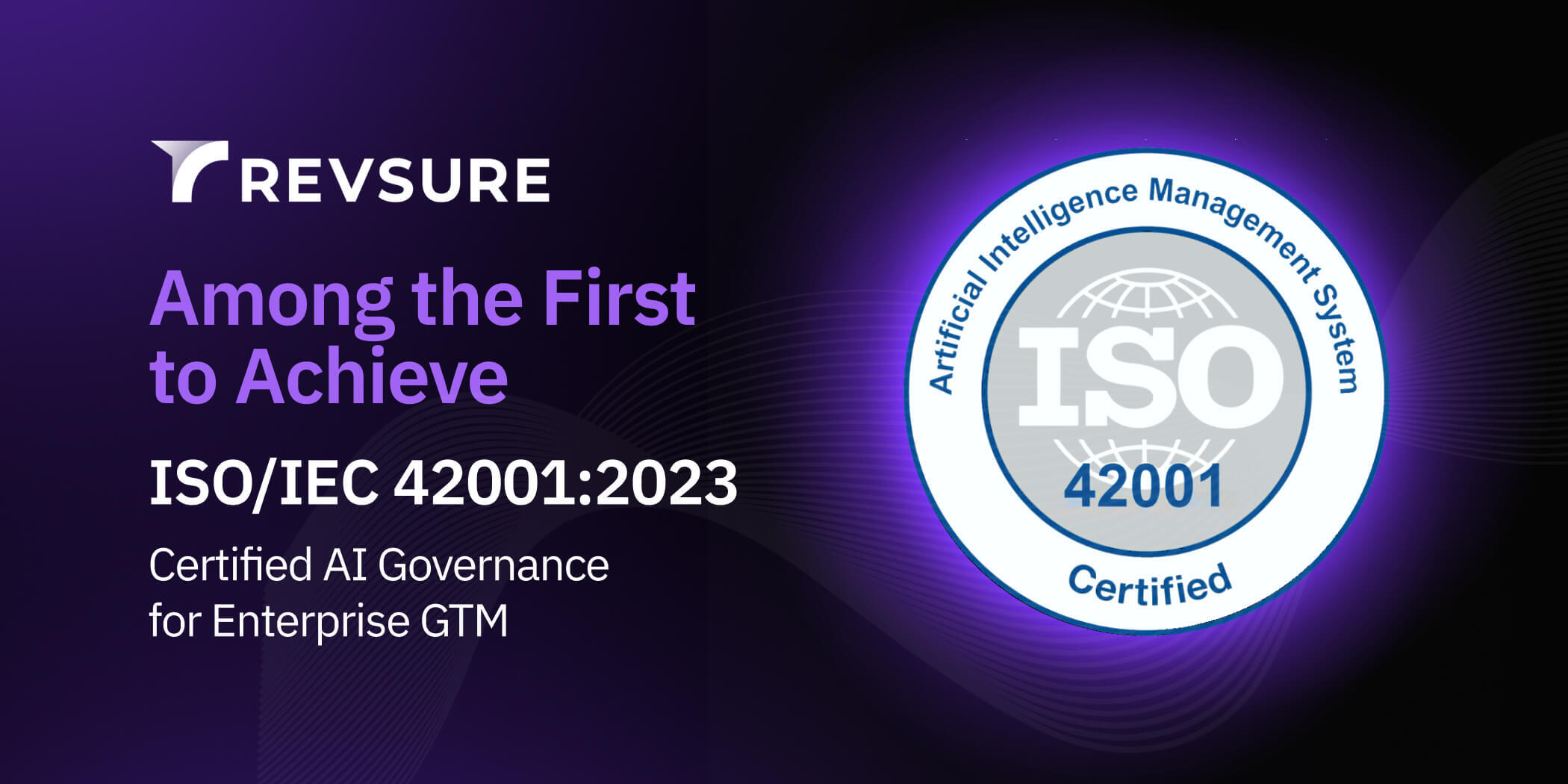
In practice, this means AI is not only performant, but also controlled, auditable, and aligned with enterprise-grade requirements, from policy enforcement to decision traceability.
The Advantage Lies in Operability
A central takeaway from both the panel and the broader market is that AI itself is not a durable source of competitive advantage. Access to models is converging. Agent capabilities are becoming standardized.
The real differentiation will come from how effectively organizations operate AI within their systems- how they structure context, define ownership, enforce governance, and continuously improve execution. In this environment, AI is not the advantage. The operating system that manages it is.
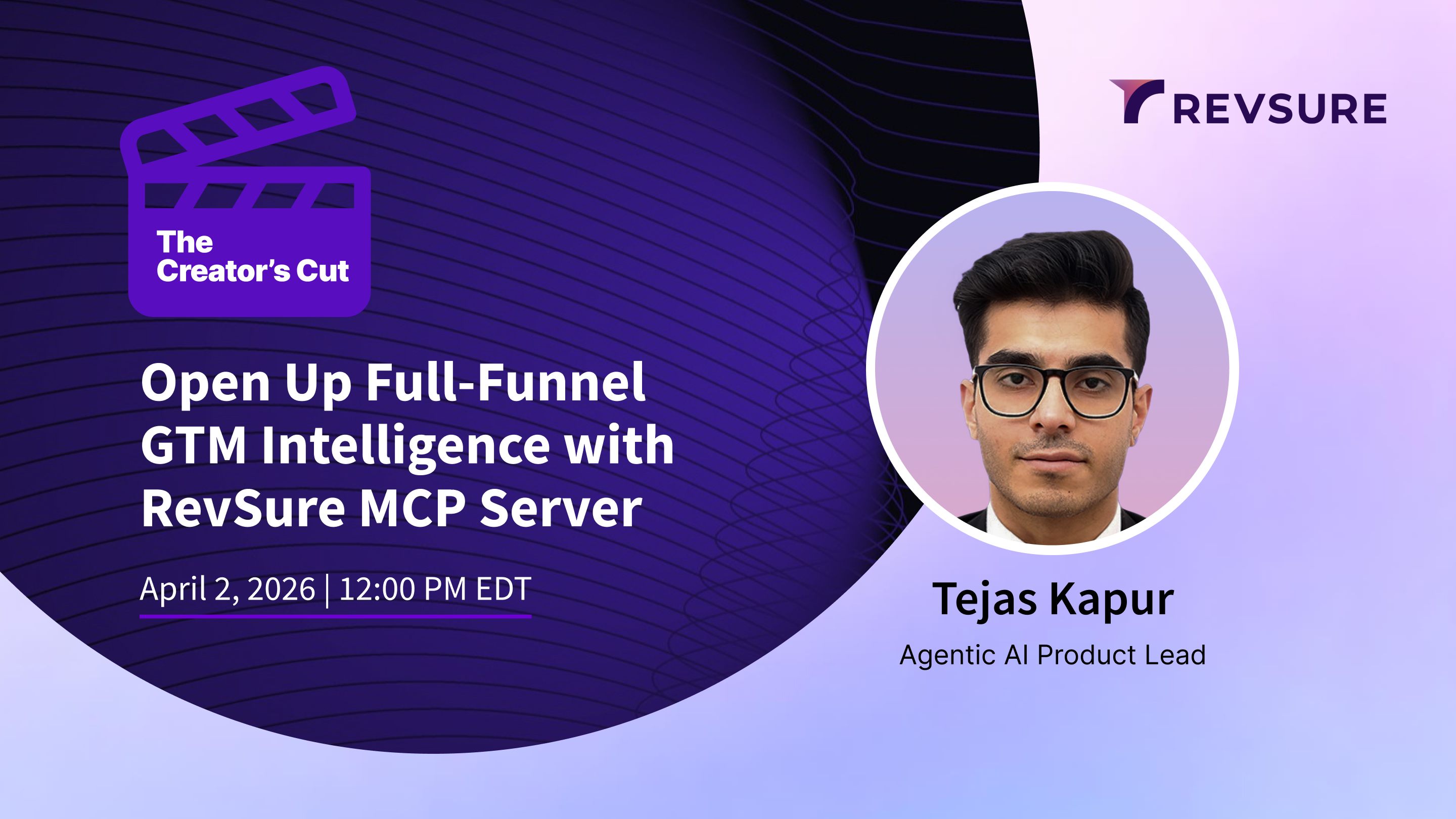
On Demand | Open Up Full-Funnel GTM Intelligence with RevSure MCP Server
Most AI agents today generate outputs in isolation. Very few are able to act on a unified, governed view of go-to-market data. This session explores how the RevSure MCP Server enables agents to operate on shared context, connecting fragmented signals across the funnel, reasoning on buyer journeys, and triggering coordinated actions across systems in real time.
Live Session | RevSure Product Updates: March Release
Join us for a detailed walkthrough of RevSure’s March 2026 release, focused on turning GTM data into execution. The session covers new capabilities across email intelligence, Buyer Persona Models, Redshift and Apollo integrations, scheduled AI insights, and agentic workflows, designed to improve visibility, accelerate prioritization, and enable more precise execution across the revenue lifecycle.

What Comes Next
As AI becomes embedded in execution, the defining questions for go-to-market leaders will continue to evolve. The focus will shift from what AI can do to how it is managed- who owns it, how it is governed, and how it improves over time. The companies that move early to build systems around control, accountability, and shared context will not simply adopt AI faster. They will build coordinated, compounding systems of execution that scale without breaking. In that future, AI will not be a tool that teams use. It will be a workforce that organizations manage.