On this page
MCP server use cases for GTM fall into five patterns: reconstructing why recent deals were won, scoring live pipeline against those winning patterns, finding closed-lost accounts that have started behaving like buyers again, weighing budget allocation for pipeline against bookings, and testing whether a recent pattern still holds across a larger sample of wins. Each example below is a real prompt run against live customer data through the RevSure MCP server in Claude, with the analysis it returned.
All customer, account, and contact examples below are anonymized. Actual use cases, prompts, and data used.
What RevSure is
RevSure is a Full Funnel GTM intelligence platform for B2B teams. It unifies CRM, marketing automation, ads, ABM, web, product, and warehouse data into a governed full-funnel data layer, with a semantic data graph and traceable buyer context designed for analysis, activation, and AI-driven execution.
That foundation matters because RevSure is not just another reporting surface. RevSure’s platform delivers full-funnel attribution, marketing mix modeling, incrementality testing, pipeline acceleration, probabilistic journey orchestration segmentation (next-best-action recommendations), and rich buyer-journey analysis built on a harmonized GTM data layer.
Missing data?
Most GTM teams do not have a data shortage. They have a coherence shortage.
Signals are spread across systems, definitions drift by function, and critical questions get trapped in disconnected dashboards. RevSure solves that by giving teams one trusted operating layer that fits together marketing, sales, buyer behavior, and commercial outcomes.
So, why MCP?
New to the protocol itself? Start with what an MCP server is for the definition and architecture, and MCP for GTM for what a revenue team connects and in what order. The rest of this page is what the connection is actually used for.
Because even the best GTM teams have questions that can’t be easily defined upfront. They cut across time, teams, dashboards, and buyer journeys, and they need deep reasoning, not just reporting.
Every great sales and marketing team has ad hoc reporting needs. Often, questions cut across time, teams, journeys, dashboards, and attribution views. Questions that require real, thoughtful analysis across multiple slices of the business. Questions that may eventually lead to building dashboard or reports, or may not.
That is where MCP shines. In Claude, especially, it lets sales and marketing professionals ask those questions in natural language – in their own words – get back a structured, interactive answer, not a wall of text. From CROs and CMOs to managers and individual contributors, anyone on the GTM team can use RevSure’s trusted data to explore complex questions and pressure-test ideas, to quickly get a clear point of view.
When RevSure meets Claude, everything changes!
RevSure already gives teams rich, accurate answers that are repeatable at scale. RevSure via MCP in Claude adds something different: reasoning at scale across multiple views, time frames, and analytical surfaces at once.
The output feels different. Instead of a dense answer or a single chart, the user can get an interactive ranked scorecard, a comparative model, a timeline, or a decision artifact that is easier to absorb, challenge, and act on. All they have to do is ask!
The kinds of questions this unlocks
Here are actual prompts used with real customers:
- explain the journey behind the most recent wins and look for gaps
- compare current open opportunities to recent closed-won deals
- find closed-lost deals from 9–10 months ago that are warming back up
- help balance paid-budget optimization for pipeline versus bookings
Those are not dashboard questions. They are reasoning questions. These are questions that could take hours or even days to analyze, answered in minutes.
Use case 1: why did we win our most recent deals?
One strong workflow started with two recently closed-won deals and asked RevSure/MCP to explain how they actually got across the line. The artifact did not just summarize the accounts; it reconstructed the journey to closed won.
One anonymized win showed conviction building before the opportunity formally existed, with self-serve exploration, repeat site visits, nurture engagement, and then a rapid formal selling motion. The second showed a different pattern, with a clearer champion, a tighter buying group, and a more deliberate meeting cadence.
That is where the experience gets exciting. The user is no longer looking at two old deals; they are looking at two emerging playbooks.
Use case 2: which open deals look like our past winners?
The next step was even more compelling. RevSure/MCP took those winning patterns and applied them to current opportunities.
One anonymized enterprise deal showed unusually strong early engagement, multi-threading, and executive attention. But the artifact did something far more useful than declaring it healthy: it showed the gaps.
It highlighted where the opportunity still lagged past winners, including thinner meeting depth, weaker self-serve evidence, and less certainty around the real champion. That gives a sales or marketing professional a sharp, evidence-backed point of view they can react to with their own account knowledge.
Use case 3: which closed-lost deals are warming back up?
This is the example that really captures the promise.
Looking back nine to ten months at closed-lost opportunities, RevSure/MCP did not simply return a list of stale deals from the CRM. It surfaced the ones that were “legally dead” (closed-lost) but recently alive in behavior.
In one anonymized account, senior contacts were visiting pricing and proof-heavy pages. In another, there was a burst of active email engagement across multiple employees in a short window, including more senior roles.
Any CRM or MAP can show you what was lost. RevSure/MCP found lost deals that were warming up.
Just as important: It did not answer with a blob of prose. It created an interactive artifact (interactive HTML in Canvas) that ranked the accounts, summarized the signals, and laid out a practical plan of action.
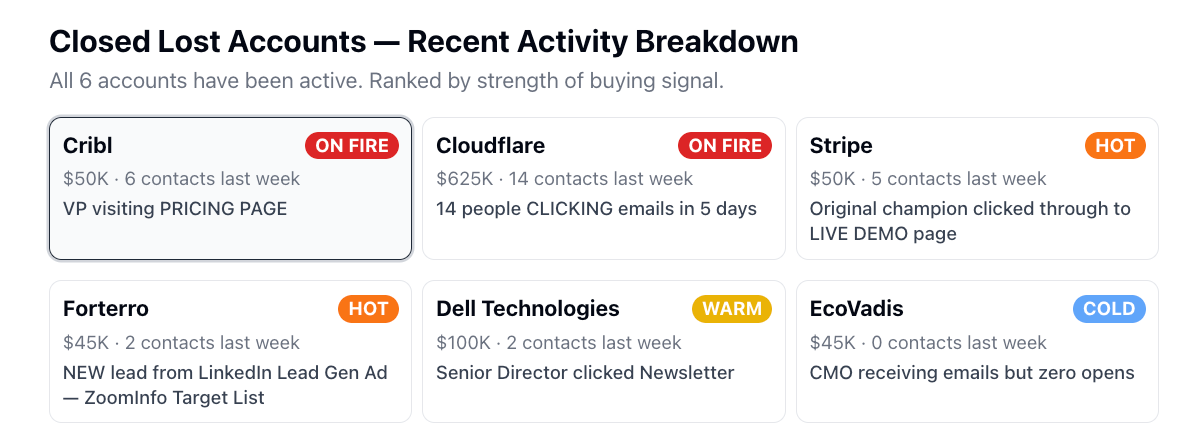
That “action plan” is truthfully just “one model's take.” Its real value is giving a clear perspective to refine with “human understanding” like relationship contexts, sales-cycle nuances, and everything else that never lives fully in a database.
Use case 4: should this budget chase pipeline or bookings?
Another workflow tackled a leadership question that comes up constantly: should the same budget be optimized for more pipeline, or for more bookings?
That is a better question than “what performed best,” because it forces the tradeoff into the open. One allocation can generate more pipeline volume, while another produces more efficient booked outcomes. The results: Optimize towards booking and get $6.2 million in sales, or maximize pipeline (gaining $1 million more pipeline) but “lose” $3 million in sales.
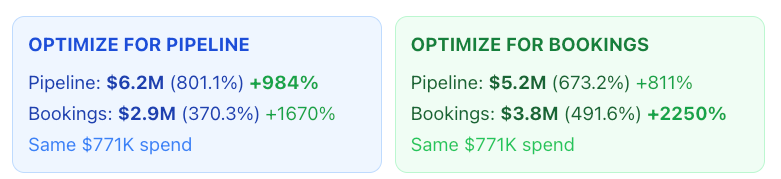
RevSure does the measurement work. Claude, via RevSure/MCP, turns that into an interactive comparison a team can discuss, pressure-test, and use in planning.
Use case 5: does the pattern hold across our last twenty wins?
One of the best artifacts compared the last two wins with the last twenty wins. That is a serious analytical move, because it tests and balances what’s tried and true vs. what motions are “working now.”
The broader model changed the picture. Deal size mattered more, technical validation emerged as its own motion in larger deals, and nurture looked less like a supporting tactic and more like part of the selling system itself.
That is not just prettier reporting nor gratuitous analysis. It's deep reasoning applied to a trustworthy and robust data set.
Why tool composition changes the answer
AI performs best in a narrow domain with rich data and real subject matter expertise behind the question, which describes GTM analysis closely. The person asking still supplies the judgment about what matters and why. The model supplies the ability to hold several analytical surfaces in view at once and to keep its working visible while it does.
Spotlight: What makes this powerful is tool composition — Claude doesn't call one tool and summarize. It chains multiple specialized tools together, using the output of one as the input to the next, building layered analysis that no single dashboard could produce.
– Shubh Tripathi, AI Engineer, RevSure.ai
A skilled sales or marketing professional can ask deep, complex questions in natural language and get back interactive reports built on top of trusted GTM data. Instantly, that can feel surprisingly close to having a dedicated analyst, strategist, and systems thinker working alongside you.
- Revisions are researched and displayed; Claude keeps the older versions.
- Nothing is lost – just refined.
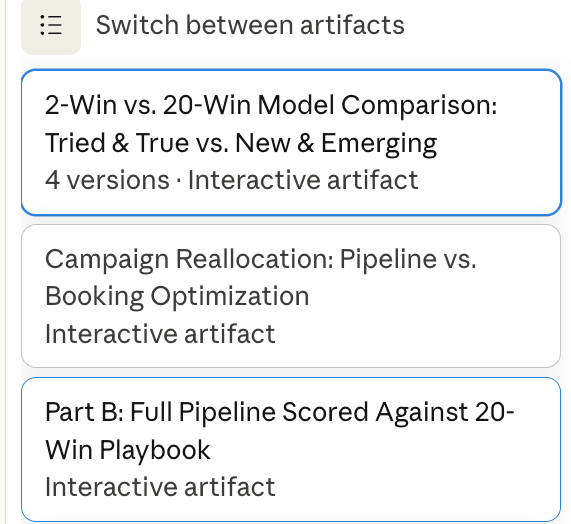
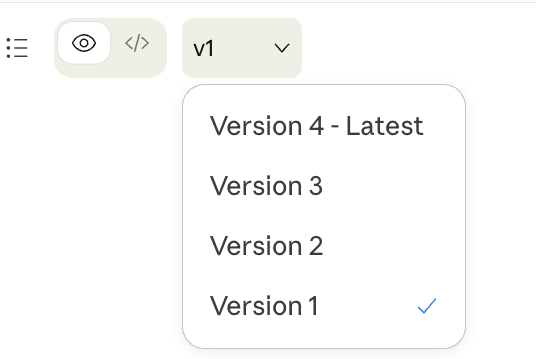
That is the wonder of an LLM + RevSure/MCP. This doesn’t replace humans, it puts team members at the head of the table.
Why the format matters
The point is not that every recommendation will be right. The point is that RevSure/MCP in Claude gives the team a clear, data-backed point of view that they can respond to.
That is enormously valuable in GTM work. A marketer or seller can agree, disagree, reframe, or deepen the analysis with context that only they know, but they are no longer starting from zero.
How Claude, ChatGPT, and Gemini compare
Most frontier models and many other platforms support MCPs. We’ve leaned into Claude. Here’s why.
Claude
Claude is the strongest fit for this workflow today because Anthropic has made MCP part of the actual product surface across Claude.ai, Claude Desktop, Claude Code, and the API. That is a big reason RevSure’s cross-view reasoning and interactive artifact workflow feel more natural there.
ChatGPT
ChatGPT has a solid offering. It often offers better reasoning and always offers a greater context window.. OpenAI’s current docs show support for MCP-backed custom apps, connected apps, interactive experiences, and broader app usage inside ChatGPT. The catch? The workflow is more interrupted because users need to repeatedly complete authentication flows, sometimes, work within developer mode or workspace controls.
It’s also less fluent in building interactive artifacts that can be accessed in-platform. That does not make ChatGPT unimportant. It just means the experience is more stop-start for this particular style of ad hoc, cross-view GTM analysis.
Gemini
Gemini is different again. Google’s official docs do show MCP support in the Gemini API SDKs, but that is primarily a developer and API story; the end-user Gemini Apps experience doesn’t support Custom MCP today. For the specific user-operated RevSure workflow described here, that makes Gemini a weaker practical fit today.
Security and Validation
RevSure is SOC 2, Type II secure, and ISO/IEC 42001:2023 certified – the world’s first international standard for Artificial Intelligence Management Systems (AIMS).Part of RevSure’s leadership in responsible, governed, and transparent AI.RevSure is also ISO 27001:2022 and GDPR compliant.
Spotlight: RevSure's tools don't give the AI open-ended data access. Every request is authenticated per user, every parameter is validated against the tenant's own data. The model can only see what the logged-in user is authorized to see, through the same governed layer that powers RevSure's production platform.
MCP is an open protocol. As more AI platforms adopt it, the same RevSure data and tools will work across all of them — no custom integration required.
– Shubh Tripathi AI Engineer, RevSure.ai
The real takeaway
RevSure is the essential layer in this story because it creates the trusted GTM foundation: harmonized data, stable business logic, rich journey visibility, and repeatable answers. MCP is what lets a model reason across that foundation when the question spills beyond what a predefined report can anticipate.
That combination is what makes the experience feel new. RevSure provides the truth layer; Claude, via MCP, provides the reasoning layer.
Final thought
The most interesting thing here is not that an LLM can call tools. It is that a sales or marketing team can ask a hard, messy, high-value question across multiple GTM surfaces and get back an interactive, evidence-backed point of view built on trusted data.
That is what makes RevSure/MCP in Claude feel so powerful. It is not replacing human judgment. It is giving human judgment a much stronger place to start.
Common questions
What are the main MCP server use cases for GTM teams?
Five recur most often: reconstructing why recent deals were won, scoring live pipeline against those winning patterns, finding closed-lost accounts that have started re-engaging, weighing budget allocation for pipeline against bookings, and testing whether a recent pattern holds across a larger sample of wins. All five are ad hoc reasoning questions rather than dashboard questions.
How is an MCP use case different from a dashboard report?
A dashboard answers a question someone anticipated and built for in advance. An MCP use case starts from a question nobody built a report for, and the model reasons across several views, time frames, and analytical surfaces to assemble the answer. The output is an interactive artifact that can be challenged and revised rather than a fixed chart.
Which AI assistant works best for these MCP use cases?
Claude, at present, because Anthropic has made MCP part of the product surface across Claude.ai, Claude Desktop, Claude Code, and the API. ChatGPT supports MCP-backed custom apps but the workflow is more interrupted by repeated authentication and workspace controls. Gemini's MCP support sits in the API SDKs rather than the end-user apps.
Can an AI assistant see data the user is not allowed to see?
No. Every request through RevSure's MCP server is authenticated per user, and every parameter is validated against the tenant's own data. The model sees only what the logged-in person is authorised to see, through the same governed layer that powers the production platform.
How long does this kind of analysis take?
Minutes. Reconstructing the journeys behind recent wins, or scanning nine to ten months of closed-lost deals for behavioural re-engagement, would normally take an analyst hours or days of manual work stitched across several systems.
Related reading: what is an MCP server covers the protocol and the architecture. MCP for GTM covers the connection order for a revenue stack. The RevSure MCP server page covers security, governance, and access control.