Want to see RevSure in action
Schedule a demo now
Book a Demo
Most revenue teams are tracking the wrong thing. They're watching what's happening in their pipeline: calls logged, emails sent, stages updated, and missing the signals hiding in the silence. This issue explores why absence is the most underrated risk indicator in B2B GTM, what the research says about the cost of missing signals, and how RevSure's pipeline intelligence layer is built to surface what didn't happen before it becomes a loss.
Revenue teams have never had more data. CRM activity, call recordings, intent scores, engagement metrics, and the dashboard are always full. Yet deals still slip, forecasts still miss, and the post-mortem always reveals the same thing: the warning signs were there, they just weren't visible.
The core problem is structural. Modern revenue intelligence is designed to detect presence, what happened, what was logged, and what moved. It is not designed to detect absence, what was expected to happen, and didn't.
A champion goes quiet for two weeks. An executive sponsor stops attending calls. A deal that was multi-threaded across five stakeholders suddenly narrows to one contact. None of these events generates an alert in a standard CRM or pipeline dashboard. They are invisible by design.
This is the signal gap that costs revenue teams the most, and it's the one that's hardest to close without purpose-built AI.
The evidence starts close to home. RevSure's 2026 State of Agentic AI in B2B GTM report, based on insights from 306 senior GTM leaders across the US and UK, found that while 76% of organizations are already deploying or implementing Agentic AI, the majority are doing so without the full-funnel context needed to act on what the data is missing, not just what it contains. In fact, 96% of leaders believe AI agents with full-funnel context would significantly improve execution, yet most current deployments remain point-by-point and disconnected from a unified signal layer.
The cost of that disconnection shows up directly in pipeline outcomes. Predictiv's 2025 B2B Revenue Activation study found that 91% of B2B marketing leaders are concerned about missing revenue from opportunities they never identified in the first place, and among teams that misprioritize accounts, 83% report missing revenue targets as a direct result. The study identified the #1 barrier to effective account prioritization as a lack of unified data, followed closely by outdated and incomplete signals.
Download the RevSure 2026 Agentic AI Report
Forrester's The State of Business Buying, 2026 (January 2026) reveals just how dramatically the buying environment has shifted, and how much harder it now is to read deal health from activity alone. The typical B2B buying decision now involves 13 internal stakeholders and 9 external influencers, with that number rising for larger or more strategic purchases. Buying groups at this scale don't communicate uniformly; they go quiet, they shift internally, they redirect, and none of that shows up in a CRM field.
The report also found that procurement is now a decision-maker in 53% of buying cycles, engaging from the very start of the process and scrutinizing features and functions well beyond price. For revenue teams, this means a deal can appear active and healthy at the rep level while an entirely separate evaluation is playing out in procurement, invisible to any system that only tracks logged interactions.
This is exactly why absence signals matter more than ever. When buying groups are this large and procurement influence this early, the silence of a single stakeholder or the drop-off of a key contact isn't noise; it's a structural warning that demands a response.
Read Forrester's The State of Business Buying, 2026
Not all silence looks the same. RevSure's AI models expected engagement patterns at every stage of the funnel and flagged when reality diverged from expectation. These are the four absence signals most reliably associated with deal loss:
Champion disengagement. Your internal advocate stops attending calls, forwarding content, or responding to messages. This is rarely a scheduling issue; it's a political shift inside the account. By the time it shows up in your CRM, the deal has already moved against you.
The missing follow-through. After a strong demo or pricing conversation, a prospect commits to the next steps, and then nothing happens. Every day of silence after a promised action is a signal. Most platforms log the original meeting. Almost none flag the absence of what was supposed to come next.
Multi-threading collapse. A deal that started with five stakeholders on calls narrows to one. Stakeholder scope is one of the strongest indicators of deal health, and its erosion is one of the clearest early warnings of loss. Yet, it's completely invisible in pipeline views organized around stage rather than engagement depth.
Stage velocity stalls. A deal sits in "Negotiation" for three times its historical average with no explanation surfaced. The deal isn't flagged as at-risk because it technically hasn't regressed. But time is a signal. Velocity loss is revenue loss in slow motion.
See how RevSure surfaces pipeline risk early
Detecting absence at scale requires more than a dashboard. It requires AI that understands what should be happening at each stage of a deal, and alerts teams the moment that expected behavior breaks down.
RevSure's pipeline intelligence layer models historical engagement patterns across your funnel, maps them to deal-level context (account, contact, stage, rep), and surfaces deviations in real time. This means your team knows a deal is going quiet before the champion officially disappears. It means stakeholder collapse is visible when it starts, not after the loss.
The result is a forecast grounded in what's actually happening, not in what reps reported in their last CRM update. And it means pipeline reviews shift from status updates to genuine intervention conversations.
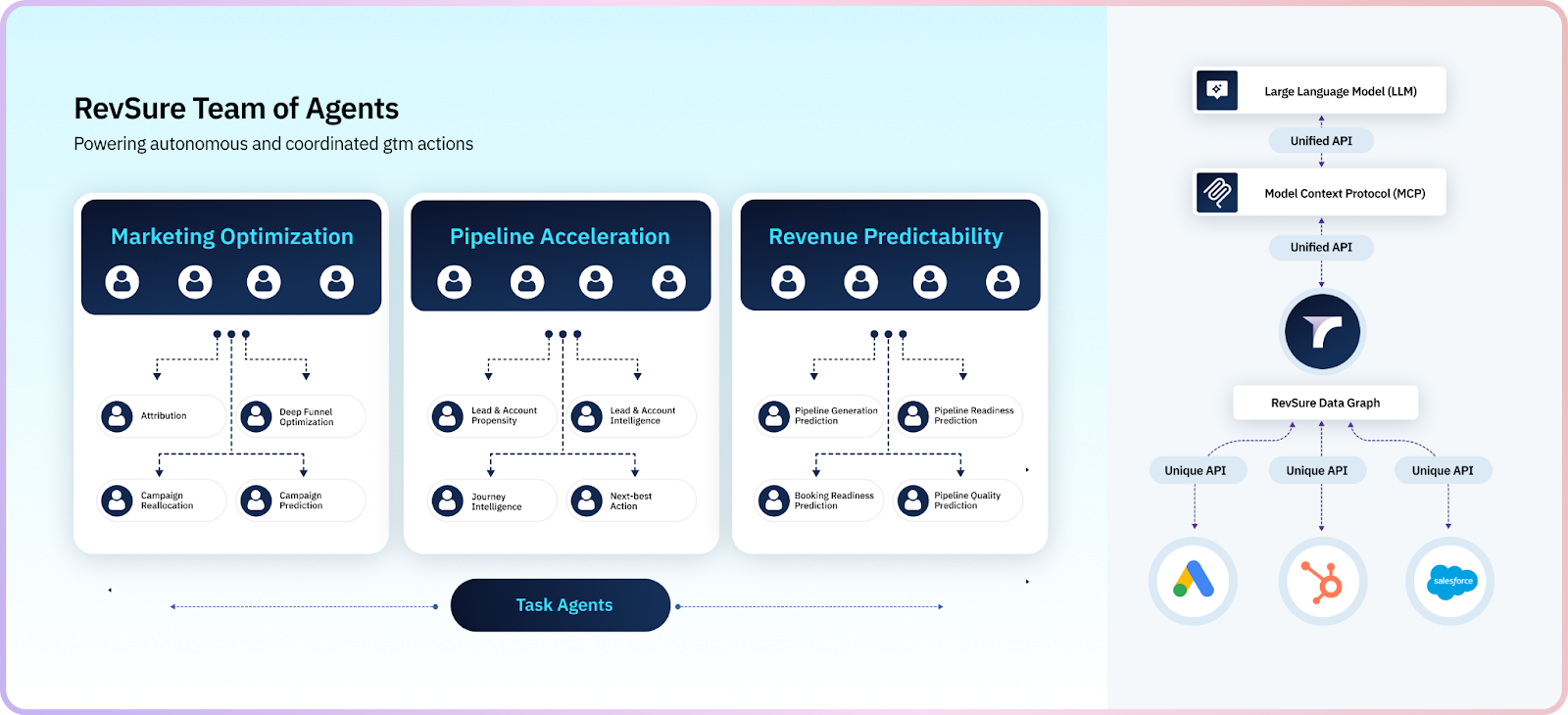
Learn how RevSure powers full-funnel pipeline intelligence
RevSure has been named a LinkedIn Marketing Partner for B2B Attribution & Analytics, bringing a new level of visibility into how LinkedIn activity drives pipeline and revenue.
Through RevSure's new integration with LinkedIn Company Intelligence, customers get a complete view of paid and organic touchpoints by company, connecting the buyer journey from first engagement to closed-won. That means stronger linkage between marketing activity and revenue outcomes, more complete campaign influence on pipeline, and improved measurement within existing workflows, without adding complexity.
Dashboards look healthy, yet conversions slip. Forecasts feel stable early in the quarter, only to collapse in the final stretch. This piece breaks down why traditional forecasting fails in 2026 and why pipeline predictability now requires a new operating system built not on static snapshots, but on dynamic intelligence and real-time signal interpretation. If your team is still navigating the quarter using last month's CRM data, this is the read that reframes what pipeline confidence actually looks like.
RevSure Founder & CEO Deepinder Singh Dhingra has spoken extensively about why the next era of revenue intelligence isn't about capturing more signals; it's about understanding what the absence of signals means. In this video, he explains why the teams winning in 2026 are the ones building AI that can read silence as clearly as it reads activity.

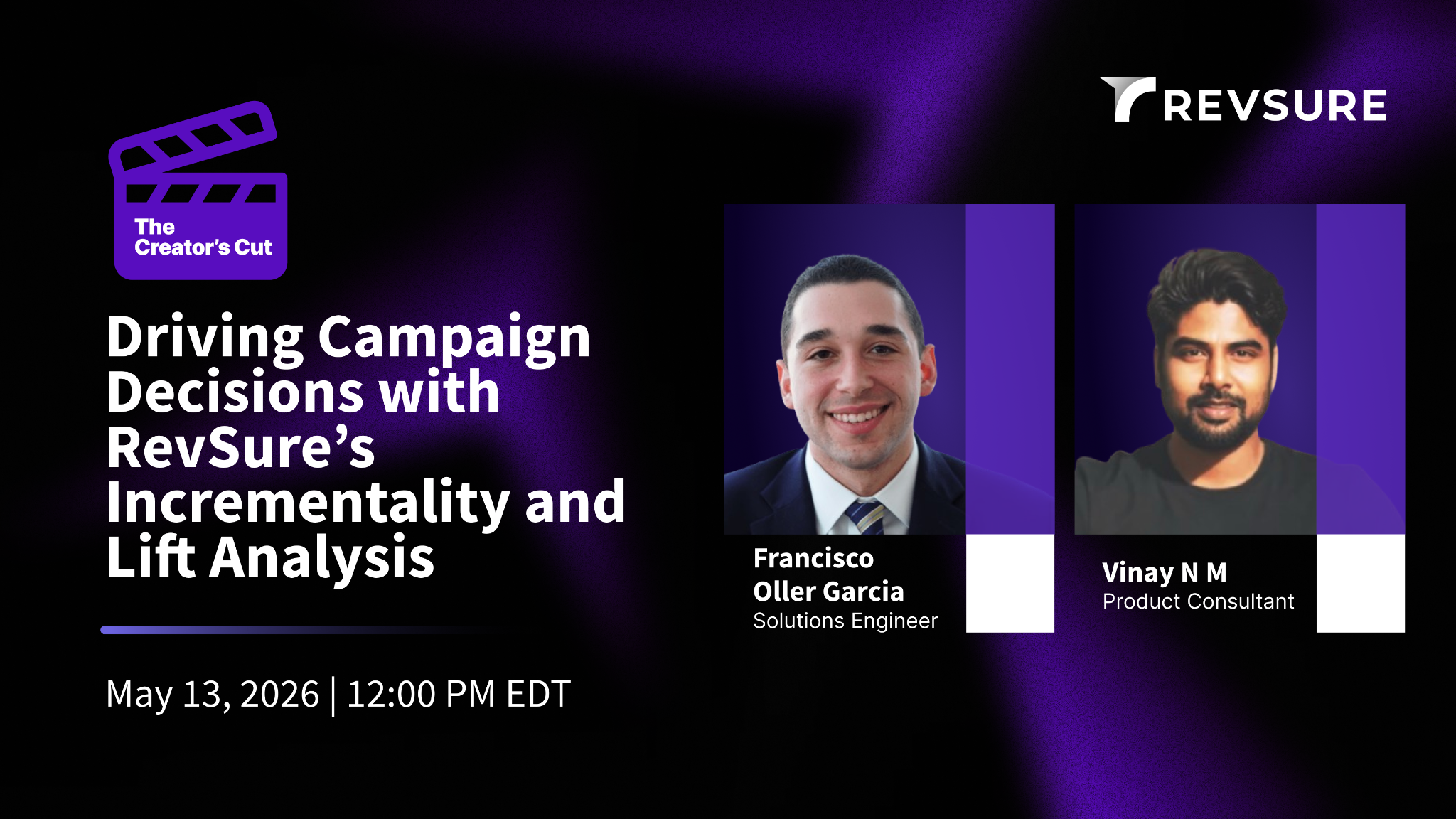
Attribution tells you what happened. Incrementality tells you what you actually caused. In this session, Vinay and Francisco walk through RevSure's lift analysis framework, how to design test vs. control experiments, measure true incremental impact across conversions and pipeline, and make budget decisions based on causal evidence rather than correlated metrics.
Campaigns don't fail fast; they degrade slowly through saturation, adstock effects, and shifting response curves. By the time lagging indicators catch up, the budget has already been wasted. In this session, Ram walks through RevSure's MMX framework, how to identify diminishing returns early, compare marginal ROI across campaigns, and simulate budget shifts before executing them. The result: re-allocation decisions based on true incremental lift, not aggregate or last-touch metrics.

-----------
Thanks for reading. The most expensive deals in your pipeline right now aren't the ones flashing red. They're the ones that look fine while quietly going dark. The teams that close more business this quarter won't have more data; they'll have better visibility into what the data isn't saying.
See you next issue.