Rethinking Account Research in the Age of AI Agents
On this page
In modern B2B go-to-market teams, understanding an account often means piecing together signals scattered across dozens of systems. In this issue of RevSure Horizons, we explore how agentic AI is beginning to transform account research from a manual, fragmented task into a continuously updated intelligence layer that helps revenue teams understand accounts and decide where to engage next.
For years, account research has been one of the most time-consuming activities in B2B go-to-market teams. An SDR preparing for outreach typically jumps between multiple systems- LinkedIn for company context, CRM for past conversations, marketing tools for campaign engagement, enrichment platforms for firmographic data, and internal notes to understand prior interactions.
The challenge isn’t the lack of data; it’s that the data exists across disconnected systems, each offering only a partial view of the account. Marketing sees campaign engagement. Sales sees conversations and pipeline activity. Product teams see usage signals. No single system captures the full story.
As GTM systems grow more complex, this fragmented view of accounts becomes harder for revenue teams to navigate. Account research becomes slower, important signals are often missed, and deciding which accounts deserve attention next becomes increasingly difficult. This is why account research is emerging as one of the first GTM workflows being transformed by AI agents.
Gartner: AI Agents in Enterprise Applications
According to Gartner, AI agents are rapidly becoming a foundational capability in enterprise software. In a recent forecast, Gartner predicts that 40% of enterprise applications will incorporate task-specific AI agents by 2026, up from less than 5% today.

This shift reflects a broader move away from traditional software automation toward systems that can analyze signals, make decisions, and execute tasks across workflows.
McKinsey: The Agentic Organization
McKinsey researchers describe this transformation as the emergence of agentic organizations, where AI systems coordinate work across business processes rather than functioning as isolated productivity tools.
In this model, AI agents operate as workflow orchestrators, gathering signals across systems, synthesizing insights, and helping teams execute decisions more effectively.
From Static Research to Continuous Account Intelligence
Account research has traditionally been treated as a preparation step. Before outreach or meetings, revenue teams gather context about a target company- its leadership, business model, recent news, and potential decision makers. The goal is to assemble enough information to personalize conversations and identify opportunities.
But in modern GTM environments, account activity unfolds continuously across marketing campaigns, sales conversations, website engagement, and product interactions. AI agents are beginning to change this model.
Instead of producing a one-time research snapshot, agentic systems continuously monitor signals across the revenue ecosystem and update account context as new activity emerges. Engagement events, campaign interactions, CRM activity, hiring signals, and product usage are synthesized into a living view of the account.
For this to work, however, AI agents need access to the signals that actually drive revenue decisions. Those signals typically live across multiple GTM systems:
- CRM platforms capturing pipeline activity and conversations
- Marketing tools tracking campaign engagement
- Website and product analytics revealing behavioral signals
- External sources surfacing hiring, funding, and company news
When these systems operate in isolation, AI can only see fragments of the account story. But when those signals are unified, agents can interpret engagement patterns, identify buying signals, and recommend account-specific next steps for revenue teams.
This is the foundation that enables platforms like RevSure to move from account intelligence to coordinated account action.
Product Deep Dive | Autonomous Account Research with RevSure
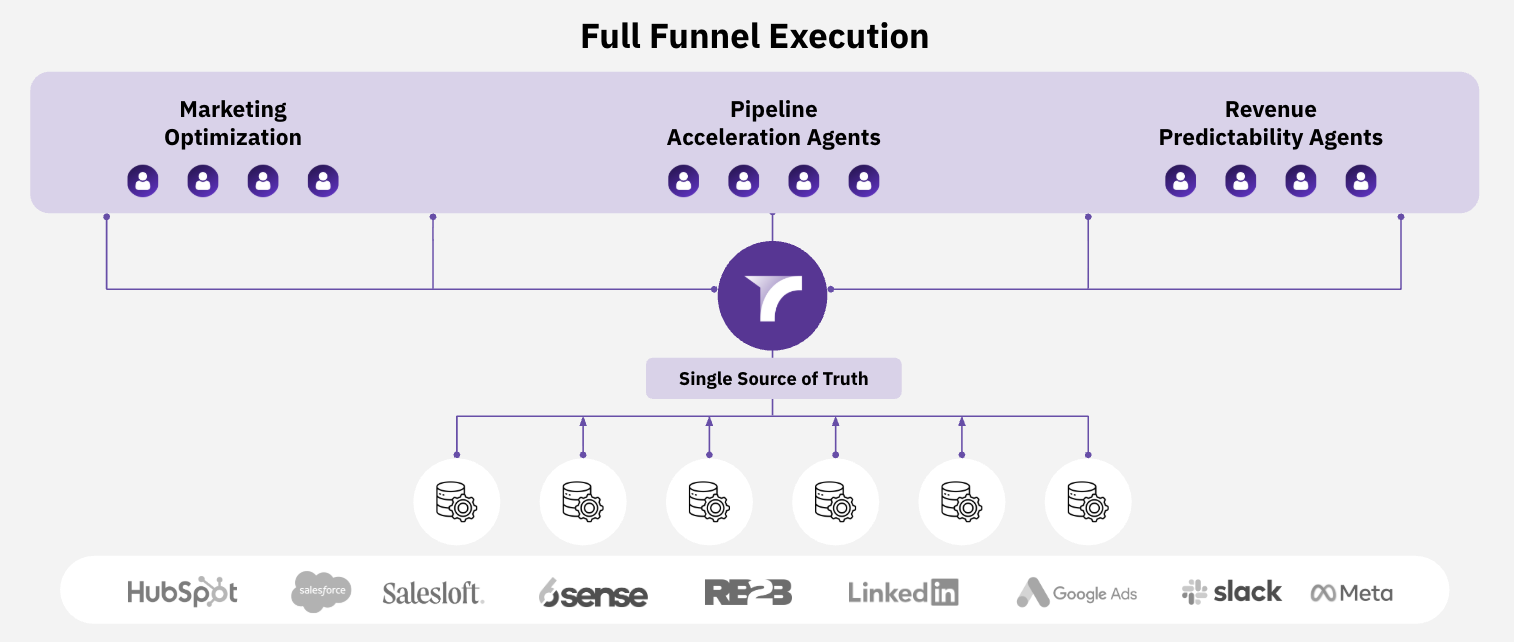
RevSure’s Agent Hub enables GTM teams to deploy specialized agents that continuously gather and synthesize account intelligence across the revenue ecosystem.
The platform begins with a unified GTM data foundation. Signals from CRM systems, marketing automation platforms, ad channels, website activity, sales engagement tools, product analytics, and enrichment sources are connected into RevSure’s data graph. This model links leads, accounts, contacts, opportunities, and revenue outcomes into a single system of record.
On top of this unified data layer, the Account Research Agent analyzes engagement signals across the account journey to generate real-time intelligence for revenue teams.
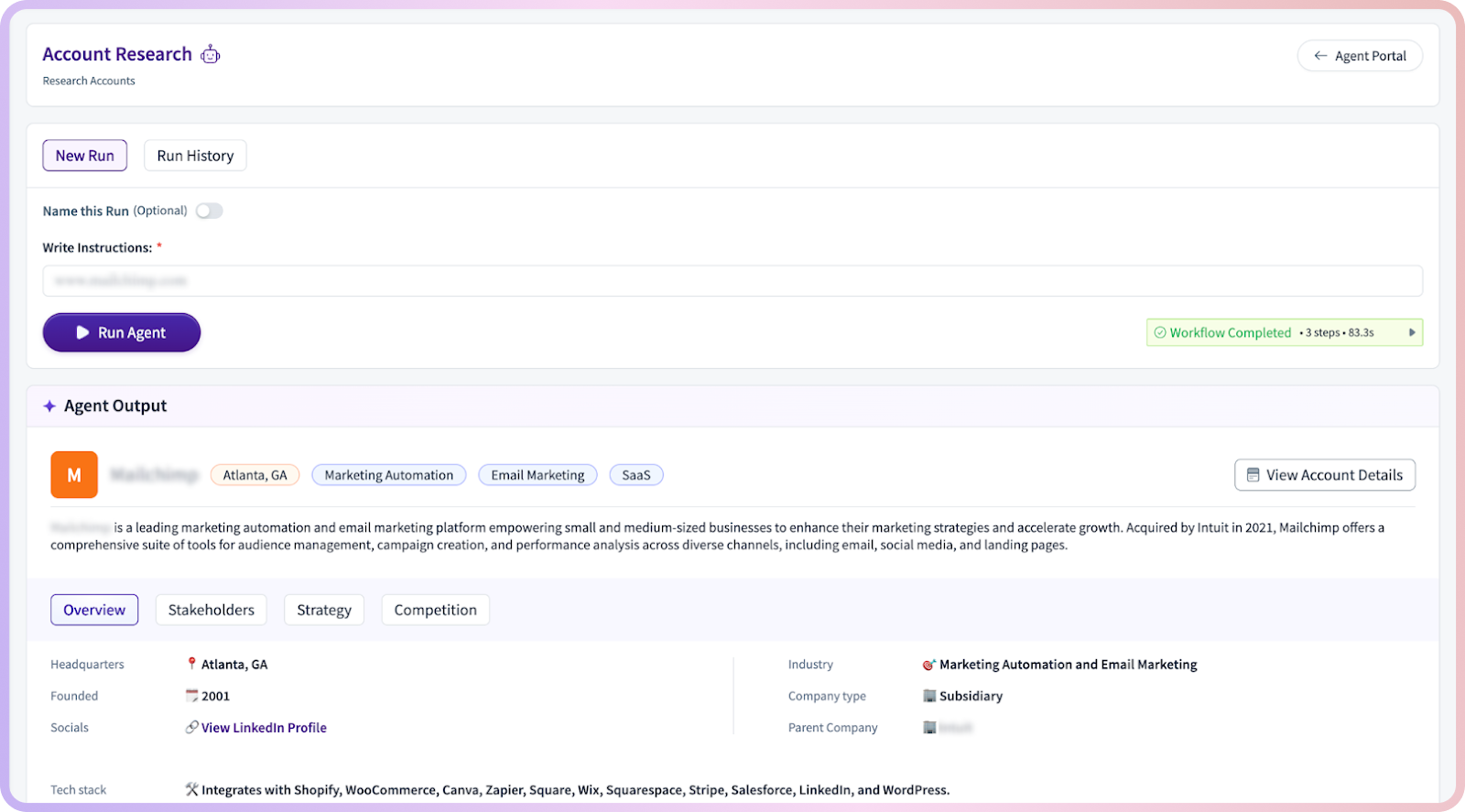
Instead of manually stitching together fragments of data from multiple tools, teams receive a comprehensive view of each account within seconds.
Key capabilities
- Unified account intelligence: Company overview, funding signals, executives, technology stack, and market context generated instantly.
- Complete account journey: Marketing engagement, sales interactions, campaign touches, and pipeline activity stitched into a chronological account timeline.
- Buying group visibility: Insights into contacts, engagement patterns, stakeholder roles, and potential decision makers across the account.
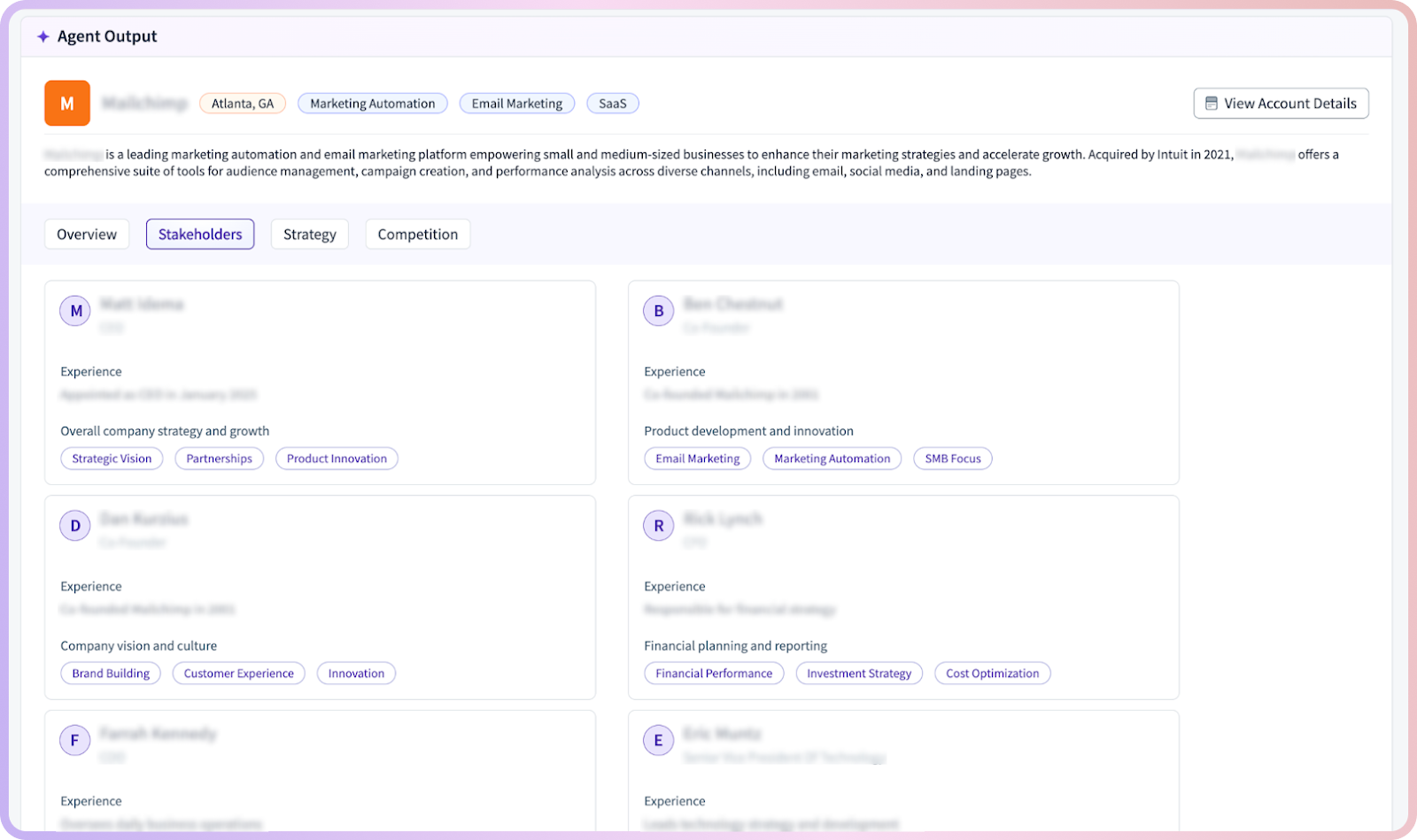
But intelligence alone isn’t enough. Revenue teams still need to translate insights into action.
From Account Intelligence to Account Action Plans
RevSure extends account research beyond insight generation with account-specific action plans designed to guide engagement and outreach.
Based on the account’s engagement history, ICP fit, stakeholder roles, and intent signals, the platform automatically generates recommended next steps tailored to the account. These action plans provide:
- Contact-specific outreach: Personalized messages and email drafts aligned with stakeholder roles and engagement history.
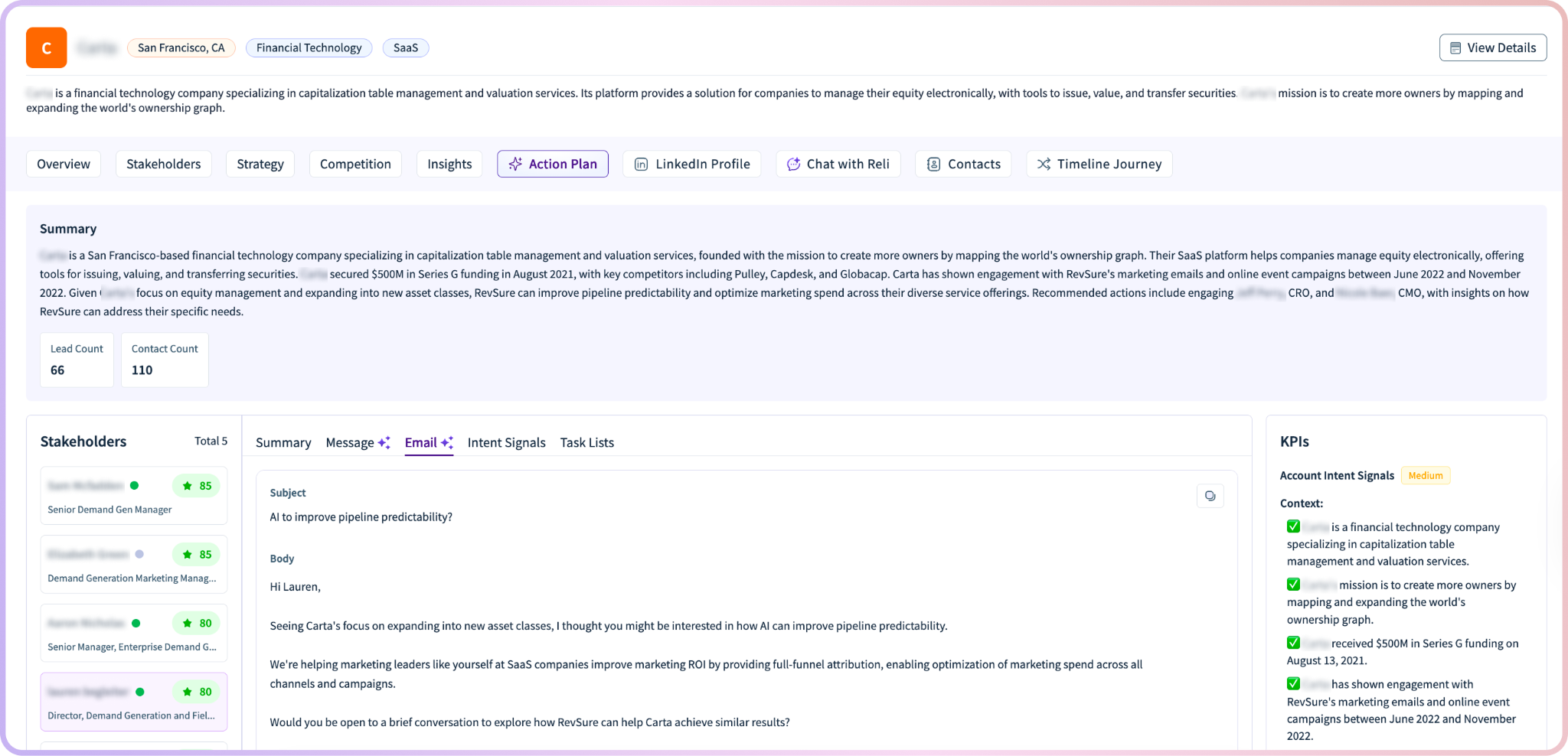
- Intent signals and engagement insights: Signals that reveal where interest is emerging across the account.
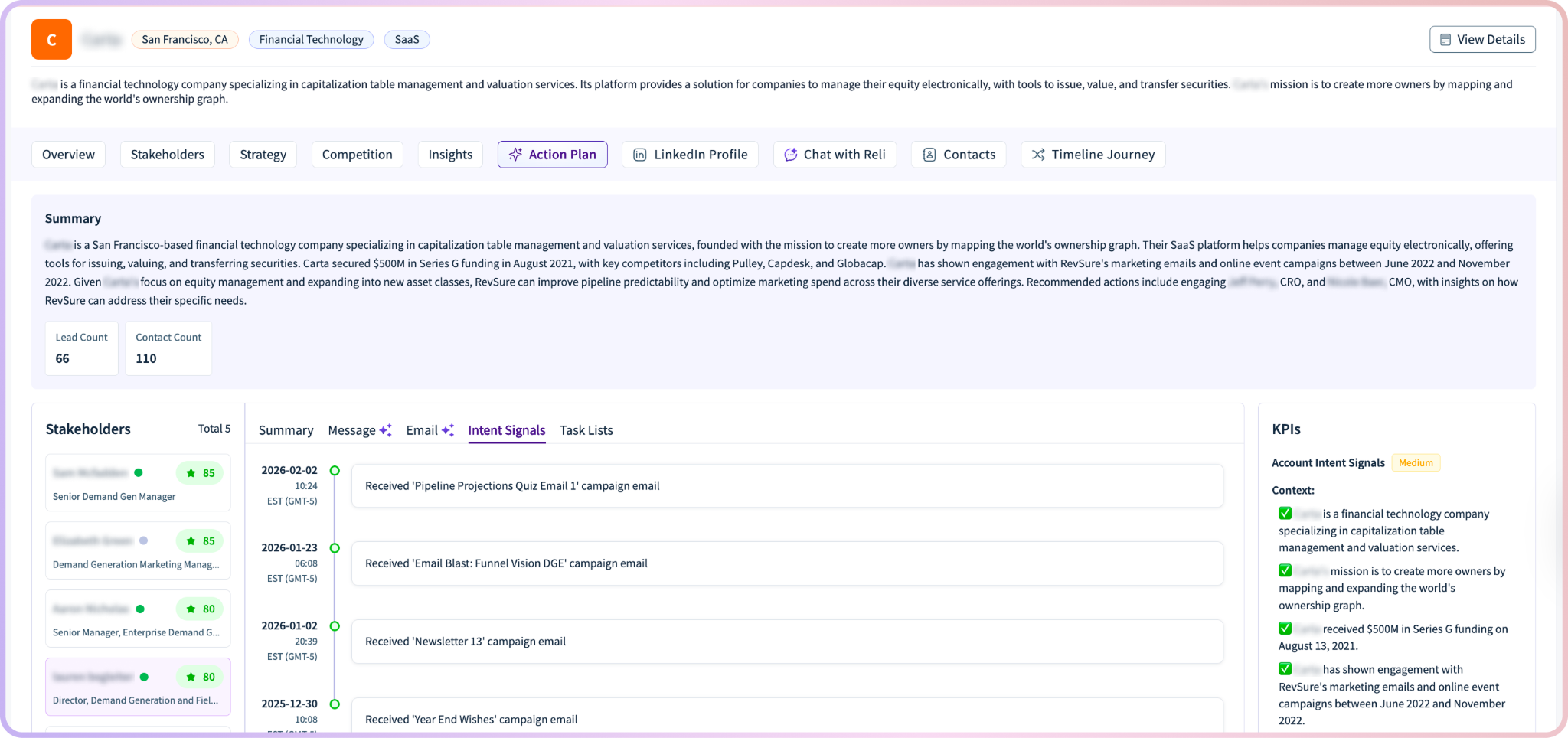
- Task lists for SDRs and AEs: Recommended actions that help teams prioritize the next steps for advancing the account.
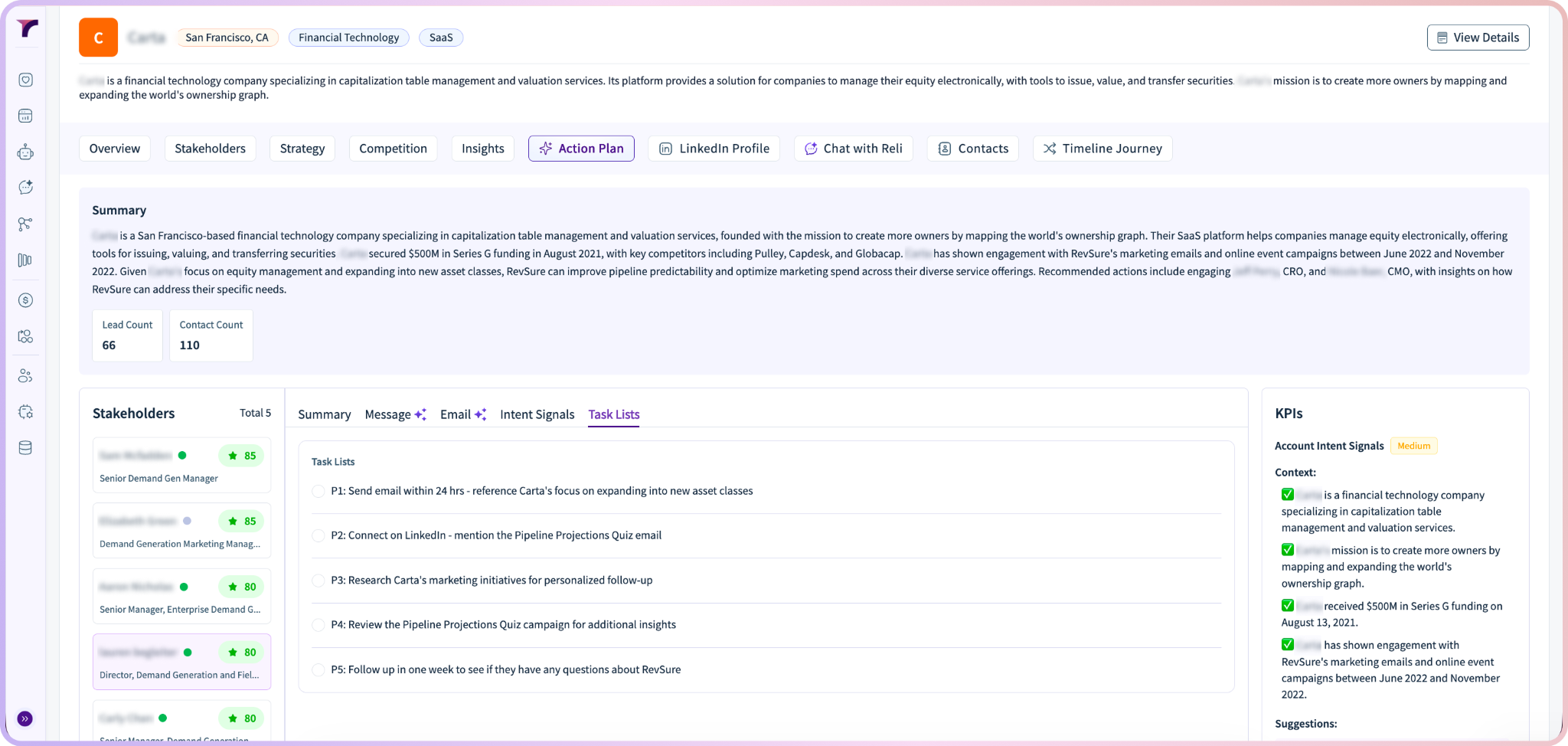
- Account-level strategy guidance: AI-generated summaries that connect account context, campaign engagement, and stakeholder activity.
Because these recommendations are grounded in the full account journey, they help teams move quickly from research to coordinated execution. Instead of static research reports, RevSure delivers dynamic account action plans that evolve as engagement signals change. The result is a shift from fragmented research workflows to an always-on intelligence and execution layer for GTM teams.
Watch On Demand | RevSure Product Updates: February Release
Missed the live session? The February product release walkthrough is now available to watch on demand.
In this session, Vinay demonstrates new capabilities designed to help GTM teams move from signal visibility to governed execution across the revenue funnel, including enhanced campaign channel classification, global dashboard filters for consistent reporting, integrations that convert meetings and conversations into structured GTM signals, and agentic AI account action plans that translate insights into prioritized outreach and next steps.
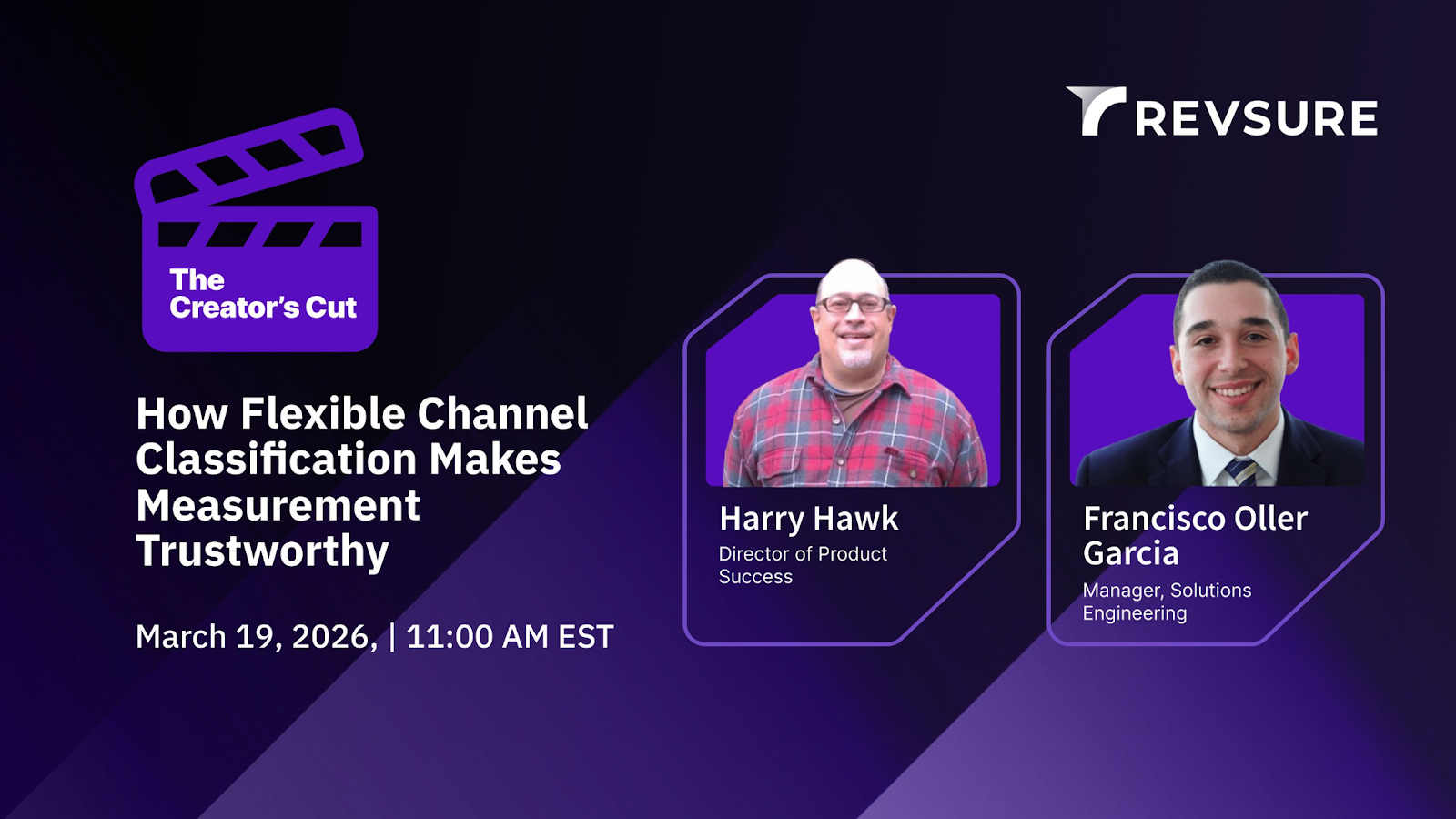
Upcoming Event | How Flexible Channel Classification Makes Measurement Trustworthy
Join us for a live session on how flexible channel classification makes marketing measurement more reliable.
Harry Hawk and Francisco Garcia will walk through practical approaches to normalizing inconsistent campaign inputs across UTMs, CRM campaigns, referrers, and events. The session will demonstrate how modern GTM teams build governed classification using rule logic and validation, apply AI-assisted classification to close remaining gaps, and reprocess historical data to keep attribution and channel reporting consistent as campaign taxonomies evolve.
What’s Next for Agentic GTM
Account research is just one of the many workflows being reshaped by agentic AI.
As GTM data becomes more connected and AI agents gain access to richer signals across the revenue stack, their role will extend far beyond research. The same foundations that enable autonomous account intelligence can also support broader revenue workflows.
Agents will increasingly assist teams with pipeline prioritization, buying group discovery, campaign optimization, and next-best-action recommendations across the entire funnel.
In this model, research is no longer a task performed before engagement. It becomes part of an always-on intelligence layer that continuously analyzes account activity and guides where revenue teams should focus next.
For modern GTM organizations, the shift is clear: moving from fragmented research workflows to unified GTM intelligence powered by AI agents. As agentic systems mature, the teams that unify their data and operationalize these insights will be the ones best positioned to move faster, prioritize smarter, and execute more effectively across the revenue funnel.