Agentic PLG: Designing Self-Optimizing Growth Systems
On this page
Product-led growth has made user behavior visible, but not actionable. Despite rich product data, most organizations struggle to convert insights into timely execution. This issue explores how agentic AI is closing that gap, transforming PLG into a continuous, self-optimizing system that drives real-time growth across the revenue lifecycle.
Product-led growth (PLG) has become a primary driver of efficient growth in B2B SaaS, reshaping how companies acquire, convert, and expand customers. Today, over 60% of high-growth SaaS companies embed PLG into their go-to-market strategy, with product usage data emerging as one of the strongest indicators of buyer intent, often preceding traditional pipeline signals by weeks. Yet, this visibility has not translated into outcomes. In many PLG models, fewer than 5% of free users convert to paying customers, and as many as 40–60% never reach activation. The challenge is not understanding behavior; it is acting on it at the right moment.
To support this shift, organizations have invested heavily in analytics and experimentation infrastructure. Modern GTM stacks now offer deep visibility into activation funnels, retention cohorts, feature adoption, and expansion signals. Teams can clearly see what users are doing and where opportunities lie. Yet a structural gap persists between insight and execution.
Despite this visibility, most PLG systems still rely on human coordination to act on insights. Decisions are made in cycles, while user behavior evolves in real time. In this issue of RevSure Horizons, we explore how agentic AI is redefining this model. Unlike traditional systems that surface insights, agentic systems interpret signals, make decisions, and trigger actions autonomously across the revenue lifecycle. They transform product data from a passive reporting layer into a continuous system of execution.
McKinsey Perspective | PLG as the Engine of Efficient Growth
Product-led growth has moved beyond experimentation into a core driver of SaaS performance. McKinsey describes PLG as a model where the product itself becomes central to acquisition, retention, and expansion, enabling companies to scale with lower sales costs, stronger product virality, and higher net retention.
At the same time, McKinsey’s research highlights an important nuance: while PLG is widely adopted, only a subset of companies achieve outsized results. The differentiator is not visibility into user behavior, but the ability to translate that behavior into coordinated go-to-market action.
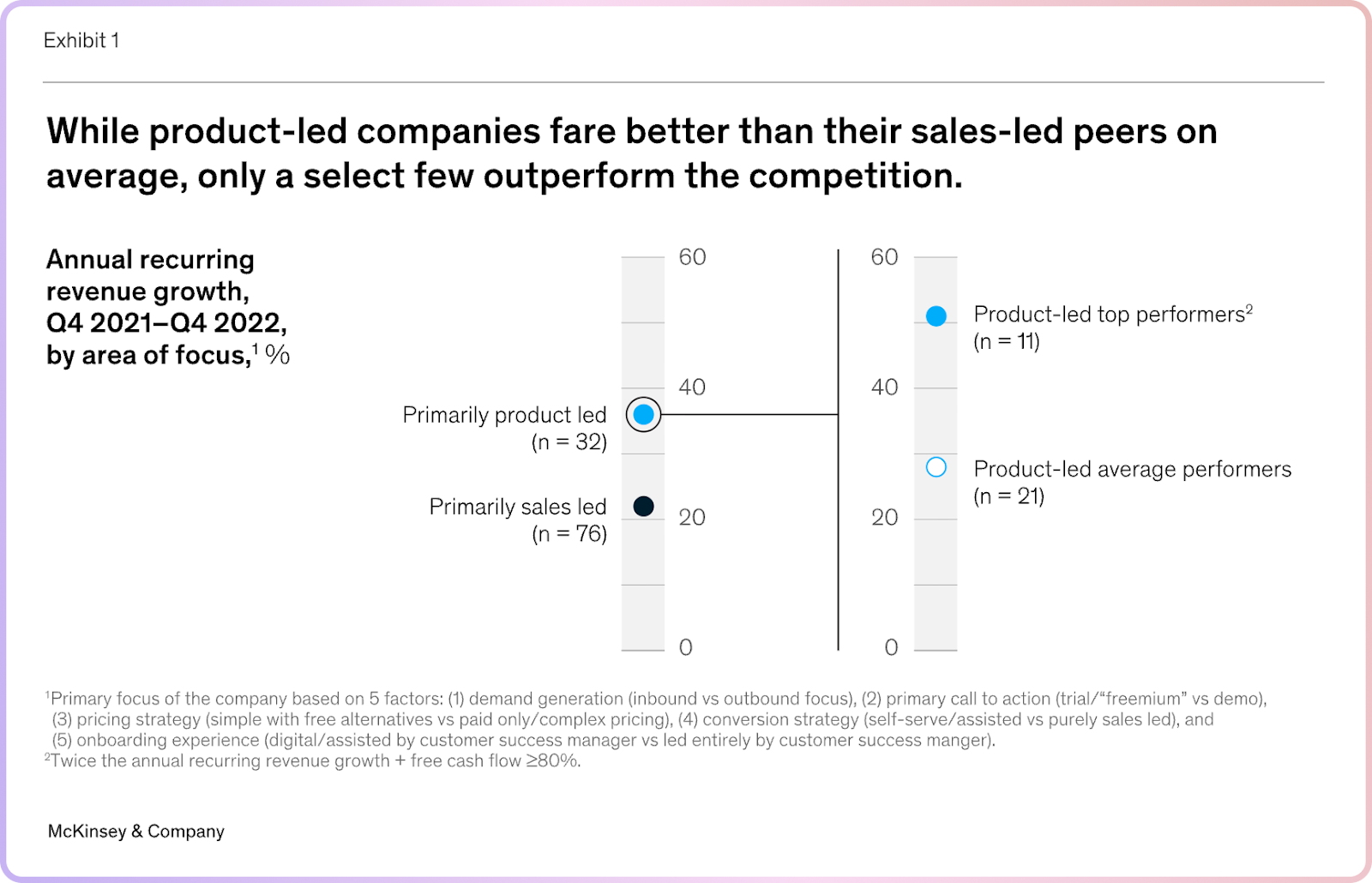
PLG Benchmarks | Adoption is High, Execution Still Lags
Recent benchmarks show that 58% of B2B SaaS companies already operate a PLG motion, and over 90% plan to increase investment in it. At the same time, PLG companies are significantly more likely to achieve faster growth and higher retention, with some studies showing 2× higher chances of achieving 100%+ YoY growth. Yet, these same benchmarks reveal a critical gap:
- Only a minority of companies effectively operationalize product signals (e.g., low adoption of PQLs)
- Many struggle to consistently act on the data they collect
In other words, while PLG adoption is widespread, execution maturity remains uneven.
The Emerging Gap: From Visibility to Action
Taken together, these trends point to a clear inflection. Organizations have successfully made user behavior visible at scale. Product data is abundant, high-frequency, and increasingly predictive of revenue outcomes.
What has not scaled is execution.
In most PLG environments, insights still require human interpretation and coordination before action is taken. This creates a structural mismatch: signals are generated continuously, but execution remains delayed and fragmented. Traditional PLG was designed for a world where humans interpreted data and acted on it later. That model is no longer sufficient.
The Next Phase: Agentic PLG
This is where agentic AI introduces a fundamental shift. Agentic systems move beyond analysis to execution. They continuously detect signals across product and GTM data, interpret their context, and trigger coordinated actions in real time, without waiting for manual intervention.
This shift is being accelerated by two converging forces: the maturity of product data infrastructure and the rapid advancement of AI systems capable of autonomous execution. In doing so, agentic systems embed decision-making and execution directly into the growth system, closing the gap between insight and action.
PLG, in this model, evolves from a system that explains growth to one that drives it.
From Growth Loops to Continuous Systems
Traditional PLG operates through iterative growth loops. Teams observe user behavior, analyze patterns, implement changes, and measure outcomes over time. While effective, this model is inherently periodic and dependent on human intervention.
In an agentic model, this loop becomes continuous. Instead of waiting for analysis cycles, systems operate in real time:
- Signals are detected as they emerge
- Context is interpreted across product and GTM data
- Actions are triggered immediately
- Outcomes are fed back into the system for ongoing learning
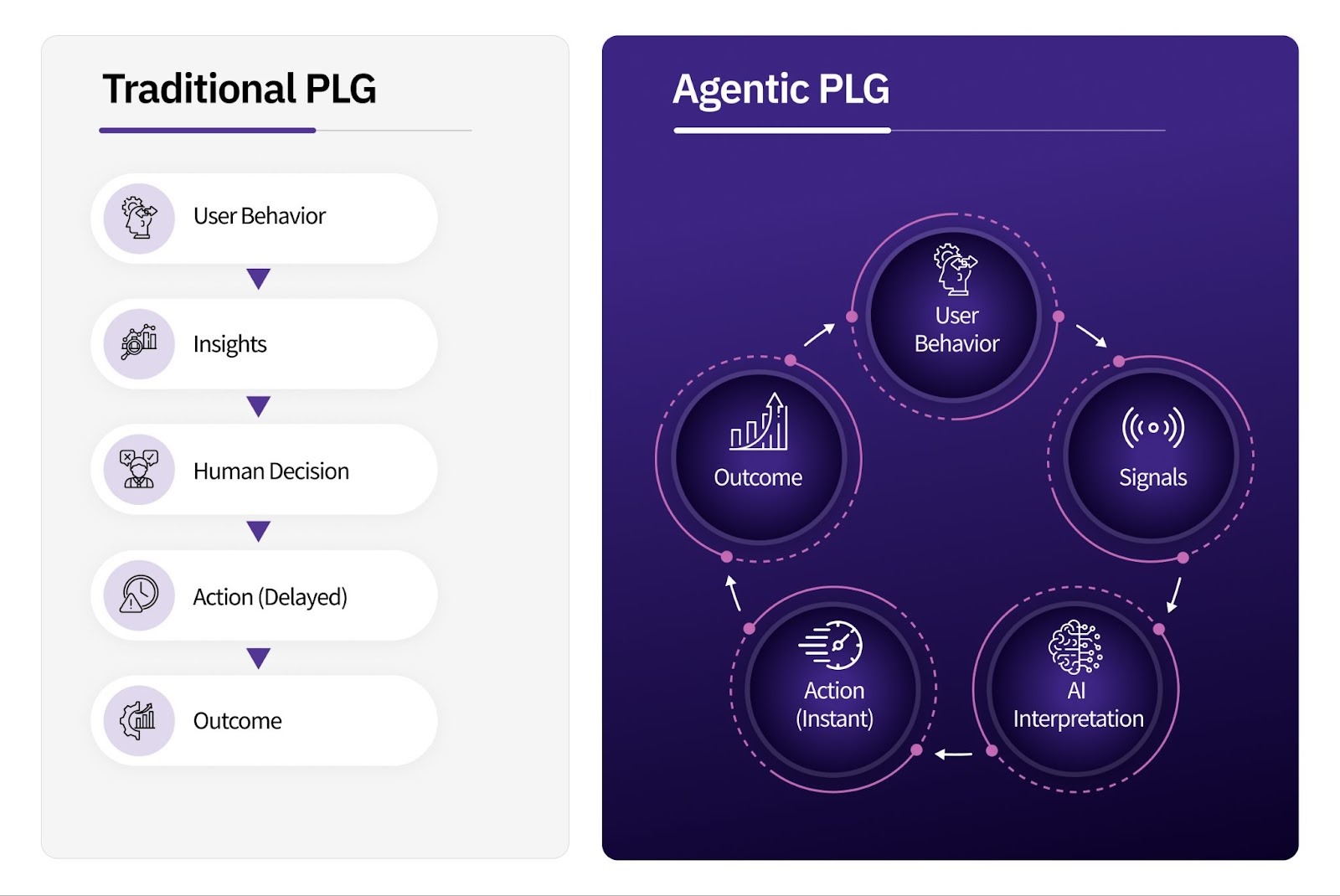
This transforms growth from a sequence of interventions into a continuously adapting system. The implications are significant. Onboarding friction is no longer identified after drop-off rates decline; it is addressed as users encounter it. Lifecycle engagement is no longer scheduled in advance; it is triggered by behavior in the moment. Expansion opportunities are no longer surfaced in pipeline reviews; they are acted upon at the point of intent.
Growth, in this model, is not optimized periodically. It is continuously orchestrated. In practice, this shift changes how users experience the product. A new user entering a free trial is no longer left to navigate onboarding alone. Systems can detect stalled activation, trigger contextual guidance, and surface high-intent accounts to sales in real time. Instead of identifying drop-off after it occurs, intervention happens at the moment friction emerges.
Inside RevSure | The System of Action for Agentic PLG
As discussed, Agentic PLG requires more than visibility into user behavior. It requires a system that can continuously interpret signals and act on them across the revenue lifecycle.
RevSure provides this foundation through a unified context layer that connects product usage, CRM data, marketing engagement, sales activity, and external signals into a single, actionable view of the customer. This allows systems to understand not just what users are doing, but what that behavior means for pipeline and revenue.
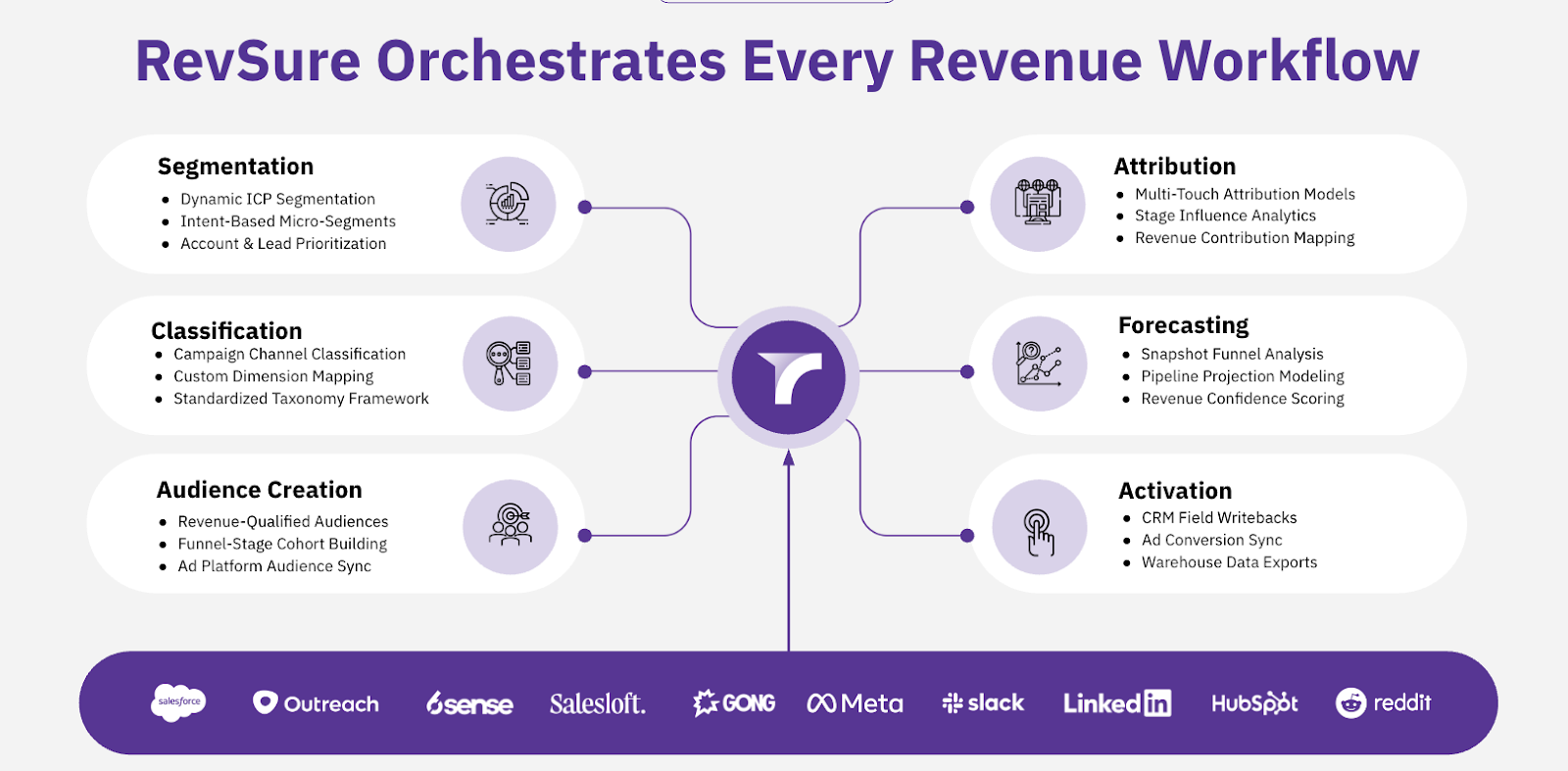
On top of this foundation sits an AI reasoning and orchestration layer that continuously analyzes signals and determines next-best actions across the funnel, from campaign optimization and lead prioritization to pipeline acceleration and deal intelligence.
Together, this creates a system where signals are not just observed, but continuously translated into coordinated action.
Designing and Deploying Agents with RevSure Agent Builder
RevSure operationalizes this system through its Agent Builder, enabling teams to design and deploy specialized AI agents tailored to specific GTM workflows.
Instead of relying on static rules or predefined workflows, teams can configure agents around use cases such as lead prioritization, outreach, lifecycle engagement, or expansion detection. These agents interpret signals, make decisions, and execute actions in real time, without requiring engineering support.
For example, teams can deploy SDR-focused agents that monitor product and engagement signals, identify high-intent accounts, and trigger personalized outreach at the moment of readiness.
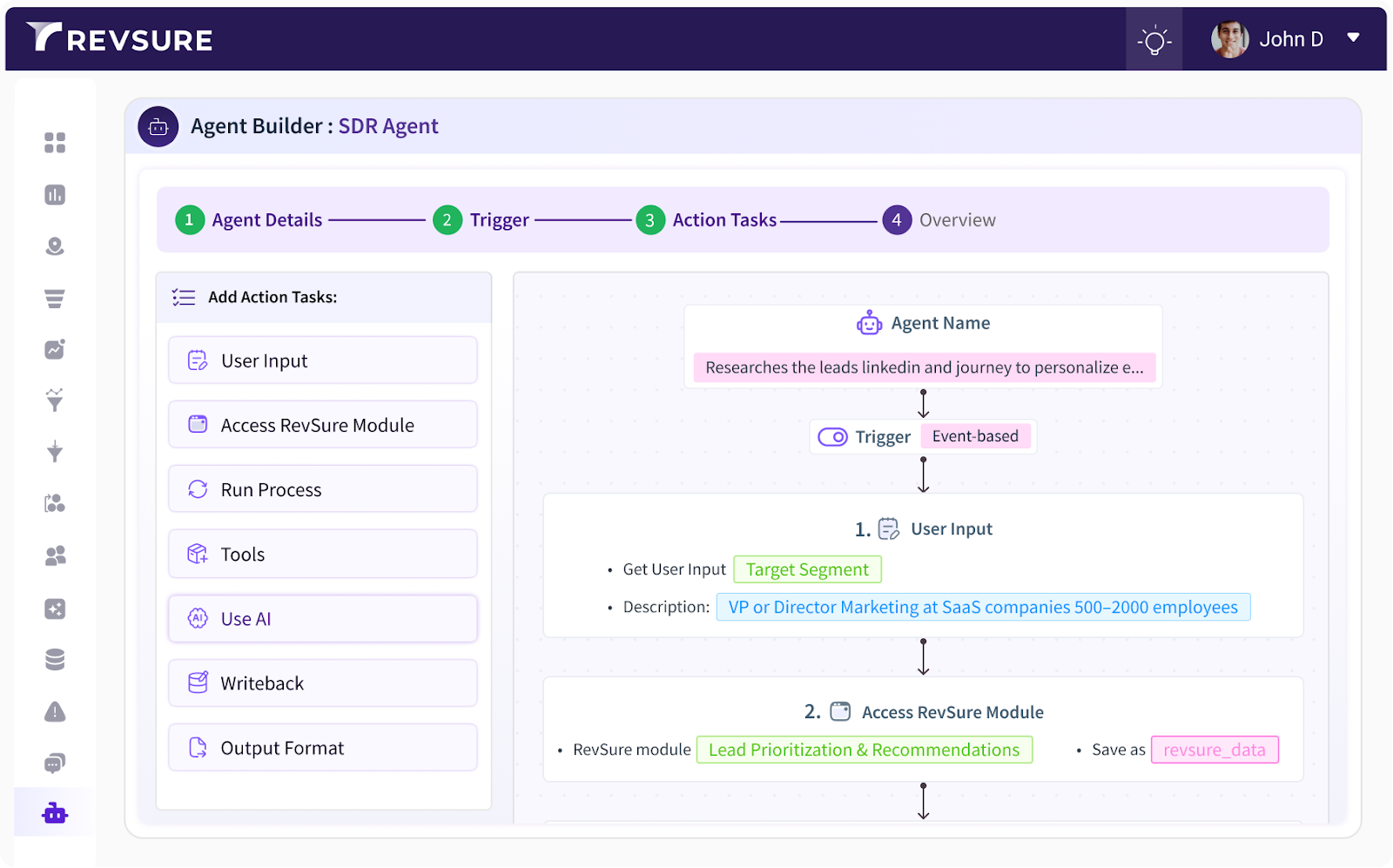
Unlike traditional SDR workflows, which rely on static lists and delayed signals, these agents operate continuously, ensuring that sales engagement is aligned with real-time buyer behavior.
Because all agents operate on a shared data and intelligence layer, they function as a coordinated system rather than isolated automations. This allows marketing, sales, and RevOps to act on the same signals simultaneously, reducing latency and improving execution consistency.
The result is a shift from workflow-based execution to agent-driven systems, where growth is continuously orchestrated, not manually managed.
From Signals to Revenue Impact
The value of Agentic PLG is not in automation alone, but in how effectively signals translate into revenue outcomes, especially in PLG environments where a majority of users never activate and conversion depends on timely, contextual engagement.
This enables a range of high-impact outcomes:
- Lifecycle engagement aligned to behavior
Campaigns and outreach are triggered based on real-time user activity rather than predefined schedules. - Adaptive onboarding experiences
Friction is addressed dynamically as users progress, improving activation and time-to-value. - Expansion at the point of intent
High-intent accounts are surfaced and engaged by sales when usage signals indicate readiness. - Next-best actions across the funnel
Teams are guided by continuously updated recommendations grounded in unified data.
This shift is particularly visible in how leading teams approach demand generation in PLG environments. Rather than optimizing for top-of-funnel metrics such as sign-ups, organizations are increasingly focusing on deep-funnel signals: activation, retention, and expansion. In practice, this means reallocating spend toward channels that drive high-value user behavior, even if they generate fewer initial conversions.
For example, teams using RevSure have identified cases where high-volume channels like paid search drive the majority of sign-ups but contribute minimally to activation or expansion. In contrast, channels such as email, organic, and brand, while smaller in volume, drive a disproportionate share of retained and expanding users.
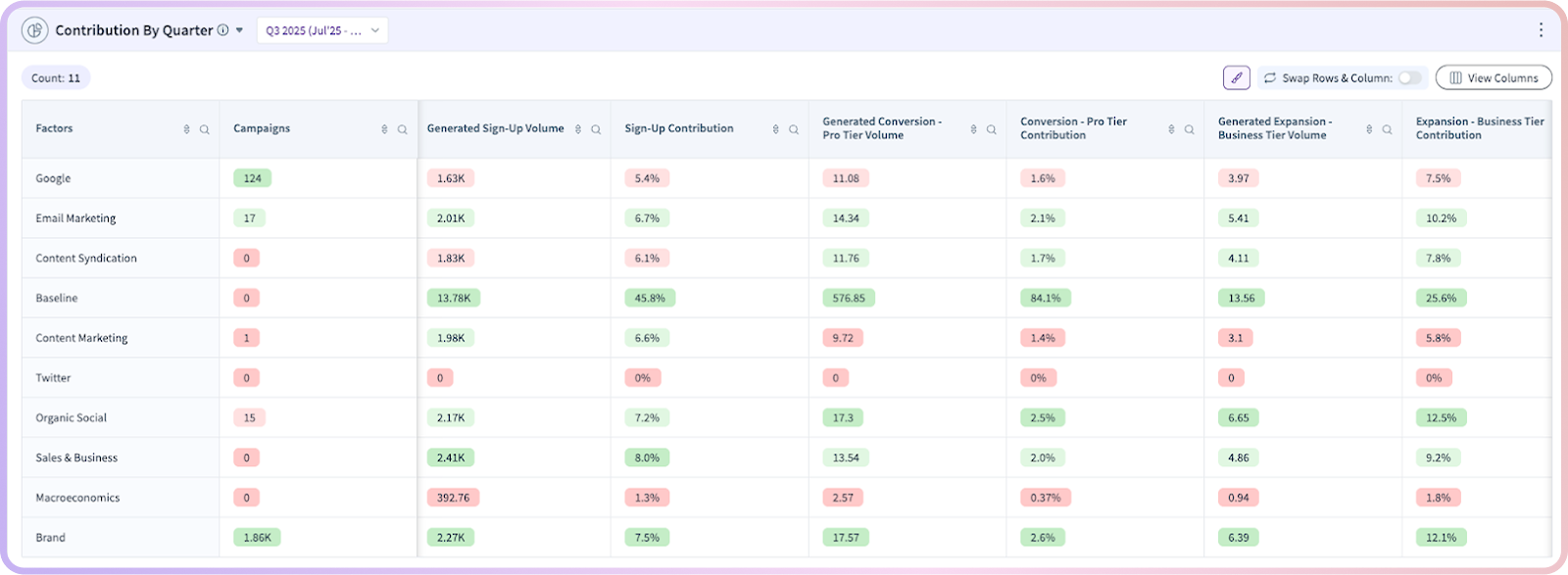
By feeding these deeper signals back into ad platforms and GTM workflows, organizations enable systems to optimize not for clicks or form fills, but for users who activate and generate revenue. Because these actions are coordinated across product, marketing, and sales, execution becomes faster, more precise, and more aligned with business outcomes.
The result is a shift from fragmented growth efforts to integrated, signal-driven workflows, where every action is optimized for long-term value, not just short-term conversion. From first interaction to expansion, agentic systems continuously guide users through each stage, ensuring that intent is captured, nurtured, and converted without delay.
In Practice | Agentic PLG in Action at Agent.ai
Agent.ai, a PLG-driven company, faced a familiar challenge: high volumes of sign-ups, but limited visibility into which channels actually drove activation, retention, and revenue.
By leveraging RevSure, the team shifted from optimizing for top-of-funnel metrics to acting on deeper signals such as product usage and engagement. These signals were fed back into ad platforms, enabling campaigns to optimize for real outcomes rather than clicks.
This led to a clear shift in execution. Spend was reallocated toward high-value channels, feedback loops were established across the GTM stack, and decisions were driven by downstream impact, not just acquisition volume.
The results were significant: a 36% increase in weekly active users, cost per sign-up reduced to below $1, and over 1.12 million agent-driven interactions—reflecting deeper, more meaningful engagement. Refer below quote by Sam Mallikarjunan, General Manager, agent.ai.
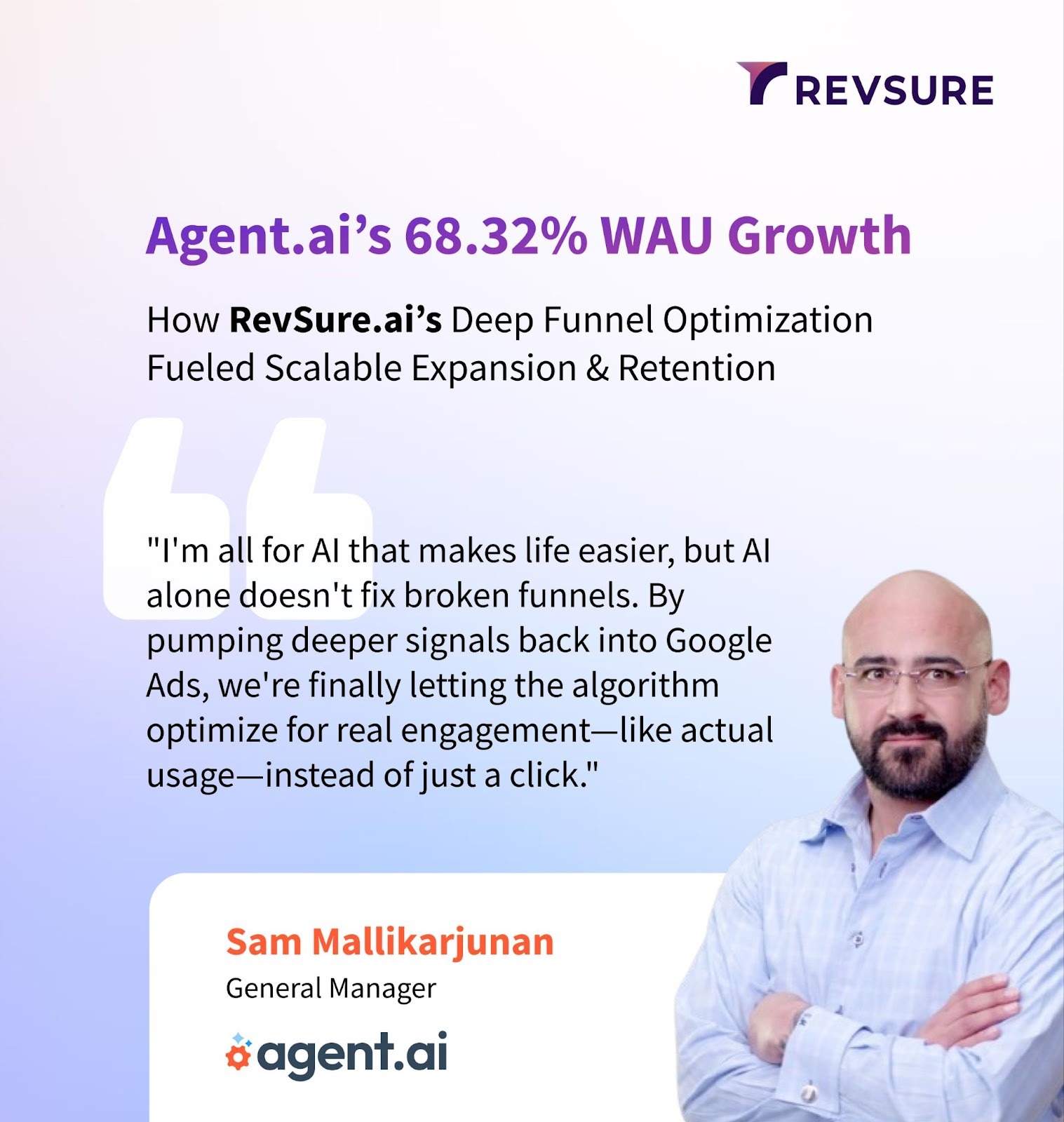
More importantly, growth was no longer optimized for sign-ups alone, but for retention, engagement, and revenue.
On Demand | Making Measurement Trustworthy with Flexible Channel Classification
Attribution is only as reliable as the data behind it. In this session, Harry Hawk and Francisco Garcia explore how GTM teams bring consistency to fragmented campaign inputs by treating channel classification as core measurement infrastructure. Learn how to normalize data across UTMs, CRM campaigns, and events, apply governed rules with AI-assisted classification, and maintain accuracy as taxonomies evolve.
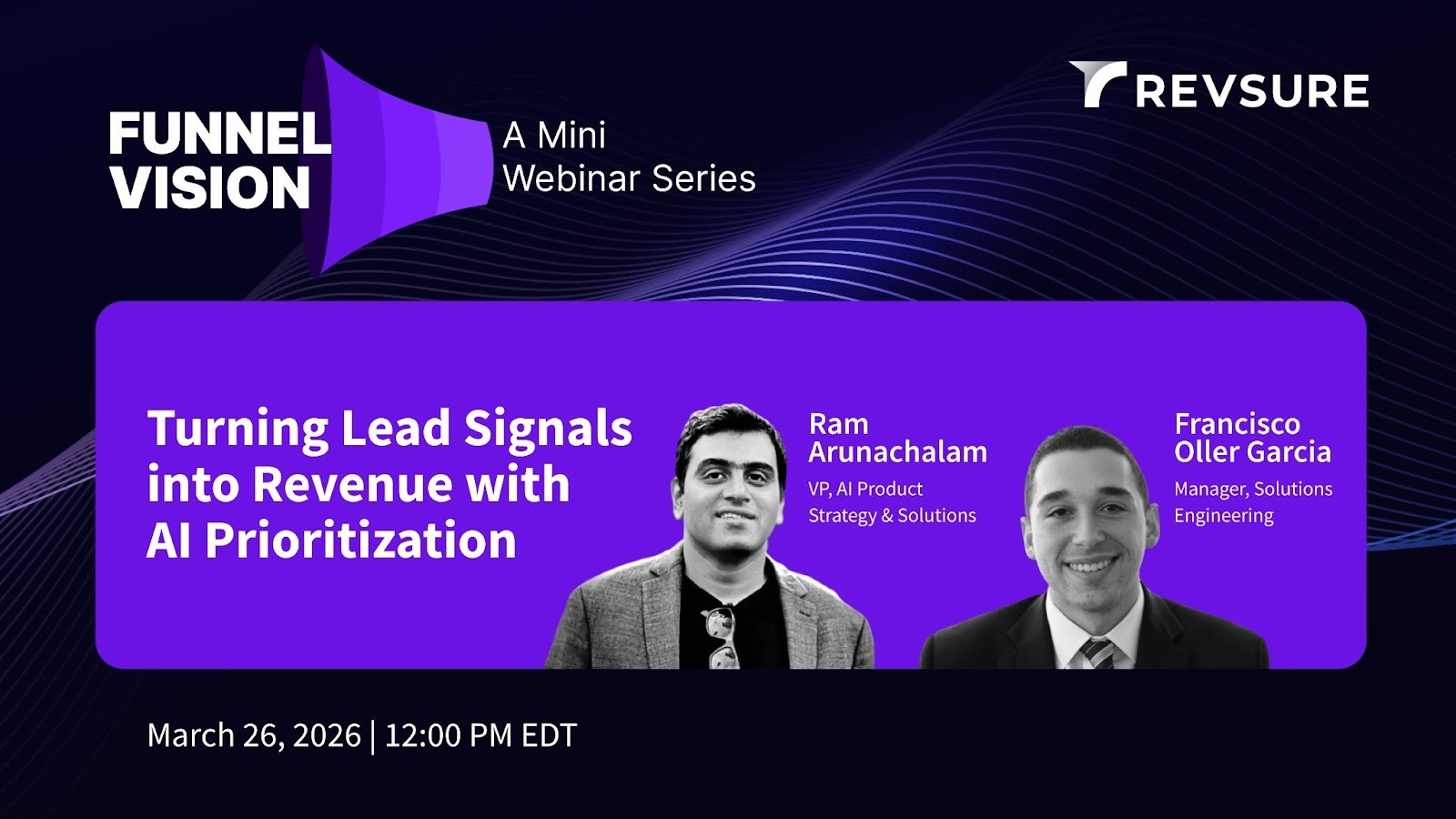
Live Session | Turning Lead Signals into Revenue with AI Prioritization
Not all leads are created equal, and treating them that way limits pipeline efficiency. In this Funnel Vision webinar, Francisco Garcia and Ram discuss how modern GTM teams are moving beyond static scoring models toward AI-driven prioritization. Learn how to identify high-propensity accounts, understand the signals driving conversion, and take next-best actions that accelerate the pipeline.
Looking Ahead | The Future of Agentic PLG
PLG began by making user behavior visible. The next phase is defined by making that behavior actionable without delay. As agentic systems mature, product signals will continuously trigger changes across onboarding, engagement, and revenue workflows, without waiting for manual intervention. Growth systems will become increasingly autonomous, adaptive, and aligned across functions.
This does not eliminate the role of teams. Instead, it elevates it. The focus shifts from executing workflows to designing systems, defining strategy, and guiding how intelligence is applied across the customer lifecycle. In this model, growth is no longer driven by dashboards or discrete campaigns. It is driven by systems that learn, adapt, and execute in real time.
PLG, in its next evolution, becomes a self-optimizing growth engine, embedded across the entire revenue lifecycle.