On this page
Attribution has moved out of marketing long ago. In 2026, it sits at the center of revenue strategy. Enterprise GTM organizations are now in an environment defined by longer buying cycles, multi-threaded buying committees, along with declining signal quality, rising CAC, and increasing scrutiny from CFOs and Boards. On top of this, Marketing teams are expected to generate pipeline predictably. Sales is expected to convert it efficiently, while Finance expects ROI to be measurable, defensible, and forecastable.
This shift in dynamics has changed what attribution platforms must deliver. Yet most current market conversation revolves around superficial questions: how many touchpoints are captured, how fast are dashboards refreshed, how deep can journeys be mapped. Those capabilities matter. But enterprise attribution has evolved beyond visibility.
The real question is, can attribution function as a revenue operating system: proving what is incremental, forecasting pipeline health, and triggering actions while the quarter is on. That question is where RevSure and HockeyStack differ and diverge.
HockeyStack recently wrote a comparison blog framing RevSure as a limited forecasting tool with weaker attribution depth, no or little dark funnel visibility, batch-only reporting, and lesser enterprise readiness. That is not just misleading; it is technically false.
We are writing this article to clarify what RevSure actually delivers, falsify HockeyStack’s claims, and elaborate on what enterprise GTM attribution is in 2026.
Two Platforms, Two Different Enterprise Realities
Arguably, both HockeyStack and RevSure operate on the same foundational truth: modern B2B revenue is shaped by millions of interactions across marketing, SDR/BDR, sales, partners, and offline channels, and most of them occur long before a buyer identifies themselves. The difference between the two platforms lies not in touchpoint unification, but in what platform is designed to do after those touchpoints are unified, and for which GTM environment it is built.
HockeyStack is adopted most strongly by SMB and growth-stage teams with fewer tools within their GTM techstack, seeking quick deployment and multi-touch reporting across marketing channels. On the other hand, RevSure is purpose-built for upper mid-market and enterprise B2B organizations with complex GTM motions: multi-product portfolios, regional sales segmentation, extensive partner ecosystems, offline influence, account hierarchies, etc. Many of the RevSure customers have more than 50 tools within their GTM tech stack, all integrated with RevSure.
HockeyStack is primarily optimized for attribution as descriptive buyer journey analytics. RevSure is optimized for attribution as predictive revenue intelligence: proving incrementality, forecasting opportunity health, and recommending/ triggering next-best actions while the pipeline is still in motion.
It is worth noting that HockeyStack has recently adopted predictive language into its positioning to match the broader category shift. This definitely created a lot of visibility for Hockeystack, but visibility alone is no longer sufficient. Enterprise teams increasingly require attribution platforms that connect measurement to forecasting and execution, along with reporting. The question is not whether a platform mentions prediction. The question is whether its architecture supports it. In the case of HockeyStack, the platform's capability is questionable.
RevSure Is Not “Just Forecasting.” It Is Full Funnel Attribution AI.
HockeyStack mentions in its blog that RevSure is primarily a pipeline analytics and forecasting tool with limited attribution depth. That is completely incorrect.
RevSure is a full-funnel AI solution, spanning marketing optimization, pipeline acceleration, and revenue predictability across the entire GTM lifecycle: from anonymous visitor through closed-won revenue.
RevSure supports the full spectrum of attribution models, including First Touch, Last Touch, Linear, U-Shaped, J-Shaped, Time Decay, Influenced, and AI-driven models such as Markov Chain attribution. This ensures every enterprise team can measure impact in the way that best aligns with their GTM motion and buying realities.
RevSure replaces static attribution models with a dynamic, graph-based attribution engine designed for hybrid, multi-channel GTM environments. Built on a unified data foundation, it maps and weights touchpoint influence across key dimensions on an ongoing basis, including channel, campaign, region, product line, segment, and funnel stage.
As buyer journeys evolve through online and offline interactions, across paid media, ABM, events, SDR/BDR outreach, AE engagement, and partner activity, RevSure calculates attribution in real time to reflect true contribution to pipeline and revenue.
This enables teams to perform granular, multi-dimensional attribution analysis with full traceability into account journeys and a governed, accurate view of what is driving revenue outcomes. Whether you want transparent, rule-based models or advanced probabilistic AI attribution, RevSure provides both, enabling enterprises to move away from opinionated credit assignment toward data-driven revenue accountability.
The Enterprise Shift: From Credit Assignment to Causal Proof
The central debate in modern attribution is no longer how many touchpoints you can capture. The real question is whether you can prove what is incremental versus coincidental.
Multi-touch attribution models distribute fractional credit across interactions. They are useful, but they remain correlational. If a channel appears frequently in closed-won journeys, it receives credit. That does not prove that removing that channel would affect revenue. That is why Enterprise teams require causal measurement.
To address this in a holistic manner, RevSure’s measurement framework integrates three layers into one unified system:
- Multi-touch attribution for credit assignment and granular journey influence
- Incrementality testing with statistical lift, pre-/post, and causal testing
- Marketing Mix Modeling to quantify marginal ROI per channel while accounting for seasonality, noise, and macro shifts
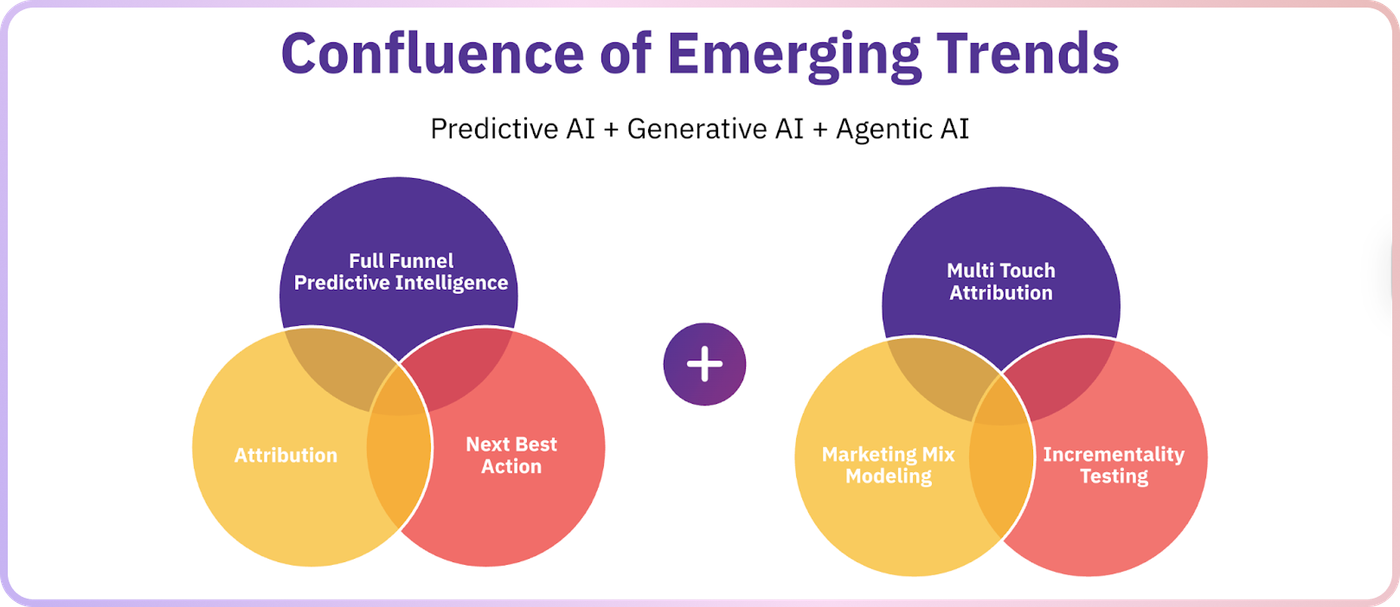
This layered methodology transforms attribution into statistically defensible revenue measurement.
Dark Funnel Visibility: HockeyStack’s Claim Is Incorrect
Another major claim in HockeyStack’s recent blog is that RevSure focuses primarily on known contacts and CRM touchpoints, with limited dark funnel visibility. That is false as well.
RevSure helps B2B GTM teams uncover and act on dark funnel demand by identifying de-anonymized visitors and accounts before they ever convert into known leads. Through seamless CRM matching, first-party tracking pixels, and third-party intent integrations, RevSure captures pre-conversion behaviors, including content consumption, journey patterns, and external intent signals. RevSure’s AI engine then prioritizes high-intent activity, like repeated pricing page visits or other deep engagement, enabling GTM teams to focus outreach on the accounts most likely to convert, even when no individual contact record yet exists.
Enterprise buyers do not move in linear CRM-native paths. They engage anonymously, across devices, across channels, and often through offline influence before they ever convert. RevSure is architected specifically to capture that reality, bringing together:
- Anonymous engagement and pre-form activity
- First-party pixel and server-side capture
- Offline events, partner touches, and field influence
- CRM opportunity progression and stage transitions
To clarify again, RevSure provides best-in-class deanonymization and identity resolution, including cookie-less tracking, fingerprinting, and privacy-compliant visitor stitching. RevSure unifies digital and non-digital touches into full-funnel journeys, spanning from dark funnel engagement through deep pipeline conversion.
Architecture Depth: Governance, Classification, and Activation
HockeyStack claims in its blog that RevSure lacks foundational capabilities such as categorization, governance, activation, and robust architecture. This is one of the most misleading assertions in their comparison.
RevSure’s attribution engine is built on a unified GTM data graph designed for enterprise-grade governance and traceability. It supports granular drill-down attribution across accounts, opportunities, regions, products, and funnel stages, with full configurability to match how enterprises actually operate. RevSure also provides automatic channel classification, including standardized taxonomies and AI-based classification for unmatched campaigns.
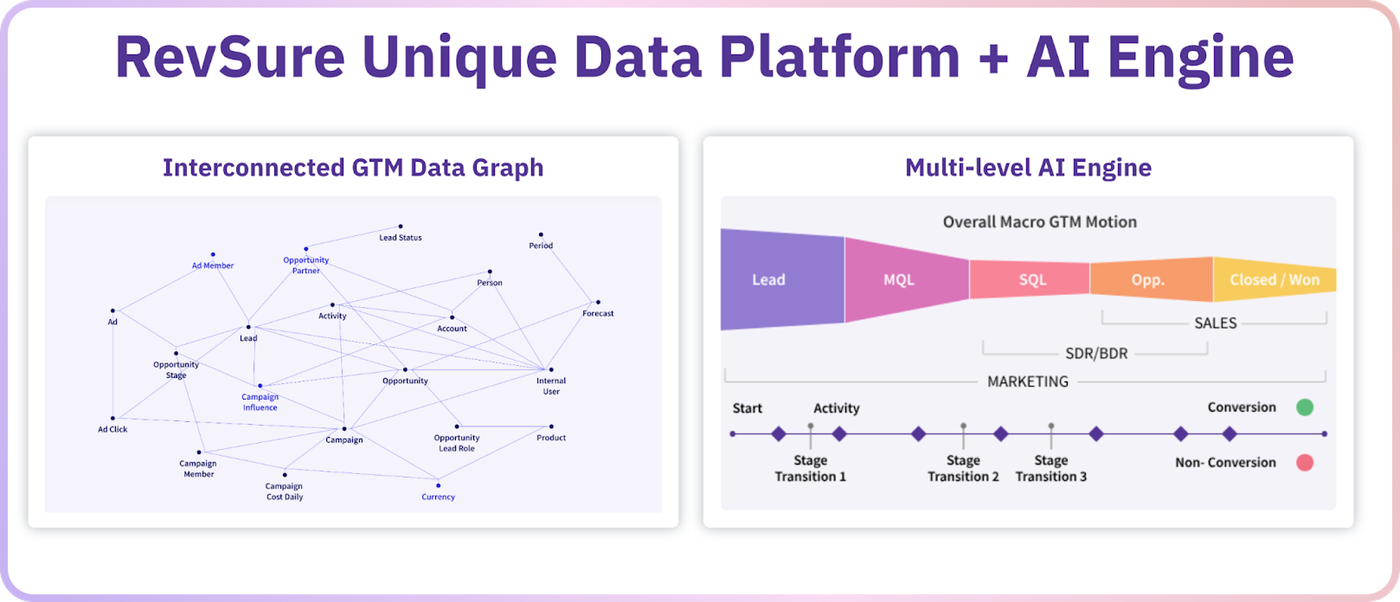
Governance is not an afterthought in RevSure. Enterprise attribution without governance collapses into inconsistent reporting across teams. RevSure includes:
- Role-based access control and data scoping
- Custom funnel definitions and attribution logic
- Conversion tracking across online and offline influence
- Activation through CRM and MAP writebacks
This is not a stitched reporting layer. It is a revenue-grade attribution architecture.
Real-Time Tracking: Enterprise Flexibility, Not Batch Limitations
HockeyStack also claims that RevSure relies solely on batch processing for updates and refreshes, creating data latency that makes real-time execution impossible. That is also incorrect and baseless.
RevSure 100% supports real-time monitoring and activation, including the output of its AI engine, like opportunity-level scoring, projections, etc. Enterprise GTM teams can act immediately on pipeline risk, intent spikes, or marginal ROI shifts.
Batch processing is an option because most B2B enterprises operate in heterogeneous data environments. Not every signal requires a millisecond refresh in RevSure, and many of our customers prefer configurable processing windows for governance, compliance, and cost control.
So to clarify, real-time is definitely supported in RevSure, and our platform’s flexibility is enterprise-grade.
AI Depth: Predictive Engine with 90%+ Accuracy
In the comparison blog, HockeyStack positions its AI agents as category-defining while minimizing RevSure’s AI capabilities. Whereas the reality is the opposite. Predictive capability in HockeyStack is a recent phenomenon, whereas RevSure has had it in its DNA since day 1.
RevSure has over 20 interconnected predictive AI models working in tandem across attribution, pipeline acceleration, and revenue predictability. These models span:
- Opportunity propensity and win probability
- Stage velocity forecasting and pipeline health scoring
- Campaign performance prediction and spend optimization
- Markov-chain attribution and causal lift modeling
- Marketing Mix Modeling and Incrementality Testing
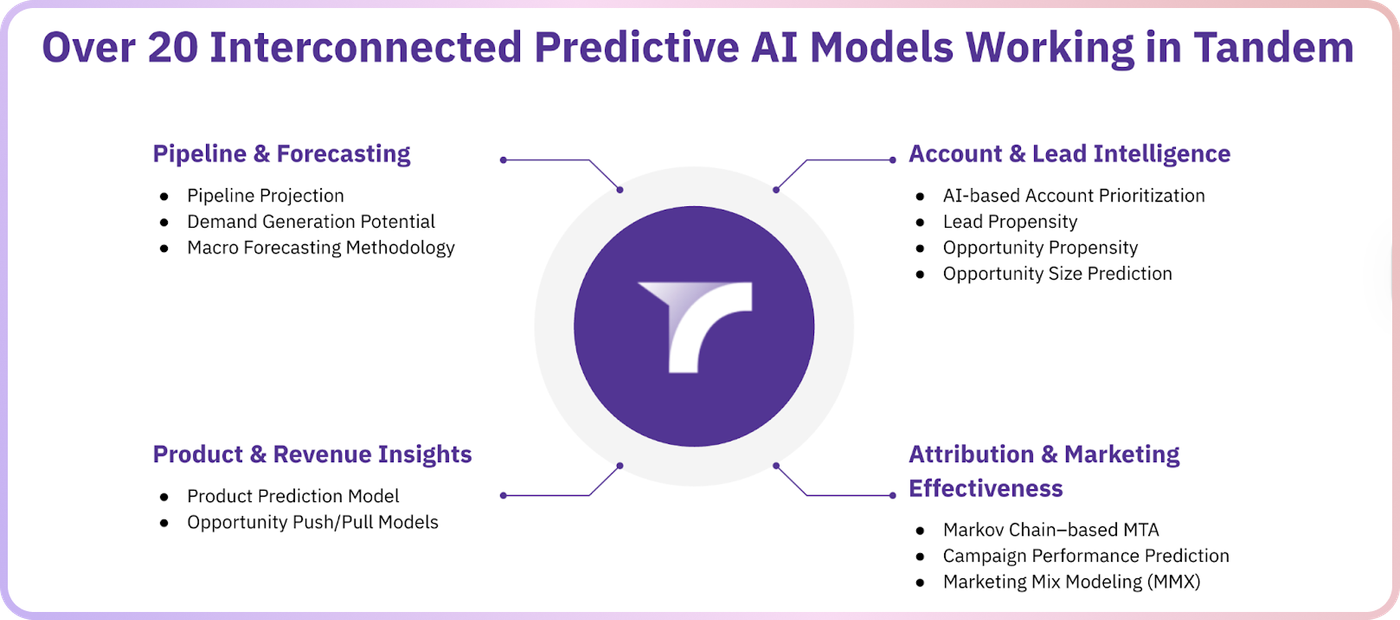
RevSure’s AI is embedded across the full revenue lifecycle, connecting attribution directly to forecasting and execution. We boast 90%+ accuracy for these AI models, and most of our customers who initially use RevSure’s analytical capabilities upgrade to AI within 3-6 months of use. That’s the power we are talking about here. Our customers can also trace the AI output and compare it against actuals within the product itself. For example, you can compare daily pipeline projections with actual pipeline generation on that day in RevSure. Our AI is not a black box; it is fully transparent and traceable.
The AI Reasoning Engine Behind RevSure
At the core of RevSure is an AI reasoning engine built for full-funnel B2B GTM motion. It can operate across 1B+ sales and marketing interactions, including online and offline engagement, product usage, calls, meetings, transcripts, and paid media, unifying more than 10M+ visitors into accounts and opportunities.
This powers RevSure’s Full Funnel Context Data Platform: an enterprise-grade foundation that unifies fragmented GTM data across marketing, sales, and revenue operations into clean, connected, AI-ready context throughout the buyer journey. Unlike traditional CDPs or Attribution platforms that stop at harmonization and analytics, RevSure standardizes identities, enriches signals, and activates trusted full-funnel context directly into workflows and agentic AI systems in real time. On top of the platform is advanced data enrichment and identity resolution, including ICP segmentation, persona and buying-group mapping, and campaign, channel, region, and product context. Attribution is not just about capturing touchpoints; it is about structuring them into meaningful buying signals.
RevSure’s Agentic AI continuously evaluates pipeline momentum, opportunity risk, and incremental channel impact, and executes actions. Through secure MCP-aligned system access, insights are activated directly into CRM and other GTM tech stack, enabling teams to prioritize high-intent accounts, intervene on risk, and reallocate budget on high-impact campaigns. Together, agentic AI, MCP-grade connectivity, full funnel data architecture, and enrichment transform attribution from reporting into revenue control.
Enterprise AI Governance, Security, and Trust
As attribution platforms increasingly rely on predictive and agentic AI, enterprise B2B teams require more than performance claims; they require governance, auditability, and security guarantees.
RevSure is built with enterprise-grade controls aligned with leading global standards, including ISO/IEC 42001 for AI management systems, alongside ISO 27001 and SOC 2 Type II for information security. RevSure also supports GDPR and CCPA compliance requirements, ensuring data governance and privacy protections are foundational, not optional. In an era where GTM leaders make million-dollar budget decisions based on AI-driven insights, trust is a baseline in RevSure.
Self-Serve Analytics and Autonomous GTM Teams
Another HockeyStack claim in the comparison blog is that RevSure requires a heavy reliance on implementation and is difficult for teams to operate autonomously. That is also completely false.
RevSure is designed for self-serve enterprise usage post-onboarding, with modular analytics environments, pre-built templates and widgets, and drill-down reporting, starting from executive summaries to granular attribution paths. Enterprise GTM teams can operate independently without relying on engineering or every report iteration. RevSure also supports integration into broader data ecosystems through APIs, BI-ready tables, and governed reverse ETL workflows. Autonomy is a platform requirement, and RevSure is built for it.
Enterprise Proof: Customers, Outcomes, and Readiness
HockeyStack’s blog also attempts to establish that RevSure is less enterprise-ready. The adoption reality contradicts that.
RevSure is used by leading enterprise B2B SaaS organizations with complex GTM motions and high governance requirements. Enterprise readiness is not a marketing claim; our customer logos reflect the reality. Some of the top cybersecurity, fintech, AI, and data companies are using our solution.
Our enterprise readiness is reflected in architecture, compliance, customer outcomes, and cross-functional adoption. RevSure supports enterprise-grade compliance, data isolation, and multi-region operational requirements. The RevSure platform is built for revenue leaders who cannot afford attribution that is merely descriptive.
Global Roots and Founder’s Pedigree
HockeyStack’s comparison blog also briefly notes that RevSure is headquartered in Bengaluru, India, a framing that implies weaker enterprise capability or offshore dependency. That narrative is so outdated and misleading.
Bengaluru is one of the world’s most advanced SaaS and AI ecosystems across the globe. Many of the successful enterprise software companies have been built from global-first foundations across North America and India. Deep engineering depth and AI innovation are not geographical liabilities; they are competitive advantages. RevSure’s roots reflect exactly that.
RevSure was founded by Deepinder Singh Dhingra, a serial entrepreneur with over two decades of experience building AI-driven SaaS businesses. Before founding RevSure, Deepinder held leadership roles across go-to-market, product, and technology in enterprise AI and big data companies, organizations known for scaling advanced analytics platforms globally. He has worked extensively with Fortune 100 and Fortune 500 enterprises, building, scaling, and exiting multiple startups in the AI and data intelligence space.
RevSure’s foundation is built on deep enterprise AI experience by leaders who understand both the technical and commercial realities of complex SaaS revenue environments. Global engineering roots combined with enterprise GTM experience are not our weaknesses; they are the reason RevSure’s architecture is as deep as it is. We are proud of that.
Independent Validation: G2 Performance and Momentum Leadership
Enterprise attribution decisions are not made on vendor narratives or comparison blogs. They are validated through independent customer feedback and market performance. In the latest G2 reporting cycle, RevSure outperformed HockeyStack across many key enterprise indicators. RevSure demonstrates stronger advocacy and trust metrics:
- 95% Likelihood to Recommend (vs 93%)
- 100% “Good Partner in Doing Business” (vs 98%)
- 100% Product Direction confidence (vs 97%)
Operationally, RevSure also leads in governance-critical areas such as Ease of Administration (90% vs 85%), an important signal for B2B teams managing complex pipelines. In advanced attribution and predictive capability categories, RevSure maintains strong satisfaction across:
- Multi-Touch Attribution (98%)
- B2B Attribution (94%)
- Predictive Forecasting (92%)
- Pipeline Management (95%)
- Integrations (99%)
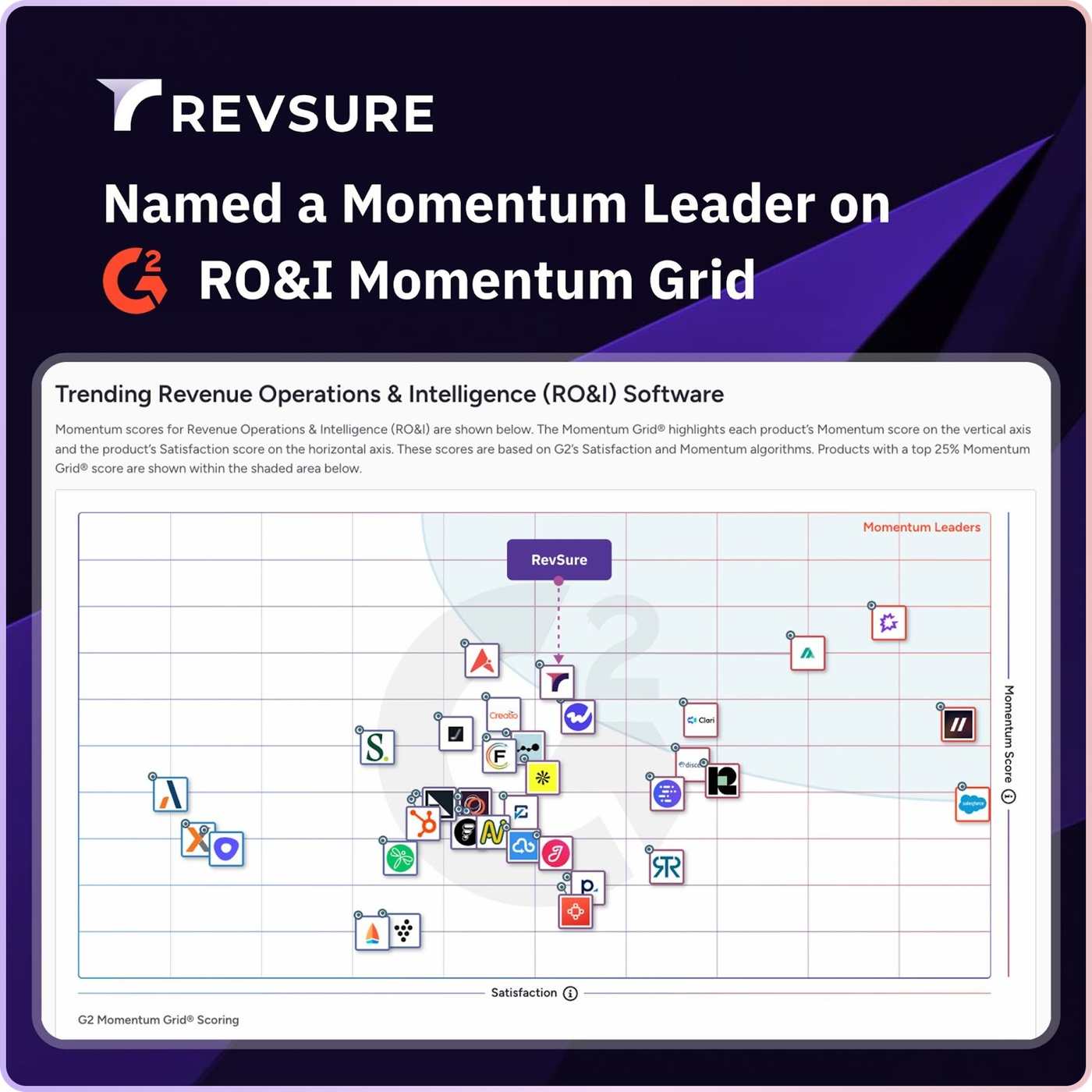
RevSure customers also report faster ROI realization, with average payback achieved in approximately 6 months. Additionally, RevSure is positioned as a Momentum Leader in Revenue Operations & Intelligence, reflecting strong adoption velocity combined with high customer satisfaction. Independent G2 validation reinforces what we have already been saying: RevSure is not a lightweight reporting tool. It is an enterprise-grade revenue intelligence system trusted by modern B2B GTM teams.
The Bottom Line
We typically don’t engage in direct critiques of competitors; that’s not how we operate. But when our platform is publicly reduced to inaccurate claims and outdated standards, it becomes important to respond with clarity. HockeyStack’s framing centers on journey visibility and descriptive attribution analytics. RevSure is built for what enterprise GTM teams increasingly require in 2026:
- Prove incrementality, not correlation.
- Forecast opportunity health, not just campaign influence.
- Trigger next-best actions, not just dashboards.
- Operate attribution as a revenue system, not a reporting layer.
Attribution is no longer about assigning credit after the quarter ends. It is about shaping revenue outcomes while the quarter is still being written. That is the enterprise standard, and RevSure was built for it from day one.