On this page
In the last post, “GTM Efficiency Is a Feeling. Cohesion Is a System,” we looked at why many go-to-market organizations call themselves efficient but still have trouble executing consistently. The RevSure’s 2026 State of Agentic AI in B2B GTM showed the problem clearly: teams move fast, but issues with lead quality, data reliability, and cross-team handoffs still slow things down.
The main takeaway was straightforward. Efficiency often means people are working harder to make up for broken systems. Cohesion is what actually makes execution scalable. This third post continues that idea, as Agentic AI now pushes GTM leaders to face the next big question:
If cohesion is the base, what happens when AI starts to take part in execution instead of just analyzing it?
This is where the difference really matters. Automation has always been about executing predefined steps. Agentic AI is about achieving outcomes. That difference is not semantic. It is structural. And it is why so many GTM leaders believe the next two years will redefine how revenue execution works.
Why Automation Hit Its Ceiling in GTM
Automation has influenced go-to-market operations for decades. Marketing automation systems launch campaigns and manage nurturing. Sales engagement platforms organize outreach. CRM workflows route leads, assign owners, and update records. These tools made teams more efficient by cutting manual work and standardizing processes.
But automation has always had a limit: it can only do what’s already been set up. It does not understand context. It does not reason across tradeoffs. It does not adapt dynamically as buying conditions shift. It follows rules.
That worked well when GTM execution could be approximated through linear funnels and predictable buyer behavior. But modern buying journeys are not linear. Signals arrive asynchronously across channels. Intent changes quickly. Accounts behave differently depending on segment, timing, internal buying groups, and competitive pressure. In this environment, rigid workflows start to show their limits. Automation can speed up activity, but it can’t coordinate execution across a complex, connected funnel.
That’s why the biggest barriers found in the research aren’t just about missing automation. They’re deeper execution problems: lead quality, inconsistent follow-up, fragmented data, and unreliable handoffs between teams and systems.
Insight Was Not Enough. Execution Became the Bottleneck.
Over the last several years, AI entered GTM as a layer of intelligence. Models scored leads, surfaced intent, summarized calls, predicted churn risk, and generated recommendations. AI helped teams interpret complexity more effectively than dashboards ever could.
But as the research shows, intelligence alone didn’t close the execution gap. Almost 47% of organizations still report problems with lead quality, and 47% mention data quality and unification gaps as main barriers. Over a third still struggle with inconsistent sales follow-up. These aren’t analytical failures; they’re execution failures.
Teams often know what should happen next. The problem is that knowing does not translate into consistent action across the funnel. This is where Agentic AI truly changes things. It goes beyond just giving insights and starts taking part in execution.
What Changes When AI Is Allowed to Act
Agentic AI systems do not stop at recommendation. They reason across context, select actions aligned with defined goals, and execute those actions within governed constraints. Instead of simply telling GTM teams what might matter, they begin operating inside the work of moving pipeline forward.
That’s why adoption is growing so fast. The report says 41% of organizations already use Agentic AI, and another 35% are rolling it out. Leaders aren’t adopting it just because it’s new; they’re adopting it because it finally connects insight directly to action, something GTM execution has needed for years.
Almost everyone sees the benefits. 96% of leaders say AI agents with full-funnel context would greatly improve execution, and 90% think Agentic AI will be essential for meeting GTM goals in the next two years.
The market shows this shift is coming. The real question is whether organizations are ready for it.
Why Most Deployments Are Still Narrow
Even with fast adoption, most Agentic AI deployments are still limited to specific workflows instead of being used across the whole funnel. This isn’t because the technology can’t do more; it’s because the environment often isn’t cohesive enough to support safe autonomy.
Leaders mention common barriers: security and privacy concerns (54%), questions about accuracy and reliability (47%), and data integration challenges (44%). They also worry about misalignment, with 77% fearing Agentic AI could become another silo if not coordinated well.
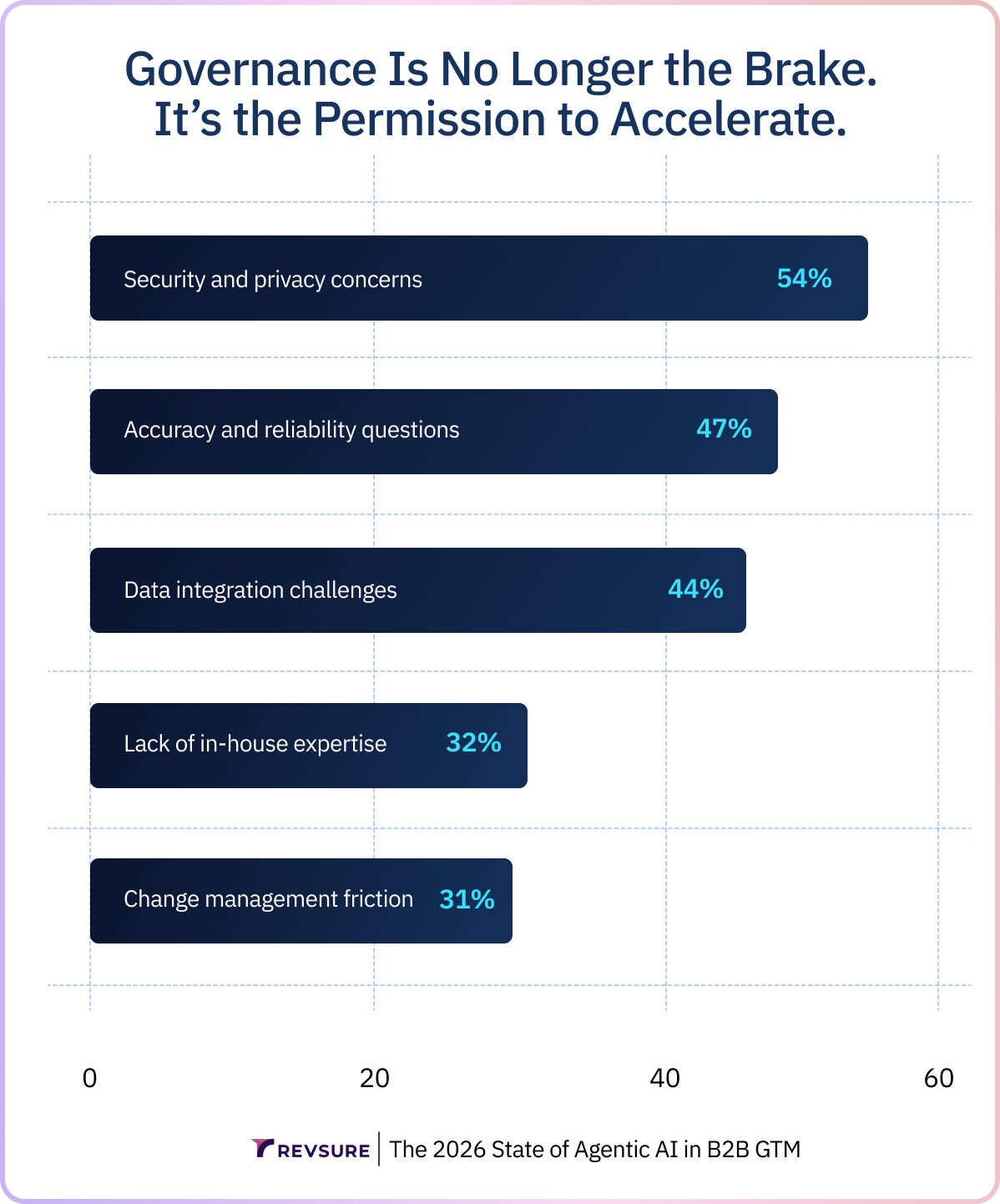
These concerns point to a deeper truth. Autonomy only works when systems share context, definitions, and governance. Without these basics, autonomous action can lead to more activity but not better results. That’s why many teams limit agents to narrow tasks. They get local efficiency but don’t reach full-funnel orchestration. This is the key difference between just deploying Agentic AI and truly transforming GTM execution with it.
The Shift From Workflow Automation to Outcome Orchestration
Organizations that go beyond narrow deployments see Agentic AI differently. They don’t ask, “What task should we automate next?” Instead, they ask, “What outcome do we want to control?”
This way of thinking changes everything.
Outcome-oriented execution is not about increasing activity volume. It is about improving pipeline velocity, conversion consistency, forecast reliability, and cost-to-pipeline efficiency. It requires systems that can continuously interpret funnel conditions and adjust actions dynamically, rather than relying on static rules.
In this model, AI does not replace human oversight. It changes where humans intervene. Leaders move upstream into defining goals, guardrails, and governance, while agents handle execution loops that would otherwise require constant manual coordination. This shift in the operating model is what makes Agentic AI truly transformative, not just a small improvement.
Governance and Integration Are What Make Outcomes Scalable
One key insight from the research is how the role of governance is changing. While leaders mention governance concerns as barriers, 97% say they feel confident about scaling AI responsibly. This shows a shift in thinking: governance isn’t seen as a brake anymore, but as the structure that lets autonomy grow.
Agentic execution needs auditability, clear decision rights, and shared definitions of performance. Without this foundation, AI stays in an advisory role. With it, AI becomes part of daily operations.
Integration is just as important. The report shows a clear gap: 95% think their tech stack can support Agentic AI, but only 64% are very confident. This gap shows the difference between simply connecting tools and truly unifying systems.
Agentic AI can only act responsibly when it has full-funnel context from CRM, marketing automation, sales engagement, analytics, and customer systems. Without this context, autonomy turns into guesswork.
The Question GTM Leaders Must Answer Now
As Agentic AI becomes more involved in revenue execution, the main question isn’t whether teams should adopt it; adoption is already happening.
The question is whether GTM organizations will continue optimizing isolated workflows or whether they will redesign execution around coordinated outcomes. Automation helped teams work faster. Agentic AI can help organizations achieve better results, but only if cohesion, governance, and integration are treated as core foundations, not afterthoughts.
The Agentic Era isn’t just about doing more with AI. It’s about building systems that execute with context, accountability, and growing intelligence.
—
Agentic AI marks the shift from workflow automation to outcome orchestration. Successful teams won’t just deploy agents; they’ll build the foundations that let autonomy drive real GTM performance.
To see the full research behind this shift, including adoption benchmarks, execution barriers, and readiness trends, download The 2026 State of Agentic AI in B2B GTM report.