On this page
There is a segmentation problem sitting inside most B2B revenue organizations that rarely gets named precisely. It is not that teams lack data on their accounts. It is that the segmentation structures available inside their tools do not match the way the business actually thinks about its accounts.
CRM fields are rigid. They reflect how the system was configured at implementation, firmographic fields, lifecycle stages, owner assignments, none of which capture the real, evolving logic revenue teams use to differentiate accounts strategically. An account is not just "Enterprise, North America, Open Opportunity." It is a strategic expansion target. A competitive displacement play. A partner-sourced deal with accelerated timeline expectations. A reactivation candidate coming back after a six-month stall.
That business logic lives in team conversations, in Slack threads, in slide decks prepared for QBRs. It rarely makes it into the systems where prioritization, engagement, and pipeline decisions actually happen. And because it does not live in the system, it cannot inform the AI models, the audience segments, or the GTM workflows that are supposed to be driving execution.
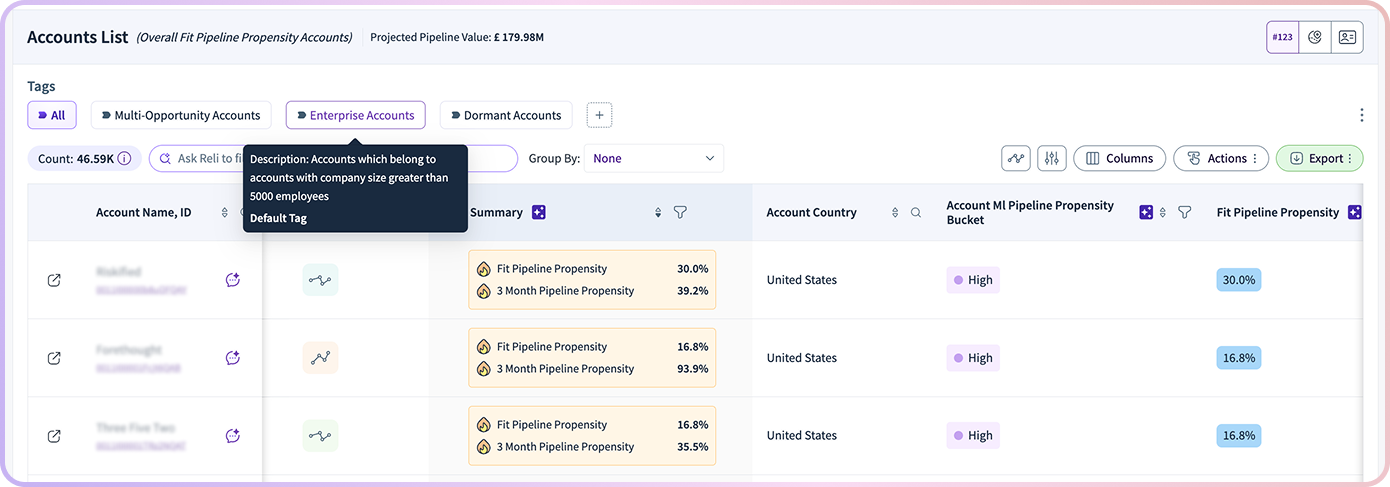
Account Tags in RevSure are built to close that gap, by giving revenue teams a structured, flexible, and execution-ready mechanism to apply their own business logic to accounts directly inside the platform where prioritization decisions are made.
The Segmentation Gap That Standard Fields Cannot Fill
To understand why Account Tags matter technically, start with what account segmentation looks like without them.
RevSure's Account & Lead Prioritization engine already applies AI-driven propensity scoring across hundreds of firmographic, behavioral, and engagement attributes. It identifies which accounts have the highest likelihood of converting, which are showing accelerating engagement signals, and which are approaching inflection points in their buyer journey. That intelligence is genuinely powerful.
But propensity scores and AI signals describe what the data says about an account. They do not capture what the business has decided about an account. These are two different things, and conflating them creates a real problem in how prioritization lists get interpreted and acted on.
A high-propensity account that the sales team has already decided to deprioritize in favor of a strategic land-and-expand motion looks the same in a standard prioritization view as a high-propensity account that is ready for immediate SDR outreach. A partner-sourced account that carries different engagement expectations than a direct inbound account shows up identically in a funnel health view unless the business has a way to tag and surface that distinction explicitly.
Standard CRM fields cannot solve this because they are not designed for it. They are schema-bound, defined at the system level, applied uniformly, and not easily extended to reflect the dynamic, context-specific logic that GTM teams actually operate on. Every time a revenue team invents a new category — "2026 ICP Expansion," "Competitive Win-Back," "Executive Sponsor Engaged", they have no good place to record it in a way that persists, surfaces in prioritization views, and flows into downstream GTM actions.
Account Tags are that place.
What Account Tags Actually Do Inside RevSure's Data Model
Account Tags introduce a flexible, user-defined labeling layer at the account entity level inside RevSure's Full Funnel Data Graph. Unlike fixed schema fields, tags are freeform and additive, teams define the labels that reflect their business logic, apply them to individual accounts or account sets, and those tags immediately become available as segmentation dimensions across RevSure's prioritization, analytics, and audience modules.
This matters architecturally because tags operate as first-class attributes on the account entity. They are not notes. They are not comments. They are structured metadata that the platform can filter on, segment by, sort against, and surface inside AI-driven prioritization views alongside propensity scores, engagement signals, and pipeline data.
The practical implication: a tag like "Strategic Expansion, Q3 Focus" or "Competitive Displacement" or "Reactivation Candidate" is not just a label visible to the person who applied it. It becomes a segmentation dimension that the entire team can filter against, that RevOps can use to build audience segments, and that leadership can use to view pipeline health and engagement coverage specifically for that tagged cohort.
Tags also stack. An account can carry multiple tags simultaneously, reflecting the layered business logic that actually applies to complex enterprise accounts. An account might be tagged as both a "2026 ICP Target" and an "Executive Sponsor Engaged" account simultaneously, and teams can filter on either dimension independently or in combination.
How Business-Defined Segmentation Changes Prioritization Quality
The most significant impact of Account Tags is on the quality of prioritization decisions, specifically, the alignment between AI-driven signals and human strategic context.
RevSure's AI prioritization engine is designed to surface the accounts that the data says deserve attention. Account Tags are designed to surface the accounts that the business says deserve attention. In the best GTM operating models, those two signals inform each other rather than operating in isolation.
Consider how this plays out across three common GTM scenarios:
Strategic account programs. Enterprise teams frequently maintain a small set of named strategic accounts that require dedicated coverage regardless of their current AI propensity score. Without Account Tags, there is no clean way to separate these from the broader prioritization list or to track their engagement patterns as a distinct cohort. With Account Tags, a "Strategic Named Account" tag creates an immediately filterable segment, visible in prioritization views, trackable in funnel health, and available as an audience for campaign activation through RevSure's Audience Creation module.
Competitive displacement motions. Accounts identified as competitive displacement opportunities often require a fundamentally different engagement approach than standard inbound or outbound targets. Content strategy, outreach sequencing, stakeholder mapping, all of it changes when the context is competitive. Tagging these accounts explicitly surfaces them as a distinct population across every relevant RevSure module, ensuring that the prioritization view, the engagement analysis, and the pipeline forecast can all be examined through the lens of what is actually a separate GTM motion.
Reactivation and re-engagement. Accounts that have gone cold after prior engagement are not the same as net-new targets, and treating them identically in prioritization views obscures performance reality. A tag like "Reactivation, Prior Opportunity" creates a distinct cohort that can be tracked for re-engagement velocity, conversion rate from reactivation, and engagement pattern differences compared to new pipeline. That analysis cannot happen without a clean segmentation mechanism at the account level.
Tags as a Signal Layer for Downstream GTM Execution
Account Tags are not just an organizational tool inside RevSure's prioritization views. They function as a signal layer that feeds into downstream execution across the platform.
Because tags are first-class attributes on the account entity, they can be used as segmentation criteria inside RevSure's Audience Creation module. A team can build a LinkedIn Matched Audience, a Marketo static list, or a Salesforce campaign target list scoped specifically to accounts carrying a given tag, without building complex multi-condition filters from scratch every time. The tag carries the business logic; the audience builder consumes it.
This connects Account Tags directly to RevSure's Writebacks and Real-time Activation layer. A segment built from a tag can be written back into CRM, MAP, and ad platform systems, keeping downstream execution aligned with the business-defined segmentation that lives in RevSure. Strategic accounts tagged in RevSure can flow into Salesforce account lists. Competitive displacement targets can populate Marketo nurture tracks. Reactivation cohorts can feed LinkedIn retargeting campaigns.
The tag defined once in Account Prioritization becomes the organizing logic for execution across the entire GTM stack.
For teams using RevSure's AI Agents, Account Tags also provide a natural scoping mechanism for agent-driven workflows. An agent configured to monitor engagement signals and trigger outreach recommendations can be scoped to operate specifically on tagged account cohorts, ensuring that automated GTM execution reflects the same strategic segmentation logic that the team has already defined.
Cross-Team Alignment as a Structural Output
One dimension of Account Tags that is easy to underestimate is their impact on cross-functional alignment.
In most enterprise revenue organizations, different teams maintain different mental models of account prioritization. Sales leadership has their named account list. Marketing has their ICP segment. RevOps has their pipeline-weighted tier structure. These models are not wrong, they reflect genuinely different lenses on the same account universe. But when they live in different systems or different spreadsheets, they create systematic misalignment in how the same accounts get treated across functions.
Account Tags give every function a shared, structured vocabulary for account segmentation that lives in a single place. When a RevOps leader tags a cohort as "Board-Level Relationship , Priority Coverage," that tag is immediately visible to sales leadership looking at prioritization views, to marketing teams building campaign audiences, and to anyone running pipeline health analysis on those accounts. The business logic is no longer siloed inside one team's spreadsheet. It is a platform-level attribute that everyone is operating from.
This is the alignment outcome that matters most at scale: not just cleaner data, but shared context, the condition where every function making decisions about an account is working from the same set of explicitly defined, business-driven segmentation logic.
Accessing Account Tags
Account Tags are available now inside RevSure's Account Prioritization module.
Tags can be created, applied, and managed directly within the account view. Once applied, tagged cohorts are immediately available as filter dimensions across RevSure's prioritization, funnel health, pipeline analytics, and audience creation surfaces.
For guidance on how to structure your tag taxonomy for maximum analytical utility, or to understand how Account Tags interact with RevSure's AI prioritization engine and downstream activation workflows, reach out to cs@revsure.ai or book a demo for a personalized walkthrough.