On this page
In enterprise marketing organizations, attribution has a structural limitation that point-in-time reporting cannot solve. A single attribution view tells you what contributed to pipeline this quarter. It does not tell you whether that contribution is growing, declining, plateauing, or shifting in composition relative to prior periods. It cannot tell you whether the channel driving the most pipeline today was driving equally strong results six months ago, or whether that performance is a recent anomaly that has not yet been reflected in budget decisions.
This is the gap between attribution reporting and attribution intelligence. Reporting answers what? Intelligence answers how it is changing, and why that change matters for how the business should respond.
Most attribution systems are built for reporting. They produce accurate snapshots of channel and campaign contributions at a point in time. They do not surface the longitudinal patterns that reveal whether marketing investment is building a durable pipeline contribution or riding a short-term signal.
RevSure's Marketing Attribution Trends Widget addresses this gap directly. By introducing a time-based view of attribution data into RevSure's dashboard layer, it gives marketing, RevOps, and GTM leadership the ability to analyze how channel and campaign contributions evolve, not just what they are at any given moment.
The Limitation of Static Attribution Views
Enterprise organizations have invested significantly in attribution infrastructure. Multi-touch attribution models, marketing mix modeling, and funnel conversion analysis have become standard components of the modern marketing analytics stack. These capabilities are genuinely valuable, they answer the foundational question of which channels and campaigns are contributing to pipeline and revenue.
But static attribution views carry a limitation that becomes more significant as organizations mature in their use of marketing data. A snapshot of channel attribution for the current quarter tells you the current distribution of credit across channels. It does not tell you whether that distribution has changed relative to prior quarters, whether a historically strong channel is losing contribution share, or whether an emerging channel is building momentum that is not yet visible in aggregate spend decisions.
This creates three persistent challenges for marketing and RevOps teams:
Budget allocation decisions are made on current attribution snapshots without visibility into whether that performance reflects a durable trend or a temporary signal. Channel strategy is adjusted reactively, after performance shifts have already materialized in pipeline outcomes, rather than proactively, when the trend is first emerging in attribution data. Long-term marketing impact, the compounding contribution that brand-building and nurture programs generate across extended periods, remains invisible in single-period attribution views that cannot surface how influence patterns evolve over time.
RevSure's Attribution Trends Widget is built to resolve these limitations by making time the primary analytical dimension in attribution analysis.
Bringing Time-Based Intelligence Into Attribution Analysis
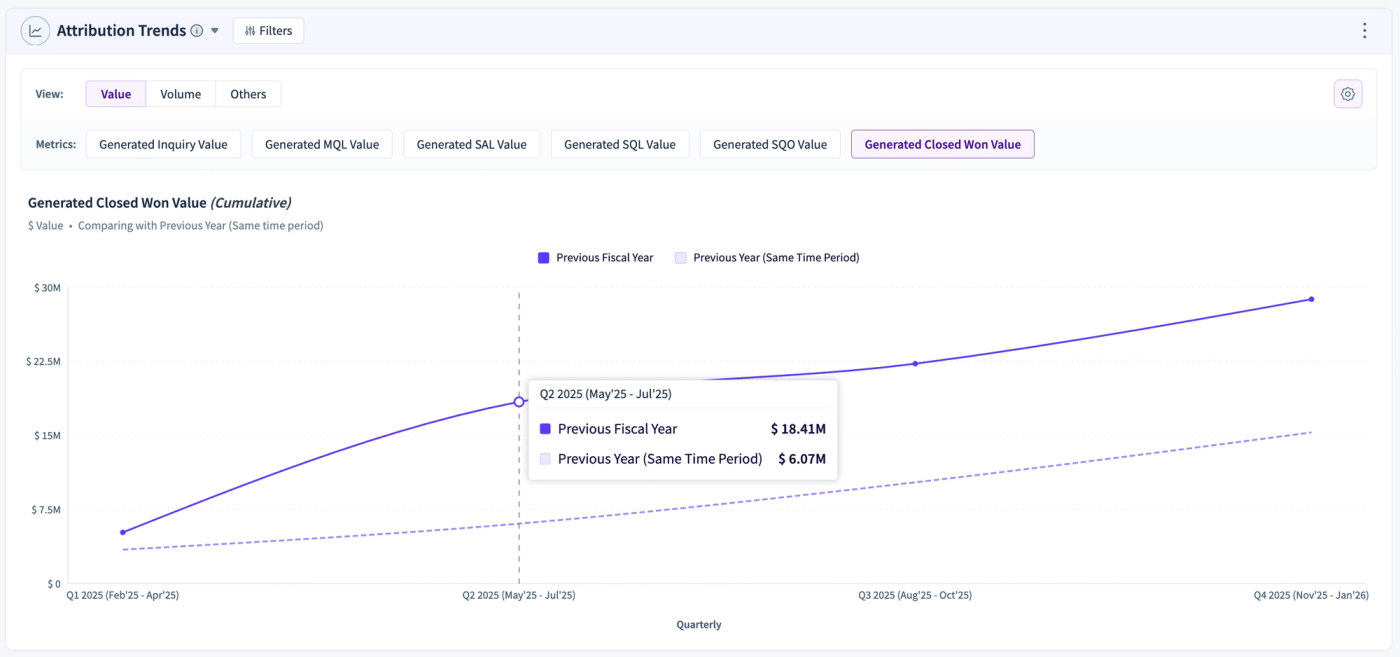
At its core, the Attribution Trends Widget introduces a longitudinal view layer on top of RevSure's existing Multi-Touch Attribution and AI Funnel Conversion Attribution capabilities. Rather than presenting channel and campaign contribution as a single aggregate figure for a selected period, the widget surfaces how that contribution has moved across time, tracking attribution shifts period over period and making those patterns immediately visible inside the dashboard interface.
This is not a simple chart of historical data. It is a structured analytical surface that allows teams to examine attribution trends at multiple levels of granularity, across channels, campaigns, lead sources, and time horizons, and identify meaningful patterns in how marketing influence on pipeline and revenue is evolving.
Once enabled, the widget surfaces inside RevSure's dashboard layer as a configurable view that can be scoped to the dimensions and time periods most relevant to the team's analytical needs. Attribution data that previously required manual comparison across multiple period-specific reports is now consolidated into a single, continuously updated trend view.
The impact is immediate. Marketing leaders gain the ability to detect channel performance shifts in real time rather than discovering them in retrospective analysis. RevOps teams gain a time-series view of attribution that strengthens the accuracy of Campaign Spend Reallocation recommendations. GTM leadership gains a long-term attribution lens that makes strategic planning conversations more grounded in actual performance trajectory.
From Attribution Snapshots to Attribution Trends
One of the most significant outcomes of introducing time-based attribution analysis is the shift it enables in how marketing performance conversations are structured inside revenue organizations.
In most organizations, marketing attribution is reviewed quarterly, a snapshot of what contributed to pipeline in the period that just closed. That snapshot is valuable, but it is inherently backward-looking and limited to a single frame of reference. It cannot distinguish between a channel that has consistently contributed at a high level over multiple periods and a channel that delivered a strong single-quarter result driven by a one-time campaign investment.
By surfacing attribution trends over time, RevSure's widget gives teams the analytical foundation to make that distinction explicitly. A channel showing consistent attribution growth across six consecutive periods tells a different strategic story than a channel showing high single-period attribution followed by decline. A campaign category that was responsible for fifteen percent of attributed pipeline twelve months ago and is now responsible for thirty percent represents a shift in marketing effectiveness that should be reflected in budget planning. Without a time-based attribution view, that shift remains invisible until someone manually constructs a period-over-period comparison.
As time-based visibility increases, so does the quality of decisions it informs. Marketing leaders can act on emerging channel trends before they have fully materialized in pipeline outcomes. Budget conversations move from defending current spend allocations based on current-quarter attribution to advocating for reallocation based on demonstrated trend trajectories. Long-term program performance, the sustained contribution that content, brand, and nurture programs build over extended periods, becomes visible and defensible in ways that single-period attribution snapshots cannot support.
Enabling Deeper Channel and Campaign Strategy
The Attribution Trends Widget expands what is analytically possible for channel strategy and campaign planning inside RevSure. Instead of evaluating channel performance solely on current attribution share, teams can now incorporate trend trajectory into how channels are assessed and prioritized.
This enables more sophisticated analysis across the marketing function, including:
Identifying channels with accelerating attribution contribution that may be underweighted in current budget allocation relative to their demonstrated trajectory. Detecting channels where attribution share is declining, providing an early signal that campaign strategy, audience quality, or competitive positioning may be shifting before that decline materializes in pipeline shortfall. Correlating attribution trend patterns with Pipeline Analytics data to understand whether channels driving increasing attribution share are also contributing to faster pipeline velocity and higher conversion rates downstream. Evaluating the long-term contribution of programs that operate across extended time horizons, partner programs, content-driven nurture tracks, community investments — that are systematically undervalued in single-period attribution views because their influence compounds gradually rather than appearing in a single quarter's data.
By combining longitudinal attribution intelligence with RevSure's existing Marketing Mix Modeling and Incrementality Testing capabilities, teams gain a more complete analytical framework, one that reflects not just what channels are contributing, but how that contribution is building or eroding over time and at what rate.
Operationalizing Trend Intelligence Across Teams
A key advantage of the Attribution Trends Widget is that the intelligence it surfaces is not confined to analytical use cases. It feeds directly into operational decisions that revenue teams make continuously, how to allocate budget, which campaigns to scale, and where to concentrate GTM resources in the periods ahead.
Once enabled inside the RevSure dashboard, attribution trend data becomes part of the shared analytical context that marketing, RevOps, and GTM leadership operate from. Channel trends that are surfacing in the widget inform the next Campaign Spend Reallocation recommendation. Attribution shifts detected in the trend view create the analytical foundation for Audience Creation decisions, moving budget and targeting toward channels where contribution trajectories justify increased investment.
This creates alignment between trend intelligence and execution. Revenue teams no longer need to manually construct period-over-period attribution comparisons to identify where performance is shifting. That analysis is continuously updated and immediately visible inside the dashboard surface they already operate from, reducing the time between signal detection and strategic response, and ensuring that attribution intelligence informs planning decisions rather than trailing them.
Built for Strategic Planning and Budget Accountability
Enterprise marketing organizations operate on planning cycles that require forward-looking justification for budget decisions. Attribution snapshots support retrospective reporting. Attribution trends support prospective planning, giving marketing leaders the longitudinal performance evidence needed to justify channel investment decisions before a planning cycle closes, not after.
The Attribution Trends Widget is designed for that planning context. By making historical attribution trajectories immediately visible alongside current performance, it gives marketing leadership the ability to walk into budget conversations with demonstrated trend evidence rather than single-period attribution data that cannot distinguish sustained performance from short-term results.
At the same time, the widget supports the cross-functional accountability that modern revenue organizations require. When marketing, sales, and RevOps leadership are reviewing pipeline performance together, the ability to show not just what attributed to pipeline in the current period — but how that attribution has evolved over time and where the trajectory is heading, fundamentally changes the quality of the strategic conversation and the credibility of the investment recommendations that follow from it.
A More Intelligent Attribution Operating Model
The introduction of the Attribution Trends Widget reflects RevSure's broader commitment to moving marketing intelligence beyond static reporting and toward a continuously updated, time-aware analytical model that reflects how marketing programs actually operate, across quarters and planning cycles, not just within them.
Combined with RevSure's Multi-Touch Attribution, Marketing Mix Modeling, Incrementality Testing, and Marketing Performance Dashboard capabilities, the Attribution Trends Widget gives marketing and RevOps teams a comprehensive analytical stack, one where current attribution accuracy and longitudinal trend intelligence operate together rather than in separate analytical contexts.
From Attribution Data to Strategic Clarity
Enterprise marketing organizations have already built the attribution infrastructure. The investment in multi-touch models, data integrations, and funnel analytics represents significant organizational effort. The next step is ensuring that infrastructure produces not just accurate snapshots of past performance, but the trend intelligence needed to make forward-looking strategic decisions with confidence.
RevSure's Attribution Trends Widget enables that transition. By bringing time-based channel and campaign intelligence into the core of the attribution analysis workflow, organizations can move from reactive attribution reporting, discovering performance shifts after they have already affected pipeline, toward proactive trend monitoring that surfaces emerging patterns early enough to act on them.
For guidance on configuring the Attribution Trends Widget for your team's planning and reporting workflows, reach out to cs@revsure.ai or book a demo with the RevSure team.