On this page
Most GTM teams have a data problem that they do not talk about in pipeline reviews. It is not missing data. It is misaligned data, the kind that emerges when a marketing leader opens the attribution dashboard filtered to North America, the RevOps analyst pulls funnel health for Enterprise accounts, and the sales leader looks at pipeline projections unfiltered. Three people. Three different slices. One review meeting where every number tells a slightly different story.
This is not a forecasting problem. It is a filter state problem. And it sits silently at the center of nearly every misaligned GTM conversation happening across revenue organizations today.
RevSure's Global Filters feature directly addresses this, not as a UI convenience, but as a structural fix to how filter context is managed, propagated, and maintained across the full RevSure analysis environment.
The Problem Is Not Filtering. It Is Filter State Persistence.
To understand why Global Filters matter technically, it helps to understand the failure mode they replace.
In a standard dashboard environment, filter state is local. It lives at the view level. When a user applies a filter on the Attribution dashboard, say, filtering to a specific region, lead source, or ICP segment, that filter context exists only within that view. Navigate to Pipeline Analytics, and the filter state resets. Open Funnel Health, and it resets again. Every module in the platform operates as a separate analytical context with no shared memory of what the user has already configured.
This means that any analysis requiring cross-module consistency, and in RevSure, almost every meaningful analysis does, requires the user to manually re-apply filter conditions at every view. For a RevOps team running a weekly pipeline review that touches Attribution, Funnel Health, Pipeline Projections, and Campaign Performance, that is four separate configuration moments, each one a potential point of divergence.
The risk is not just wasted time. It is analytical drift. A filter missed in one view means one module is showing a different population of records than the rest. In a review setting, that drift is invisible until someone asks why the numbers do not add up, and by then, the conversation has already been shaped by inconsistent data.
How Global Filters Work Inside RevSure's Data Architecture
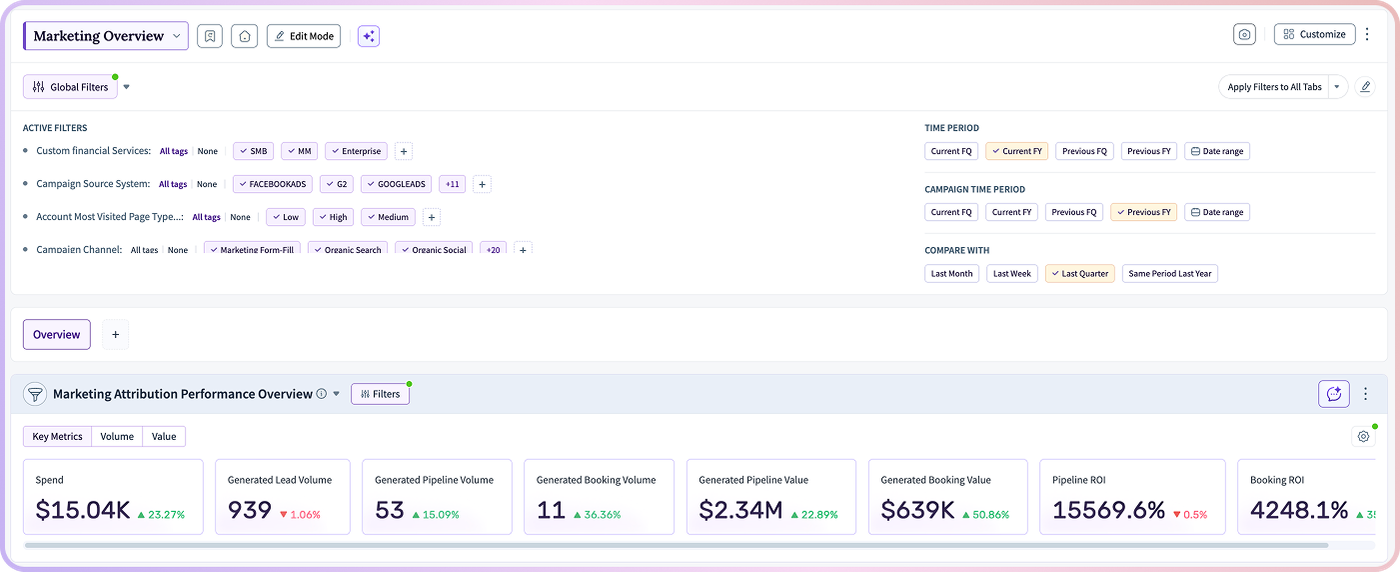
Global Filters introduce a persistent filter context layer that sits above the individual view level. When a user enables a Global Filter, the selected conditions are registered as session-level parameters that propagate across every RevSure module simultaneously, Attribution, Pipeline Analytics, Funnel Health, Campaign Performance, Audience views, and beyond.
Technically, this works by shifting filter resolution from the view layer to the data layer. Instead of each dashboard independently interpreting what data to surface, a shared filter state is applied upstream, before any module renders its output. Every view that opens during the session inherits the same filter context automatically, without any additional user action.
The result is a single analytical context applied consistently across the entire platform, not replicated at each view, but shared at the root level.
What This Changes for Cross-Module Analysis
The practical impact becomes clearest when you think about how RevSure's modules relate to each other analytically.
RevSure is not a collection of independent dashboards. It is a unified full-funnel intelligence system where Attribution feeds into Funnel Health, Funnel Health informs Pipeline Projections, and Pipeline Projections contextualize Campaign Performance. The value of that interconnection depends entirely on every module analyzing the same population of records.
Consider a RevOps team analyzing pipeline health for a specific segment, say, Enterprise accounts in EMEA sourced from Paid Demand. Before Global Filters, running that analysis across Attribution, Pipeline Analytics, and Funnel Health meant applying the same three filter conditions, account tier, region, lead source — on every module independently. Miss one, and the analysis breaks. The pipeline projection numbers no longer map to the attribution numbers because they are not looking at the same accounts.
With Global Filters, the segment is defined once. Every module automatically reflects it. The Attribution view, the Pipeline Projection, the Funnel Health breakdown, and the Campaign Performance report are all speaking to the same population. Cross-module comparison becomes reliable by design rather than by careful manual configuration.
This is particularly significant for use cases like:
Segment-level pipeline reviews where leadership needs attribution, funnel conversion, and pipeline health analyzed for the same ICP cohort simultaneously, without any risk that one module is showing a different slice of data.
Territory and regional performance analysis where filter conditions like geography, account tier, and business unit need to be held constant across every view a team opens. Previously, one missed filter could silently distort regional comparisons. Global Filters make that impossible.
Campaign-level deep dives where a marketing team needs to trace a specific campaign or lead source from first touch through to pipeline generation and opportunity progression. With a single filter applied at the global level, every module in that analysis is scoped to the same campaign from the start.
The Analytical Integrity Dimension
There is a subtler dimension to Global Filters that matters for how RevSure thinks about data governance inside the platform.
When filter state is local, analytical integrity is a user responsibility. The platform has no way to enforce consistency, it can only surface what each view is configured to show. If two team members are looking at the same report with different filters applied, the platform has no mechanism to surface that divergence. The numbers look different, the conversation gets confused, and the root cause is invisible.
Global Filters shift analytical integrity from a user responsibility to a platform responsibility. When a filter state is defined at the session level and propagated across every view, the platform itself guarantees that every module is operating on the same data context. Divergence becomes structurally impossible within that session.
For RevOps teams managing reporting consistency across functions, this is a meaningful governance capability. It means that when leadership reviews a filtered pipeline view, every number they see, across every module they navigate to, is guaranteed to reflect the same filter conditions. The platform is enforcing alignment, not relying on users to remember to re-apply it.
How This Connects to RevSure's Full-Funnel Intelligence Model
Global Filters are a natural extension of how RevSure is architected. The platform is built around the principle that full-funnel analysis requires a unified view of the entire revenue motion, not fragmented views that need to be manually reconciled.
RevSure's Full Funnel Data Graph already unifies data across CRM, MAP, ad platforms, and engagement signals into a single connected data model. RevSure's AI Engine already applies predictive intelligence across that unified data model to surface propensity scores, conversion paths, and next-best-action recommendations. RevSure's Writebacks and Real-time Activation already pushes insights back into source systems to close the execution loop.
Global Filters extend that unified model to the analysis layer. If the underlying data is unified, the filter context applied to that data should be unified too. A user should not have to work against the platform's architecture by manually replicating filter conditions at every view. Global Filters make the analysis experience as unified as the data model it sits on top of.
The Bigger Picture
Every meaningful capability RevSure ships is oriented toward the same outcome: closing the distance between what GTM data contains and what revenue teams can actually act on.
Global Filters address a specific, often invisible failure point in that journey, the place where analytical consistency breaks down not because of data quality issues, but because filter state is not being managed at the right level. By moving filter context from the view layer to the session layer, RevSure makes cross-module analysis reliable by default, not by effort.
For teams using RevSure's Audience Creation, Pipeline Analytics, and AI Agents in combination, this is the connective tissue that makes multi-module analysis trustworthy at scale.
Questions about Global Filters or how they fit into your team's reporting workflow? Reach out to cs@revsure.ai or book a demo for a personalized walkthrough.