On this page
The debate over lead and account-based strategies often falls into the trap of oversimplification. Advocates of account-based motions tout the focus and alignment benefits with sales and declare the death of MQLs, claiming that focusing on leads misses the point of engaging with Ideal Customer Profiles (ICPs) and buying committees.
But what if the debate itself is flawed? What if the real solution lies not in choosing one approach over the other but in harmonizing the two?
Here’s a contrarian perspective: MQLs are not dead—long-lived MQLs and MQAs (Marketing Qualified Accounts).
The Overlooked Reality: People Make Purchases
Account-based marketing (ABM) rightly emphasizes targeting the right accounts—those most likely to buy and benefit from your solution. This approach aligns marketing and sales around shared ICPs, reducing wasted effort.
However, what many miss is that accounts don’t make purchase decisions—people do. Even in the context of buying committees, individual stakeholders hold unique motivations, needs, and influences that guide their participation in the decision-making process.
Leads, or individuals, still matter. In fact, ABM doesn’t negate the importance of engaging with people; it amplifies it.
An account-based approach without individual-level engagement is just as ineffective as a lead-based approach without an account-level strategy.
It’s Not About Terms—It’s About Buyer Journey Progression
The terms MQL and MQA often generate debate, but they are just labels. At their core, these terms attempt to capture a snapshot of where an individual lead or account is in the buyer journey and the suitability of a company’s go-to-market (GTM) teams to spend effort in nurturing and progressing them.
Whether it’s an individual lead (MQL) or an account (MQA), the real challenge lies in the decision-making process of the GTM teams:
- Is this the right time to invest effort in engaging and progressing this lead or account?
- Is this lead/account likely to convert into a meaningful sales opportunity?
That decision—whether to nurture an MQL or an MQA—can go right or wrong. The success of your GTM strategy depends on the precision and alignment of how these judgments are made, not on the inherent superiority of one term over the other.
The Misalignment Problem: Incentives, Not Methods
The real root of the problem isn’t the choice between leads and accounts; it’s the misalignment of incentives between marketing and sales.
- In a lead-centric model, marketing is incentivized to generate high volumes of leads, regardless of quality. Sales, on the other hand, often dismiss MQLs that don’t align with their ICP and timeframe priorities.
- An account-based approach can sometimes lead to sales teams focusing exclusively on accounts that are “bottom-of-funnel”. While this is useful, this strategy unconsciously neglects the critical nurturing and engagement of earlier-stage accounts and stakeholders that may have high mid to long-term potential but are not yet ready to buy.
This tug-of-war isn’t solved by picking a side. Instead, organizations must design incentive structures that reward both volume (leads) and quality (accounts).
The Case for Harmony: MQLs + MQAs
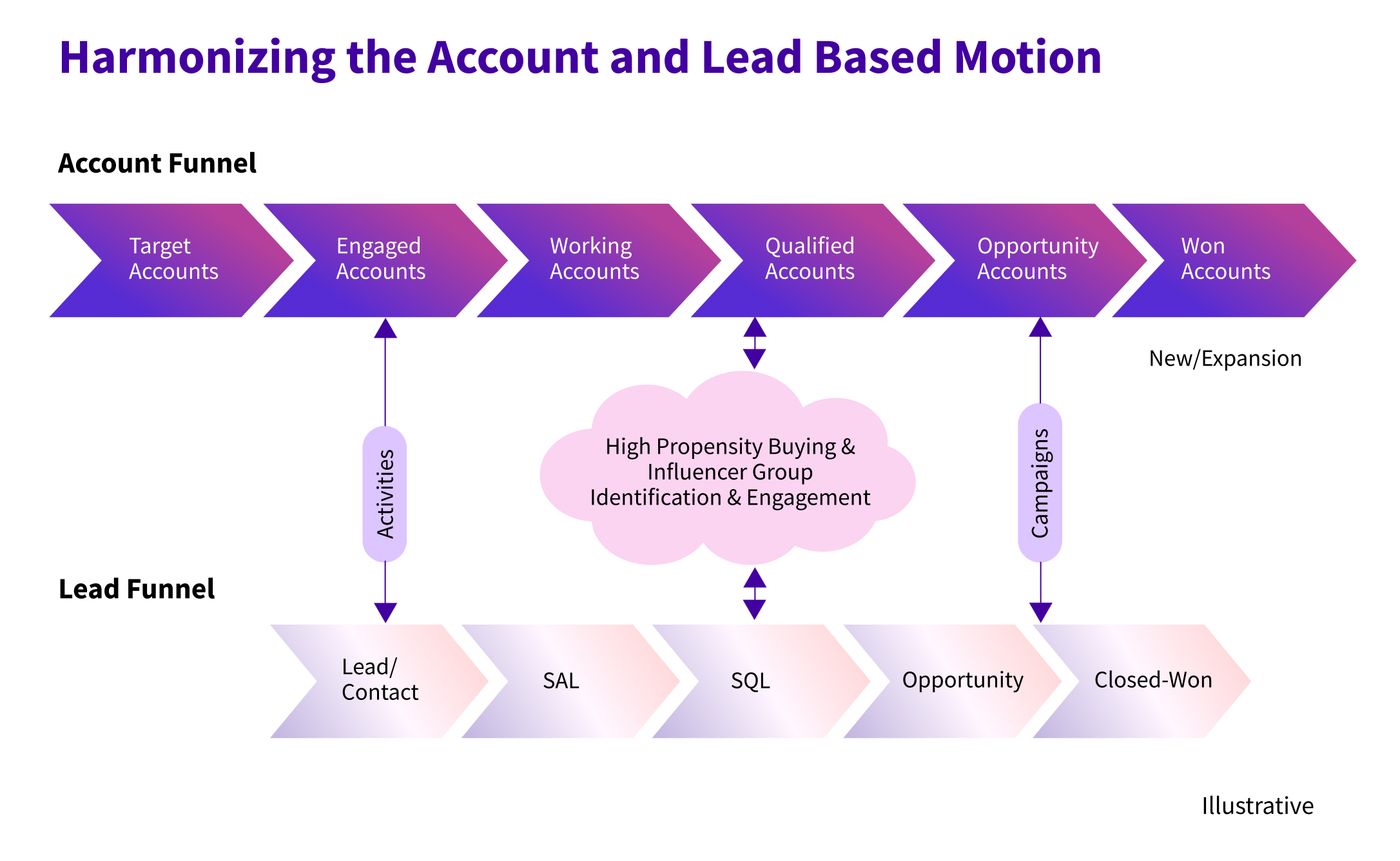
Harmonizing lead and account-based motions means embracing a “both/and” approach:
1. Start with the account, but engage the individuals.
Use account-based strategies to target ICP-aligned companies, but map and engage the key stakeholders within those accounts. Track the interactions of individuals to qualify leads (MQLs) and the account as a whole (MQAs).
2. Align incentives.
Create shared KPIs for marketing and sales, such as pipeline contribution and revenue growth, along with journey progression, engagement, and penetration of a larger list of target/focus accounts. Read more here—reward collaboration rather than division.
3. Nurture the buying committee holistically.
Buying committees are made up of individuals with distinct roles—some champions, others blockers. A hybrid approach ensures you’re engaging all the stakeholders while keeping account-level priorities in focus.
4. Integrate tools and processes.
Leverage technology to unify lead and account data, ensuring seamless transitions between marketing and sales efforts.
Connecting Lead and Account Signals to Pipeline Creation
While harmonizing MQLs and MQAs improves alignment between marketing and sales, the real impact comes when both lead-level and account-level signals are tied directly to pipeline creation. Many organizations track leads and accounts separately but struggle to understand how their combined engagement drives opportunity generation and revenue.
By integrating lead activity with account-level engagement data in CRM and pipeline analytics systems, GTM teams can better identify when both signals converge—often a strong indicator of buying readiness. For example, when multiple stakeholders within a target account engage with high-value content or product-related interactions, the likelihood of that account converting into a qualified opportunity increases significantly.
This unified view allows marketing and sales teams to prioritize outreach more effectively, focusing on accounts where both individual engagement and account-level intent signals indicate higher conversion potential. Instead of treating MQLs and MQAs as competing frameworks, organizations can use both signals together to guide pipeline prioritization and resource allocation.
Ultimately, connecting lead and account insights to pipeline outcomes ensures that marketing and sales efforts remain aligned around the shared goal of generating qualified opportunities and predictable revenue growth.
The Bottom Line: Balancing Strategy and Tactics
The debate between leads and accounts is a false dichotomy. Success in modern B2B marketing comes from balancing the precision of account-based strategies with the scale and reach of lead-based tactics.
MQLs are not dead—they are evolving. MQAs don’t replace MQLs; they complement them. By harmonizing the two, organizations can focus on what truly matters: helping people within accounts make informed, confident buying decisions.
It’s not about leads or accounts—it’s about aligning people and processes to drive meaningful business outcomes. And in that harmony, the full potential of marketing and sales collaboration is realized.