On this page
In the last post, “76% Are Deploying Agentic AI, But Most GTM Teams Aren’t Ready for What Comes Next,” we looked at a key contradiction in today’s go-to-market organizations. Agentic AI is being adopted quickly, but most teams are moving faster than they are building the solid foundations needed to scale autonomous execution responsibly. This brings up a tougher question.
If GTM teams feel more “efficient,” why does execution still break down so often?
The problem isn’t effort, intent, or even just technology. It’s the structure. For most GTM teams, efficiency is just a feeling, while cohesion is a system. Only cohesion can truly support Agentic execution at scale.
Why Efficiency Feels Real Even When the System Is Fragmented
RevSure’s 2026 State of Agentic AI in B2B GTM research shows this tension clearly. When leaders were asked about their GTM execution, 58% said it was “very efficient” and another 37% said “somewhat efficient.” By their own assessment, almost every organization thinks it’s working well.
But when these same leaders were asked about their biggest barriers to performance, their answers told a different story.
Nearly 47% cited lead quality issues, and 47% pointed to data quality and unification gaps as primary constraints on execution. More than a third highlighted inconsistent sales follow-up, while content and asset operations continued to drag down performance.
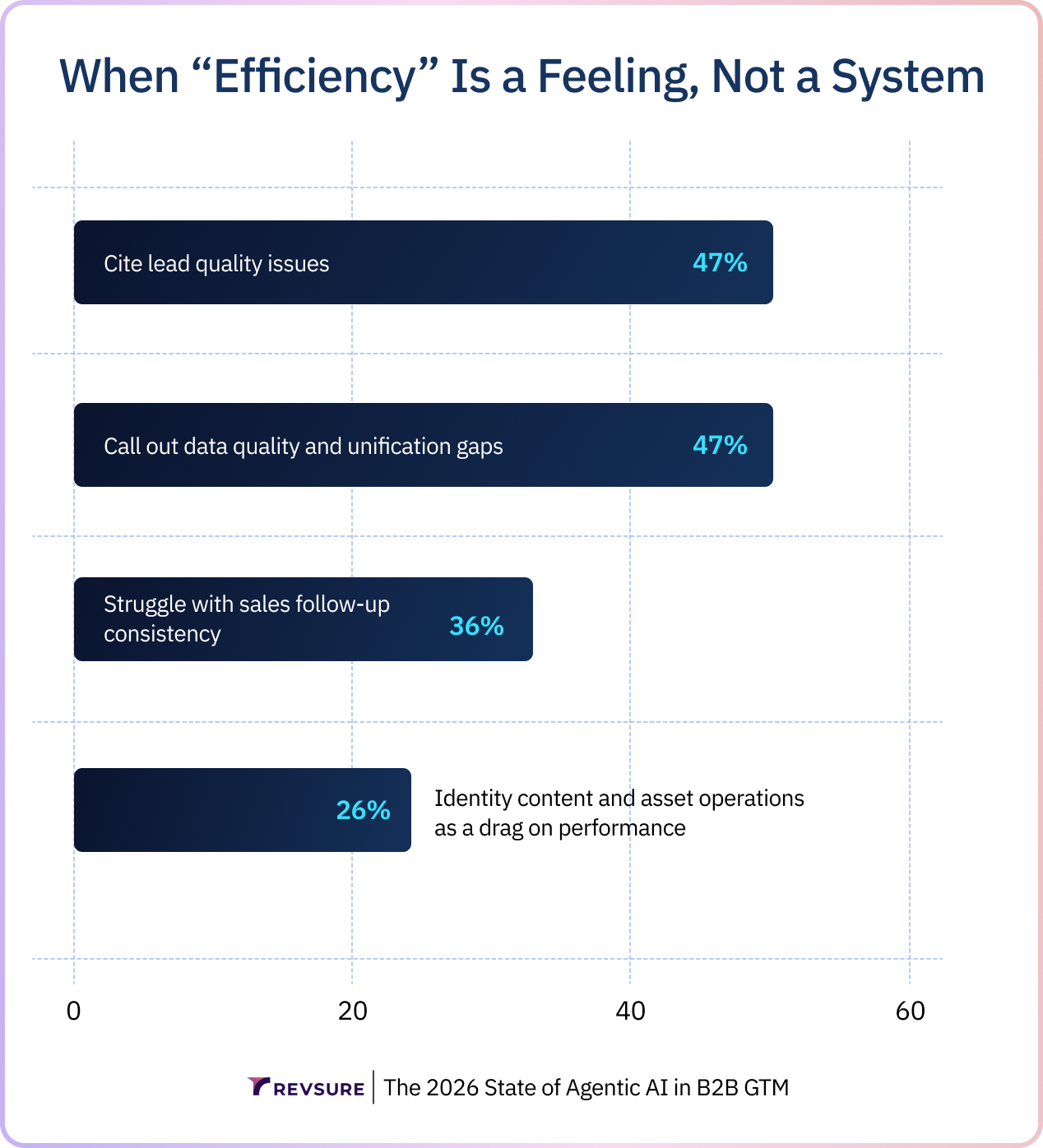
These aren’t just minor inefficiencies. They are deeper, systemic problems.
This suggests that while teams may move quickly in their own areas, the overall GTM system lacks cohesion. Signals get weaker as they move between systems, and context is lost during handoffs. Execution relies on people interpreting things instead of following a clear structure. In short, teams feel efficient because work is happening, not because the system is truly supporting them.
Fragmentation Forces Humans to Become the Glue
Most GTM organizations still use a mix of tools, data pipelines, and manual processes that people have to connect. CRM exports, spreadsheet analysis, fragile ETL pipelines, and ad-hoc reporting are still common, even in advanced settings.
Execution works because humans compensate.
They reconcile mismatched data.
They interpret unreliable signals.
They adjust prioritization based on intuition.
They override automation when it doesn’t reflect reality.
This human adaptability lets GTM teams keep working even when the system isn’t cohesive. It also explains why efficiency feels real. Work gets done, the pipeline moves, and deals close.
But the research shows the downside of this approach. When 47% of organizations say lead quality and data quality are top barriers, it shows that execution relies too much on people making up for system gaps. This method doesn’t scale.
As volume grows, channels increase, and AI starts to act more on its own, the pressure on people to coordinate becomes too much. What once felt like control now becomes a weakness. Efficiency without cohesion just moves work faster through broken systems.
Why Agentic AI Is Exposing the Limits of “Good Enough” Execution
Agentic AI changes the tolerance for fragmentation.
Traditional automation worked in imperfect systems because it handled simple, predefined tasks. Agentic AI is different—it looks at context and outcomes. It expects signals to be reliable, definitions to be clear, and systems to be aligned.
The research shows how strongly leaders understand this potential. 96% believe AI agents with full-funnel context would significantly improve execution, and 90% believe Agentic AI will be critical to achieving GTM goals within two years.
That belief is exactly why adoption is speeding up.
But the same research shows why many deployments are still limited. While 41% of organizations have implemented Agentic AI and another 35% are rolling it out, most admit these agents work in isolated workflows instead of being coordinated across the funnel.
This isn’t a technology problem—it’s an operating model problem. Agentic AI doesn’t just show what’s happening in the funnel; it shows whether the funnel is organized enough to act on.
Local Optimization Isn’t the Same as System Performance
One of the quiet lessons in the research is how easily GTM teams confuse local optimization with system health. Marketing improves engagement rates. Sales improves activity volume. RevOps improves reporting accuracy. Each function optimizes its own domain, often successfully. Yet the same organizations still struggle with inconsistent follow-up, unreliable lead quality, and fragmented execution.
That’s why 77% of leaders worry that Agentic AI could become another silo if it’s not aligned. They’ve seen what happens when teams optimize in isolation. True system performance needs shared context and definitions. Without these, AI agents—like people—will focus on their own areas and may weaken the whole system.
Cohesion is what prevents that outcome.
Governance Is Becoming the Mechanism That Enables Cohesion
The research makes it clear that governance concerns are still present, but they have changed.
Leaders cite security and privacy concerns (54%), accuracy and reliability questions (47%), and data integration challenges (44%) as top barriers to broader Agentic AI adoption. Yet at the same time, 97% say they feel confident they can scale AI responsibly. That confidence shift matters.
This shows that governance isn’t just seen as a brake anymore. It’s now viewed as the framework that lets autonomy grow. The fastest-moving organizations set clear rules for agentic execution, like audit trails, permissions, human review, and RevOps oversight. These steps don’t slow things down—they actually make execution smoother by removing confusion.
In this context, governance turns autonomy from something risky into something reliable.
Integration Is the Missing Middle Between Insight and Action
Another telling signal in the research is the gap between perceived readiness and true confidence. While 95% believe their tech stack can support Agentic AI, only 64% express strong confidence in that belief. That gap is where cohesion breaks down.
Agentic AI needs context that covers CRM, marketing automation, sales engagement, analytics, and customer systems. Without solid integration and unified data, agents can’t see the whole picture. They act on incomplete information, which makes fragmentation worse instead of fixing it.
This is why many teams feel almost ready but hesitate to give more autonomy. The tools are linked, but the logic isn’t unified. Data moves, but the meaning doesn’t. Cohesion is what’s missing between insight and action.
From Efficient Teams to Cohesive GTM Organizations
The Agentic Era is redefining what “high-performance GTM” actually means. The competitive advantage no longer comes from moving fastest in a single function. It comes from moving together with shared context, consistent execution, and governed autonomy.
In cohesive GTM organizations, marketing signals become clear sales priorities. Sales actions support the pipeline strategy instead of changing it. RevOps guides execution instead of just explaining it after the fact. AI systems work confidently because the system is organized. Efficiency is still important, but without cohesion, it just creates noise. Cohesion makes efficiency truly valuable.
The Question GTM Leaders Should Be Asking Now
As Agentic AI adoption accelerates, as outlined in the first blog, the most important question for GTM leaders isn’t where to deploy the next agent. It’s whether their operating model can support autonomous execution without creating drift. Most organizations will move through three stages:
- Unified, governed data foundations
- Embedded AI workflows inside execution loops
- Cross-system orchestration of agentic decisions
Agentic AI doesn’t create cohesion on its own. But it does make it clear when cohesion is missing. This could be the turning point when GTM moves from just fast execution to truly coordinated execution.
—
Agentic AI is moving GTM teams from surface-level efficiency to true system-level performance. The organizations that succeed won’t just adopt AI quickly—they’ll build the cohesion needed to let it work responsibly at scale. To see the full research, including adoption benchmarks, readiness gaps, and governance trends, download The 2026 State of Agentic AI in B2B GTM report.