Revenue Memory: Designing Systems That Learn
On this page
In this issue of RevSure Horizons, we explore why GTM systems capture data but fail to learn from it, leading to repeated mistakes and missed opportunities. We introduce revenue memory: systems that retain context, learn from outcomes, and improve execution over time. While agentic AI enables autonomous action, its real advantage lies in its ability to continuously learn and adapt.
Your GTM system captures everything, yet retains almost nothing of consequence. It logs calls, tracks emails, records meetings, and updates pipeline stages with increasing precision and volume. However, it fails to preserve the underlying context that actually drives outcomes: why a deal progressed, what caused it to stall, which signals were meaningful, and when a buyer transitioned from passive interest to active intent.
Despite unprecedented levels of data availability, most revenue organizations continue to operate without institutional memory. Every interaction is captured, but very little is truly learned. The same objections resurface across deals. The same signals are misread. The same patterns are rediscovered again and again.
Modern GTM systems have been designed to answer a single question: What happened?
But not the one that actually drives performance: What did we learn, and how should that change what happens next?
As a result, learning remains fragmented across individuals rather than embedded within the system. It degrades with time, turnover, and scale, forcing every new deal, account, and motion to start with less accumulated intelligence than it should.
In high-stakes B2B environments, this is not a data problem. It is a memory problem.
Market Perspective | Agentic AI as a Competitive Necessity
In Forrester’s report, “Agentic AI Is The Next Competitive Frontier,” Rowan Curran, Leslie Joseph, Brian Hopkins, and Craig Le Clair describe a fundamental shift in enterprise AI.
Agentic systems move beyond traditional models and automation- capable of planning, making decisions, and executing actions autonomously across complex workflows. Unlike earlier approaches that rely on human prompts or predefined rules, these systems can orchestrate outcomes with minimal intervention.

Forrester positions this not as incremental progress, but as a competitive necessity—where early adopters will redefine how organizations operate and compete.
However, autonomy alone is not enough.
Without the ability to retain context and learn from outcomes, agentic systems remain limited. They can execute tasks, but they cannot improve them.
This is where memory becomes critical.
Because the real advantage of agentic AI is not just in its ability to act—but in its ability to learn from every action and apply that learning to what comes next.
Inside RevSure | Operationalizing Revenue Memory
This is the problem RevSure is built to solve. Instead of treating GTM as a collection of disconnected systems, RevSure introduces a unified layer where signals, interactions, and outcomes are continuously connected, making revenue memory possible.
Within this model, agents do not operate on isolated inputs. They operate on accumulated context. They recognize patterns across past deals, interpret signals in real time, and apply those learnings to guide execution, turning historical data into actionable intelligence.
The shift is fundamental:
From:
“Here is a lead score based on predefined rules”
To:
“This account aligns with patterns from past high-conversion deals. Engage this stakeholder, address this objection early, and prioritize outreach within this window.”

Prioritization is driven by observed outcomes rather than static scoring models. Messaging reflects what has consistently worked in similar contexts. Timing improves because the system understands when signals actually matter.
Over time, the system transitions from a passive tracker of activity to an active participant in execution, continuously learning, adapting, and improving how revenue teams operate. This is what revenue memory looks like in practice.
RevSure Lens | Memory in Action
Revenue memory does not exist in abstraction. It shows up in how decisions are made and how execution improves over time. Prioritization is one of the clearest examples.
In most GTM systems, prioritization is driven by static scoring models. Leads and accounts are assigned scores based on predefined rules or isolated signals, and teams are expected to act accordingly. But these systems do not learn.
They indicate likelihood, but they do not explain it. They assign priority, but they do not refine how that priority is determined over time. RevSure approaches this differently.
By connecting signals across product, marketing, sales, and pipeline into a unified intelligence layer, it enables prioritization that is not only dynamic but continuously informed by outcomes.
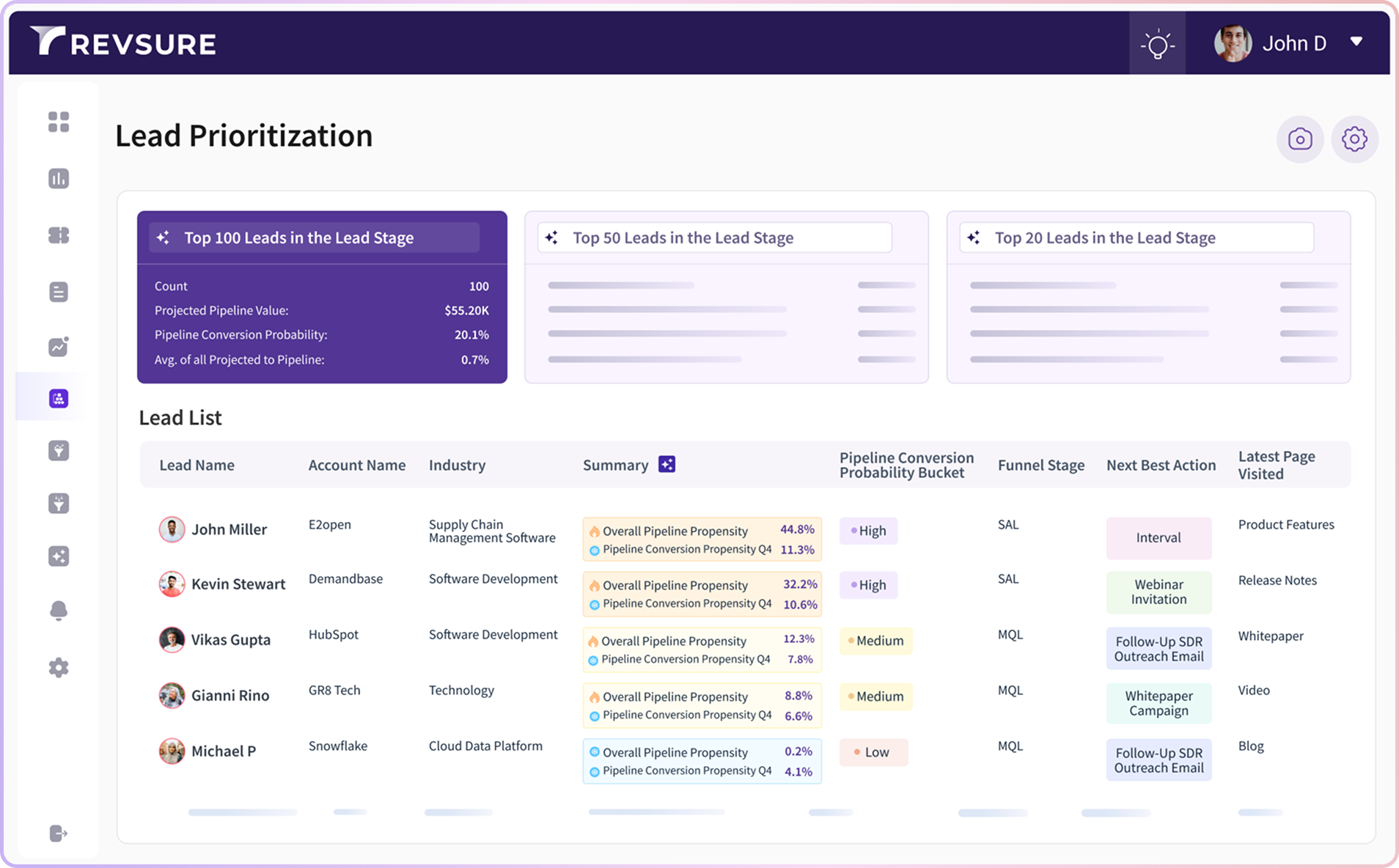
Propensity models evaluate the likelihood to enter the pipeline or convert, while incorporating intent, behavioral, firmographic, and engagement signals across the GTM stack. But the distinction is not in scoring itself. It is in what the system does with it.
As deals progress, stall, or close, the system learns which signals were actually predictive, which patterns were repeated, and which conditions led to successful outcomes. That learning is then applied to refine future prioritization, ensuring that the next set of decisions is more precise than the last.
This is where revenue memory becomes tangible. Prioritization is no longer a static output. It becomes a continuously evolving capability, where every interaction improves how opportunities are identified, ranked, and acted upon.
And the impact is measurable.
Across RevSure customers:
- 56% of conversions come from high-propensity segments
- 70% of the pipeline is generated from high-propensity accounts
- 2–4x improvement in conversion rates is observed from prioritized opportunities

These outcomes reflect a system that is no longer guessing, but learning. Because in modern GTM, the advantage is not just knowing which accounts to prioritize. It is knowing why, and getting better at it over time.
On Demand | Turning Lead Signals into Revenue with AI Prioritization
Not all leads are created equal, and treating them that way is costing the pipeline. In this Funnel Vision webinar, Francisco Garcia and Ram walk through how teams are using AI to focus on the leads and accounts that actually convert, understand why they convert, and act on it faster.

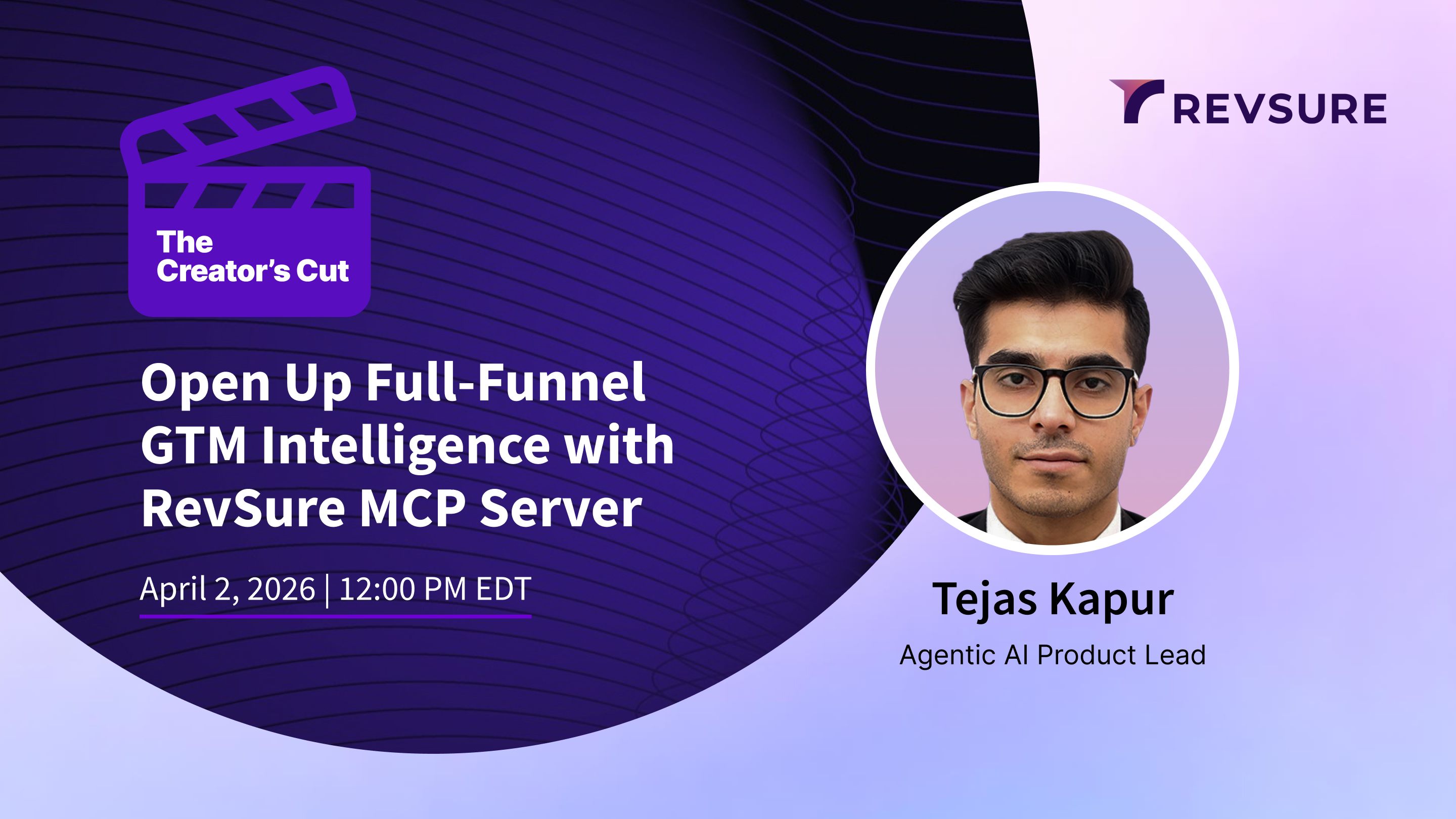
Live Session | Open Up Full-Funnel GTM Intelligence with RevSure MCP Server
AI agents are ready to act, but without control, that creates risk. In this session, the RevSure team breaks down how MCP Server acts as a secure execution layer, ensuring every action is governed, validated, and visible before it happens.
What’s Next
The next phase of GTM will not be defined by better dashboards or more signals. It will be defined by systems that learn. Systems that retain what worked, understand why it worked, and apply those learnings automatically across every new deal, account, and motion. Because once that happens, something fundamental changes.
Teams stop repeating work.
Decisions become more consistent.
Execution becomes more precise. And performance begins to compound.