On this page
In modern B2B go-to-market environments, revenue is no longer the result of a single campaign or a single moment of engagement. It is the culmination of a complex, multi-stage journey involving multiple stakeholders, channels, and interactions that unfold over time. Yet, despite this reality, many organizations continue to rely on attribution models that were designed for a far simpler era.
This disconnect between how buyers actually behave and how companies measure performance is one of the most underestimated growth constraints in B2B today.
At the heart of this issue lies a fundamental question: should revenue teams rely on first-touch attribution, or is multi-touch attribution the better path forward? More importantly, which of these approaches truly enables organizations to drive revenue, rather than simply report on it?
Attribution Is Not a Reporting Problem. It Is a Revenue Problem.
Attribution is often treated as a marketing analytics exercise, something that lives inside dashboards and quarterly reports. However, this perspective significantly underestimates its strategic importance.
Attribution directly influences how organizations allocate budgets, prioritize channels, design campaigns, and align marketing with sales. When attribution is inaccurate or incomplete, it creates a ripple effect across the entire revenue engine. Teams begin to optimize for the wrong outcomes, invest in the wrong channels, and ultimately struggle to translate activity into pipeline and revenue. In this sense, attribution is not just about measuring performance. It is about enabling better decisions. And better decisions are what drive revenue.
First-Touch Attribution: Clarity at the Cost of Reality
First-touch attribution assigns full credit for a conversion to the very first interaction a prospect has with a brand. It provides a clean and straightforward answer to a seemingly important question: what brought this buyer into our ecosystem?
This simplicity has made first-touch attribution widely popular, especially among organizations that are early in their data maturity. It is easy to implement, easy to communicate, and offers immediate visibility into top-of-funnel performance.
However, this simplicity is also its greatest limitation.
In a typical B2B buying journey, the first interaction is rarely the most influential one. Buyers engage with multiple touchpoints before making a decision. They consume content, attend events, interact with sales, evaluate competitors, and build internal consensus. Each of these steps contributes to progression, yet first-touch attribution ignores all of them.
Over time, this creates a distorted view of reality. Awareness channels appear to be the primary drivers of revenue, while the interactions that actually nurture, educate, and convert buyers remain invisible. As a result, organizations often overinvest in top-of-funnel activities while underinvesting in the stages that truly drive pipeline progression.
First-touch attribution may tell you where a journey begins, but it fails to explain how that journey leads to revenue.
Multi-Touch Attribution: A More Accurate Reflection of Buyer Behavior
Multi-touch attribution was developed to address the limitations of single-touch models by distributing credit across multiple interactions throughout the buyer journey. Instead of focusing on a single moment, it captures the cumulative influence of various touchpoints that contribute to conversion.
This approach aligns far more closely with how B2B buying actually happens. Buyers do not make decisions based on a single interaction. They move through a sequence of engagements that collectively shape their perception, intent, and readiness to buy.
However, simply adopting a multi-touch model is not enough. The effectiveness of multi-touch attribution depends heavily on how well it captures the complexity of real-world journeys and how deeply it connects insights to revenue outcomes.
Many traditional implementations still rely on static rules or incomplete datasets, limiting their ability to provide actionable insights. This is where a more advanced, system-level approach becomes critical.
RevSure’s Perspective: Attribution as a Full-Funnel System
RevSure approaches multi-touch attribution not as a standalone analytical model, but as a core component of a broader revenue intelligence system designed for complex B2B environments.
At the foundation of this approach is the concept of stage-aware attribution. Rather than treating the buyer journey as a single continuous flow, RevSure breaks it down into distinct funnel stages and assigns credit based on how touchpoints contribute to movement across those stages. This enables teams to understand not just what drives initial engagement, but what drives progression from lead to MQL, from MQL to opportunity, and ultimately to closed revenue.
This stage-level visibility is critical because different interactions play different roles at different points in the journey. What drives awareness is not the same as what drives conversion. By isolating these dynamics, RevSure allows organizations to optimize each stage independently while maintaining a unified view of the entire funnel.
RevSure’s differentiation lies in its ability to combine data integration, modeling flexibility, and AI-driven intelligence into a single, unified system that reflects how revenue is actually generated.
- It unifies engagement data across leads, accounts, and opportunities, creating a comprehensive and time-ordered view of buyer journeys that includes both online and offline interactions
- It applies attribution independently across funnel stages, enabling granular insight into what drives progression at each step rather than just final conversion
- It supports multiple attribution models, including rule-based, custom-configured, and AI-driven approaches, allowing teams to analyze performance from different perspectives
- It aligns attribution outputs directly with spend, pipeline, and revenue metrics, ensuring that insights are actionable and tied to business outcomes
- It provides deep traceability across touchpoints, campaigns, and journeys, enabling teams to drill down from high-level trends to specific interactions
These capabilities transform attribution from a static reporting mechanism into a dynamic system for understanding and optimizing revenue generation.
AI-Based Attribution: From Assumptions to Evidence
One of the most significant advancements in RevSure’s platform is its use of AI-based attribution models that go beyond traditional rule-based approaches.
Instead of assigning credit based on predefined weights, RevSure leverages probabilistic models such as Markov Chains and Hidden Markov Models to analyze actual buyer journeys. These models evaluate how different touchpoints influence the likelihood of conversion by examining the sequences of interactions that lead to successful outcomes.
This methodology allows the system to calculate the true contribution of each touchpoint by measuring how conversion probability changes when that touchpoint is removed from the journey. It also incorporates contextual factors such as industry, company size, persona, and campaign characteristics, resulting in a far more nuanced and accurate understanding of influence.
By moving from rule-based assumptions to data-driven insights, AI-based attribution provides a clearer picture of what actually drives revenue.
The Strategic Impact: How Attribution Models Shape Growth
The choice between first-touch and multi-touch attribution is not merely a technical decision. It has direct implications for how organizations grow.
When companies rely on first-touch attribution, they tend to optimize for lead generation. Channels that drive initial engagement receive disproportionate investment, while activities that nurture and convert leads are undervalued. This often leads to a growing pipeline that fails to translate into proportional revenue growth.
In contrast, organizations that adopt advanced multi-touch attribution models gain a more balanced and accurate view of performance. They can identify which touchpoints drive progression at each stage, allocate resources more effectively, and design campaigns that support the entire buyer journey.
Over time, this leads to better alignment between marketing and sales, improved conversion rates, and more predictable revenue outcomes.
Beyond Attribution: From Insight to Action
One of the key limitations of traditional attribution systems is that they stop at insight. They tell you what happened, but they do not help you act on it.
RevSure addresses this gap by integrating attribution with a broader set of capabilities that enable real-time optimization and decision-making. By connecting attribution with pipeline analytics, campaign performance, and predictive modeling, the platform allows teams to translate insights into action.
- Revenue teams can reallocate budgets dynamically based on actual performance and ROI signals
- Marketing teams can identify high-impact campaigns and refine their strategies to maximize pipeline contribution
- Sales teams can prioritize accounts and opportunities based on propensity models and next-best actions
- Leadership teams can forecast revenue with greater confidence using unified, full-funnel data
This integration transforms attribution from a passive measurement tool into an active driver of growth.
This shift toward actionability reflects a broader transformation in how attribution is evolving. As RevSure’s research highlights, 74% of marketers still struggle to accurately attribute revenue, and 65% report misalignment between marketing and sales due to inconsistent attribution data. The root problem is that traditional attribution models, whether single-touch or multi-touch, are still designed to measure the past rather than guide future decisions.
The future of B2B attribution lies in moving beyond credit assignment toward understanding what actually drives pipeline and revenue. This means expanding attribution across the full GTM funnel, combining AI-driven multi-touch attribution with marketing mix modeling and incrementality testing, and shifting from backward-looking reports to real-time, prescriptive insights.
In this model, attribution is no longer just a measurement layer; it becomes a system that tells you what to double down on, where to invest next, and how to accelerate conversions across the funnel.
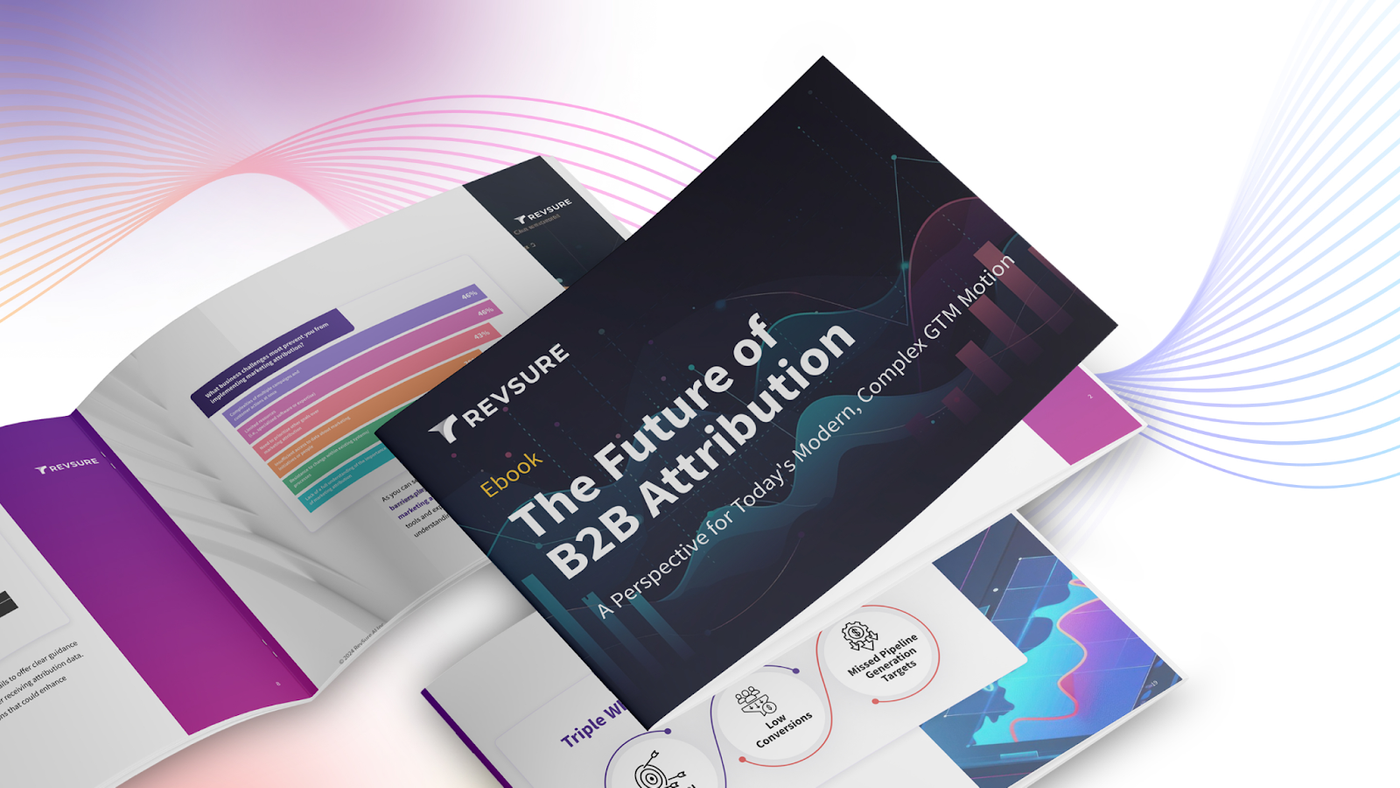
For a deeper breakdown of this shift and how leading B2B teams are operationalizing it, explore RevSure’s ebook, The Future of B2B Attribution, which outlines the frameworks, models, and practical steps to move from measurement to action.
The Final Answer: Which One Actually Drives Revenue?
First-touch attribution offers simplicity and clarity, but it does so by ignoring the complexity of modern buyer behavior. As a result, it often leads organizations to optimize for the wrong metrics and make suboptimal decisions.
Multi-touch attribution, when implemented effectively, provides a far more accurate and actionable view of how revenue is generated. It captures the interplay of multiple touchpoints, aligns insights with real outcomes, and enables better decision-making across the organization.
However, the real breakthrough lies in moving beyond basic multi-touch models toward a more advanced, stage-aware, and AI-driven approach that connects attribution directly to pipeline and revenue.
This is where RevSure’s model stands apart.
Because in today’s B2B landscape, revenue is not driven by a single touchpoint or even a set of touchpoints. It is driven by a coordinated system of interactions that span the entire funnel.
Understanding that system is what drives growth.
Closing Perspective
If your attribution model only tells you how a journey begins, you are optimizing for visibility, not revenue. If it helps you understand how deals progress, what influences them, and where to invest next, you are building a system that can scale growth predictably. That is the difference between attribution as reporting and attribution as strategy. And in a world where every decision impacts revenue, that difference is everything.