On this page
Quarterly forecasting is rarely a straight line. Revenue doesn’t arrive evenly across three months; it concentrates, shifts, and often depends on a handful of late-stage deals closing at the right time.
That’s why quarter-level projections alone aren’t enough. Teams need to understand not just what is projected, but when bookings are expected to land inside the quarter. Without that month-level clarity, pacing can look healthy on paper while risk builds underneath the surface.
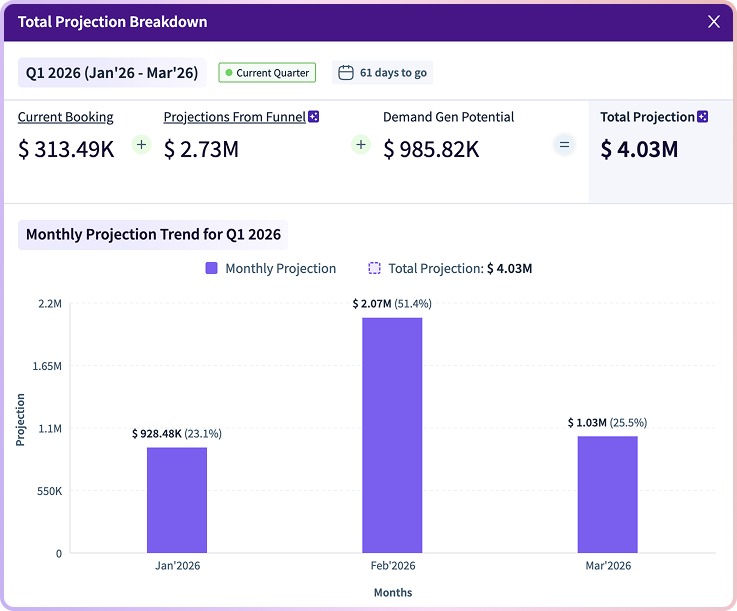
RevSure’s Monthly Projections view in Booking Readiness solves this by breaking projected bookings into month-level contributions across the quarter. Revenue teams can evaluate pacing by month, identify concentration risk early, and focus attention on periods that may require intervention.
The Challenge with Quarter-Only Forecasting
Most forecasting workflows center around a single quarterly number: total projected bookings. While useful, that top-line view often hides critical timing dynamics. A quarter can appear “on track” overall, even if most projected bookings are concentrated in the final month. That creates execution risk, because any slip in deal timing can quickly turn into a missed quarter.
Revenue leaders frequently face questions like:
- Are bookings pacing evenly across the quarter, or are we back-loaded?
- Which month carries the most risk?
- Where should sales and leadership focus attention right now?
Without month-level projection visibility, teams are left guessing. Monthly Projections brings structure and clarity to these questions.
What Monthly Projections Adds in Booking Readiness
The Monthly Projections view breaks projected bookings into contributions by month across the quarter. Instead of seeing only a single quarterly projection, teams can understand how that projection is distributed over Month 1, Month 2, and Month 3.
This view helps revenue teams move from broad forecasting to actionable pacing insights. Leaders can quickly assess whether bookings are tracking steadily or whether success depends heavily on one specific month. Monthly Projections is especially valuable for identifying concentration risk, when too much of the quarter’s projected bookings are weighted toward a narrow window of time.
For example, if the majority of projected bookings sit in the last month, teams can proactively address the risk instead of discovering it too late.
Why Month-Level Visibility Drives Better Execution
Quarterly outcomes are shaped by monthly execution. When teams can see projections broken down by month, they gain the ability to intervene earlier and manage pacing more effectively. Monthly Projections help teams:
- Evaluate whether bookings are evenly paced or heavily back-loaded
- Spot months where the projected contribution is unusually high or low
- Identify timing risk before it becomes a quarter-end scramble
Instead of waiting until Month 3 pressure peaks, leaders can take action in Month 1 or Month 2 to rebalance pipeline coverage and improve close confidence. This month-level lens makes forecasting more operational, not just analytical.
Focus Attention Where It’s Needed Most
One of the biggest benefits of Monthly Projections is that it helps teams focus attention on the periods that matter most. If Month 2 looks light, teams can accelerate pipeline creation or pull deals forward. If Month 3 is overloaded, leaders can pressure-test assumptions, validate deal health, and reduce dependence on last-minute closes.
By surfacing where bookings are expected to land, Monthly Projections creates a clearer roadmap for execution across the quarter. This enables more productive conversations across sales leadership, finance, and RevOps, grounded not just in totals, but in timing.
Forecasting That Reflects Reality
Quarterly forecasting isn’t only about predicting outcomes; it’s about managing them. And managing outcomes requires visibility into when revenue is expected to arrive, not just how much. With Monthly Projections in Booking Readiness, RevSure gives revenue teams a clearer way to evaluate pacing by month, identify concentration risk early, and focus on the periods that may require intervention.
It’s a more actionable, execution-ready approach to forecasting, helping teams stay ahead of risk and drive more predictable quarter performance.