Template

Marketing Performance Dashboard

The Marketing Performance Dashboard Template provides a unified, full-funnel view of how marketing drives pipeline, bookings, and revenue. It connects funnel progression, attribution, channel performance, and ROI into a single workspace. Built for B2B teams, it helps optimize campaigns, align cross-functional teams, and make revenue-driven decisions with confidence.

Table of Contents

Want to see RevSure in action

Schedule a 30-minute demo
Book a Demo

A unified, full-funnel view of how marketing drives pipeline, bookings, and revenue

Marketing teams today operate across multiple channels, campaigns, and touchpoints, but understanding how these efforts translate into pipeline and revenue remains a challenge. Most reporting systems still focus on isolated metrics such as leads or channel performance, making it difficult to connect early engagement to downstream outcomes like pipeline creation and bookings. This lack of visibility often leads to inefficient spend, missed opportunities, and misalignment across teams.

RevSure’s Marketing Performance Dashboard Template solves this by providing a unified, full-funnel view of marketing performance. It brings together TOFU to BOFU progression, pipeline creation, bookings, ROI, and channel effectiveness into a single workspace, enabling teams to understand exactly how marketing drives revenue.

Built for B2B Marketing, Revenue, and Leadership Teams

This template is designed for B2B organizations that need both strategic visibility and operational control over marketing performance. Marketing managers and specialists use it to track funnel efficiency, campaign impact, and channel health across paid, organic, outbound, and lifecycle motions.

Cross-functional teams, including sales, finance, and customer success, rely on it to align on pipeline contribution, forecasting inputs, and revenue influence. Executive leaders use the dashboard to monitor performance at a high level, ensuring that marketing investments are translating into measurable business outcomes.

By consolidating performance across channels and funnel stages, the dashboard creates a shared understanding of marketing’s contribution to growth.

Full-Funnel Visibility from Engagement to Revenue

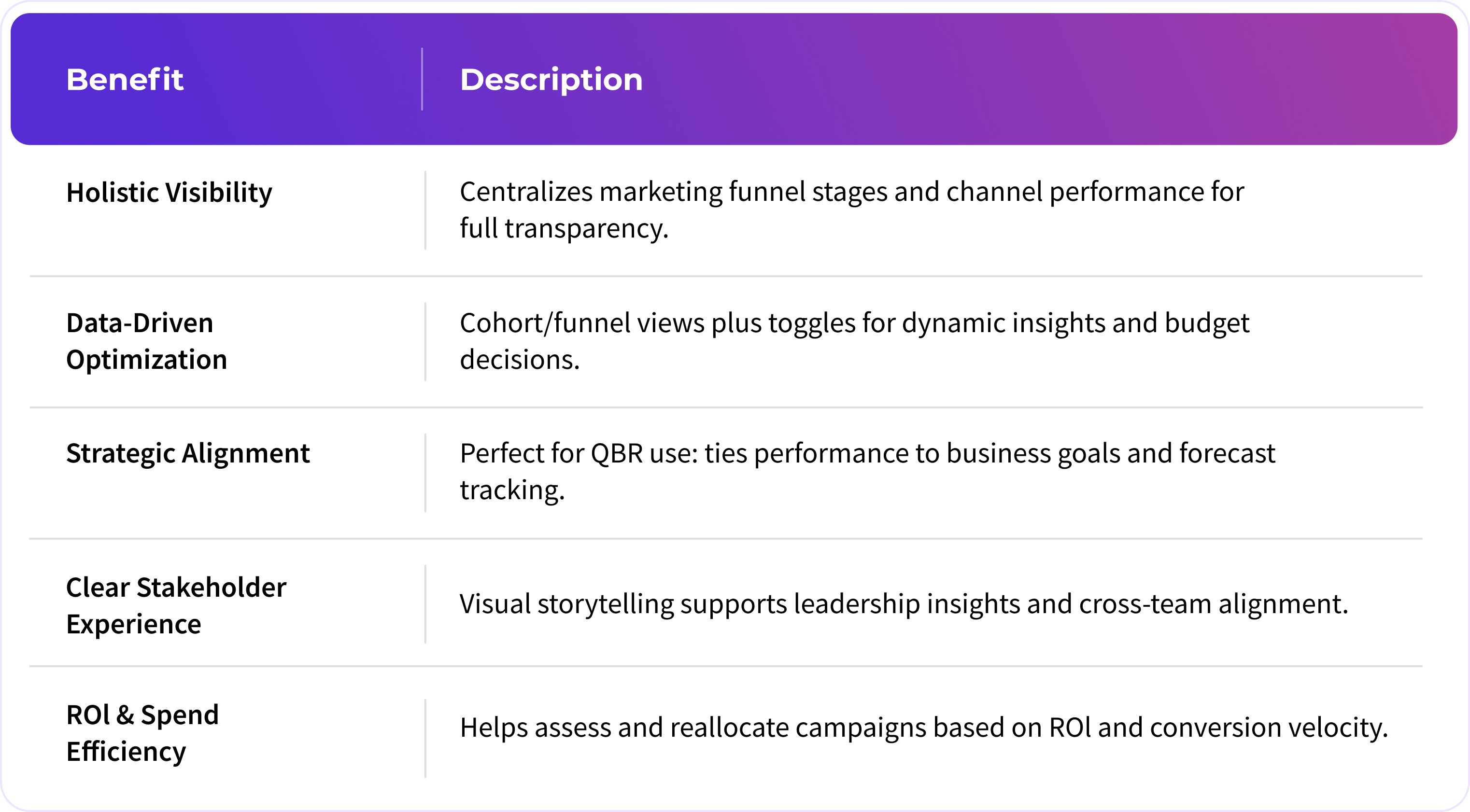
At the core of the dashboard is a complete view of funnel progression, tracking how marketing activities move prospects from early engagement through to pipeline and closed revenue. Teams can clearly see how volume and value evolve across stages, making it easier to identify where performance is strong and where improvement is needed.

This visibility helps answer critical questions such as how much pipeline marketing is generating, how efficiently leads convert across stages, and whether current funnel performance supports revenue targets. By connecting top-of-funnel activity to bottom-of-funnel outcomes, the dashboard ensures that marketing impact is measured in revenue terms rather than isolated metrics.

Channel and Campaign Performance Insights

The dashboard also provides a comprehensive view of how different channels and campaigns contribute to pipeline and revenue. By comparing performance across paid, organic, outbound, partner, and lifecycle channels, teams can understand which efforts deliver the highest return and which require optimization.

Campaign-level insights highlight how individual initiatives perform in terms of pipeline contribution, conversion efficiency, and ROI. This allows teams to make informed decisions about where to scale investment, where to refine strategy, and where to reduce spend.

Instead of relying on fragmented channel reports, teams gain a unified understanding of performance across the entire marketing ecosystem.

Cohort-Based Insights and Performance Segmentation

To support deeper analysis, the dashboard includes cohort-based views that segment performance by channel, campaign, audience, or account tier. These insights help teams identify high-performing segments as well as areas of underperformance.

By analyzing how different cohorts progress through the funnel, teams can uncover patterns in conversion, engagement, and revenue contribution. This enables more precise targeting, better campaign design, and improved allocation of resources.

Cohort analysis adds an additional layer of clarity, ensuring that performance insights are not only broad but also actionable at a granular level.

Flexible Views for Strategic and Operational Decisions

The dashboard supports flexible analysis through dynamic views that allow teams to shift between volume and value perspectives. Depending on the use case, teams can evaluate performance based on lead counts and opportunity volume or focus on pipeline value and revenue contribution.

This flexibility ensures that both executives and practitioners can use the same dashboard to answer different types of questions, from high-level performance reviews to detailed campaign optimization.

By providing both strategic and operational visibility in one place, the dashboard reduces the need for multiple reporting tools and improves decision-making speed.

From Marketing Activity to Revenue Accountability

The Marketing Performance Dashboard Template transforms marketing reporting from activity tracking into revenue accountability. By combining funnel progression, attribution, channel performance, cohort insights, and ROI into a single view, it enables teams to clearly understand how marketing drives business outcomes.

Marketing teams gain clarity on what works and what needs improvement. Revenue teams gain alignment on pipeline contribution and forecasting inputs. Leadership gains confidence that marketing investments are delivering measurable impact.

Next step: If you’re using RevSure, launch the Marketing Performance Dashboard Template to connect marketing activity directly to pipeline, bookings, and revenue. If not, book a demo to see how RevSure turns full-funnel marketing data into actionable revenue insights.

Frequently Asked Questions

What is a marketing performance dashboard?
A marketing performance dashboard provides a unified view of how marketing activities across channels and campaigns contribute to pipeline, bookings, and revenue.

How do you measure marketing performance across the funnel?
Marketing performance is measured by tracking progression from early engagement to pipeline creation and closed revenue, along with conversion rates and ROI at each stage.

Why is it difficult to connect marketing to revenue?
Most systems track isolated metrics like leads or channel activity, making it hard to link top-of-funnel efforts to downstream outcomes like pipeline and bookings.

What insights does this dashboard provide?
It surfaces full-funnel performance, channel and campaign contribution, ROI, cohort-based insights, and conversion efficiency across stages.

How does this dashboard track full-funnel performance?
It connects engagement, lead progression, pipeline creation, and revenue outcomes into a single view, showing how volume and value move through the funnel.

Who should use a marketing performance dashboard?
Marketing teams, revenue operations, sales leaders, finance teams, and executives use it to align on pipeline contribution and revenue impact.

What is cohort-based analysis in marketing?
Cohort analysis segments performance by channel, campaign, audience, or account group to identify patterns in conversion, engagement, and revenue contribution.

Can this dashboard compare channel and campaign performance?
Yes. It evaluates performance across paid, organic, outbound, partner, and lifecycle channels, highlighting which efforts drive the highest ROI.

How is this different from traditional marketing reports?
Traditional reports focus on isolated metrics, while this dashboard provides a unified, full-funnel view connecting marketing activity directly to revenue outcomes.

What metrics matter most for marketing performance?
Key metrics include pipeline generated, conversion rates across funnel stages, campaign ROI, channel contribution, bookings, and overall revenue impact.