Why CMOs & CROs Must Co-Design Decisions Now
On this page
As GTM decisions increasingly move into systems, alignment between marketing and revenue can no longer depend on handoffs, dashboards, or post-hoc coordination. Agentic AI is shifting decision-making from episodic, human-led processes to continuous, system-driven execution, fundamentally redefining how CMOs and CROs lead.
This issue examines why traditional alignment models break at scale, how autonomy amplifies existing incentives and risk, and why GTM leaders must move upstream to co-design shared decision logic.
From Functional Alignment to Shared Decision Systems
For years, CMO–CRO alignment has been treated as an operational problem, solved through handoffs, SLAs, shared dashboards, and recurring syncs. That model worked when decisions were slow, linear, and human-driven.
Agentic AI breaks this approach.
As systems begin to reallocate spend mid-quarter, reprioritize accounts daily, and trigger downstream execution automatically, alignment can no longer sit outside the system. Decisions now happen continuously, across functions, and at a speed manual coordination cannot support. In this environment, alignment shifts from process to architecture.
The role of GTM leadership is no longer to coordinate execution after the fact, but to jointly define the decision logic that governs how execution happens in the first place, shared economic objectives, common guardrails, and unified accountability for outcomes.
Gartner Insight | AI Is Redefining the CMO Role
Gartner research underscores why traditional alignment models are breaking down. In a recent survey, 65% of CMOs say advances in AI will dramatically change their role within the next two years, as decision-making increasingly moves into systems rather than people.
As AI expands marketing’s remit, from insight generation to automated execution, CMOs are being pushed upstream. Their role is shifting away from managing activity and toward designing the objectives, guardrails, and accountability frameworks that govern how decisions are made at scale. Gartner notes that organizations seeing the most impact are not those using AI as a tool, but those redesigning how decisions work across functions.
Capgemini Insight | When Autonomy Outpaces Alignment
While GTM leaders recognize that AI is reshaping their roles, most organizations are not redesigning how decisions are made across marketing and revenue. Capgemini research highlights a growing execution gap: autonomous capabilities are being introduced faster than shared decision frameworks are established.
Without common economic objectives and coordinated guardrails, agentic systems optimize locally. Marketing may improve efficiency while sales absorb volatility. Pipeline velocity may increase while predictability erodes. The risk isn’t AI making the wrong decisions; it’s systems making the right decisions against the wrong incentives.
For CMOs and CROs, this is the inflection point. Agentic AI amplifies whatever alignment already exists. Where decision logic is shared, autonomy scales impact. Where it isn’t, autonomy scales risk.
What GTM Leaders Should Do Next
As agentic execution becomes real, the question is no longer whether AI will shape GTM decisions, but who designs how those decisions are made. CMOs and CROs should start by aligning on three fundamentals:
1. Make the decision ownership explicit: Identify where decisions are already happening automatically, such as budget shifts, account prioritization, lead routing, pipeline risk flags, and determine which of those decisions should be governed jointly rather than functionally.
2. Define shared economic objectives, not functional KPIs: Efficiency, volume, and velocity metrics optimized in isolation create risk in autonomous systems. Marketing and revenue leaders must agree on the economic outcomes that matter most, predictability, revenue quality, and downside protection, and ensure systems are optimizing toward them.
3. Embed alignment into decision logic, not meetings: As execution accelerates, alignment can’t rely on reviews, dashboards, or syncs. Guardrails, tradeoffs, and escalation paths must be designed directly into the systems making decisions at scale.
Agentic AI doesn’t remove accountability from GTM leadership; it concentrates it upstream. The leaders who succeed will be those who treat alignment as a system design problem, not a coordination exercise.
Product Focus | RevSure as the Control Layer for Agentic GTM
Agentic AI accelerates execution, but without a shared control layer, speed amplifies misalignment.
As GTM decisions move into systems, organizations need infrastructure that doesn’t just generate insight or trigger actions, but governs how decisions are made across marketing and revenue. RevSure serves as that control layer, sitting above execution systems to align autonomous decision-making with shared economic objectives.
RevSure enables agentic GTM through a unified decision framework that includes:

- Shared economic modeling across marketing and revenue: RevSure models demand, pipeline, and revenue as a single economic system, aligning marketing investment, sales capacity, and revenue risk within one framework.
- System-level decision logic and guardrails: Instead of hardcoding rules in individual tools, RevSure centralizes decision logic- defining objectives, constraints, tradeoffs, and escalation thresholds that govern how autonomous decisions are made across the funnel.
- Real-time prioritization and reallocation: As performance signals shift, RevSure continuously updates recommendations for spend allocation, account prioritization, and pipeline risk posture, ensuring decisions adapt in real time.
- Closed-loop execution across GTM systems: RevSure connects decisioning directly to downstream systems, CRM, marketing automation, and activation workflows, closing the loop between intelligence and execution.
- Cross-functional visibility and accountability: CMOs and CROs share a single view into how decisions are being made, why tradeoffs occur, and where risk is emerging, creating transparency as execution becomes increasingly autonomous.
From the RevSure Blog | What CMOs Really Lose Sleep Over
A strong pipeline doesn’t guarantee strong revenue. Our latest blog explores why pipeline volume and coverage ratios often create false confidence for CMOs, and why leaders get blindsided even when dashboards look healthy. The real issue isn’t how much pipeline marketing generates, but whether that pipeline is likely to convert when the business needs it to.
The piece reframes GTM performance around predictability rather than volume, arguing for full-funnel visibility that surfaces revenue risk early enough to act. In modern GTM, confidence comes from early warning and transparency, not bigger numbers at the top of the funnel.
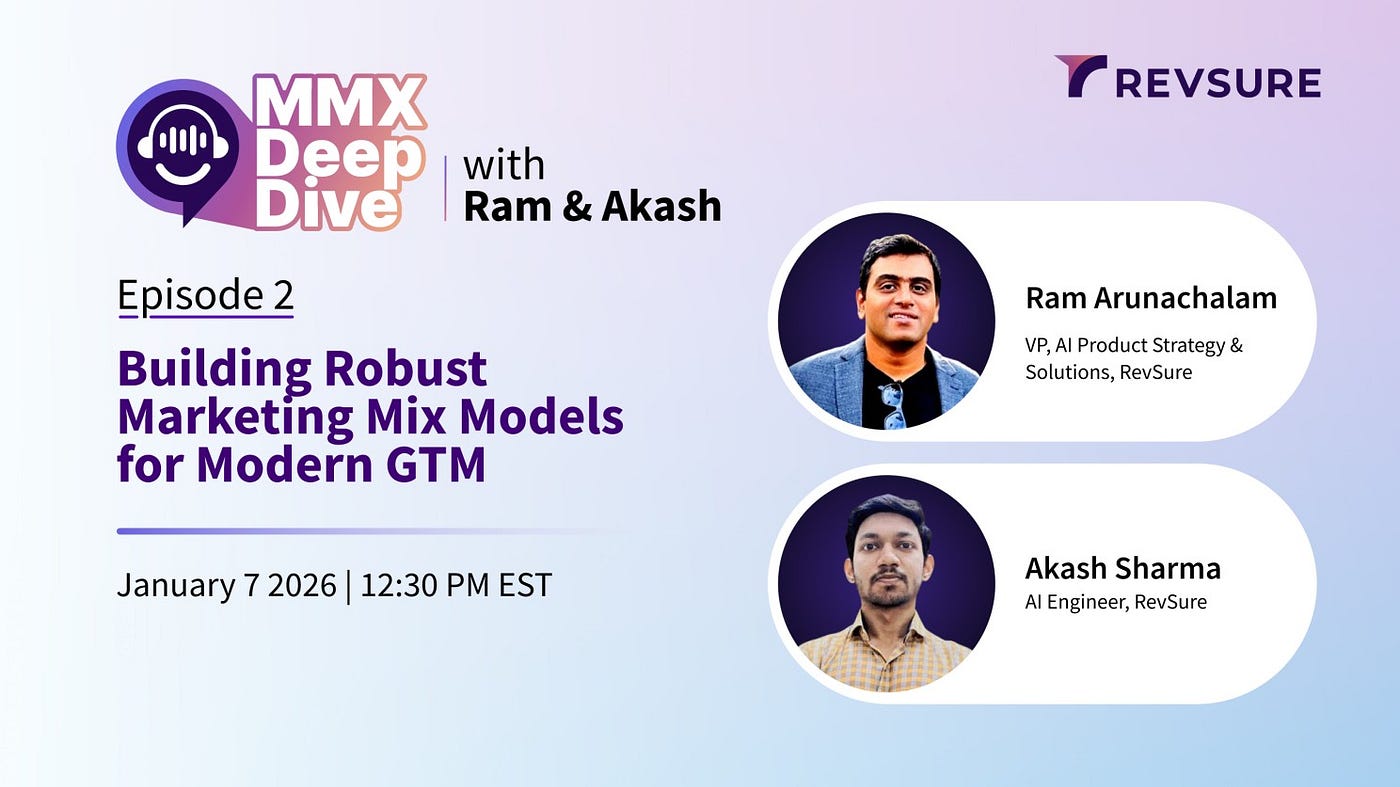
Watch On Demand | Building Robust Marketing Mix Models (MMX) for Autonomous GTM
As GTM systems move toward autonomous execution, understanding where incremental spend drives outcomes becomes critical. This on-demand MMX Deep Dive with Ram Arunachalam and Akash Sharma, walks through how modern marketing mix models are built for today’s GTM complexity, connecting signal engineering, response curves, calibration, and validation to predictive projections and continuous decision loops across spend allocation, pipeline forecasting, and execution.
Designed for teams preparing to unify MMX, predictive intelligence, and autonomous GTM systems into a single operating model, this session shows how shared economic logic powers more confident, system-driven decisions.
Upcoming Event | RevSure Product Updates: December Release
Join us for a live walkthrough of RevSure’s December product updates with Nishant Saikia and Aditya Munshi, focused on advancing real-time decisioning and agentic execution across the GTM funnel. This session highlights how recent enhancements strengthen prioritization, activation, and predictability across marketing and revenue.

What’s included in the December release:
- Real-time lead scoring powered by agentic decision logic
- CRM writebacks that close the loop between insight and execution
- Deeper funnel insights to surface risk, momentum, and opportunity earlier
- Enhancements that improve coordination across marketing and revenue workflows
This session is designed for GTM leaders and operators who want to understand how these capabilities work in practice and how they support more autonomous, aligned execution.
–
Agentic AI isn’t changing what GTM leaders are accountable for; it’s changing how that accountability is designed and enforced.
As execution becomes continuous and system-driven, alignment can no longer live in meetings, handoffs, or dashboards. It has to live in the decision logic itself. CMOs and CROs who succeed in this environment will be those who treat marketing and revenue as a single economic system, and co-design how decisions are governed, executed, and evaluated at scale.
In the next phase of GTM, autonomy isn’t the risk. Misalignment is.