The Agent Apocalypse Is Already Here: How AI Is Reshaping Revenue Teams
On this page
AI agents are multiplying across the GTM funnel, but the real challenge isn’t deploying them; it’s governing and coordinating them at enterprise scale. In this issue of Horizons by RevSure, we break down why the “Agent Apocalypse” is already here, what Forrester and McKinsey are signaling about the future of agentic systems, and how RevSure is building context-aware agentic AI to drive aligned, full-funnel execution.
The New GTM Reality: Too Many Agents, Not Enough Control
Deepinder Singh Dhingra said it best this week: The Agent Apocalypse isn’t coming. It’s already here. (Read the full LinkedIn post)

GTM used to be relatively straightforward: a manageable set of channels, a controlled tech stack, and clear ownership across marketing and sales. Today, that operating model is being replaced in real-time.
AI agents are proliferating across the funnel- executing outreach, generating content, triggering workflows, prioritizing accounts, and taking actions at machine speed. The challenge isn’t adoption. It’s governance.
Most teams are racing to deploy more agents. Very few are asking the question that actually matters:
What happens when dozens (or hundreds) of agents make decisions independently, with incomplete context and no orchestration layer?
Because at enterprise scale, that quickly turns into:
- Inconsistent buyer experiences
- Misfired outreach + false intent signals
- Duplicated actions across teams
- Data drift + attribution confusion
- Operational risk across pipeline + revenue systems
Coordination becomes the differentiator. The next decade won’t be won by the teams with the most agents, but by the teams that can keep them aligned, accountable, and operating as one system.
Forrester: The “Agent Control Plane” Is Becoming a Category
As AI agents multiply across prospecting, enrichment, sequencing, routing, and revenue ops, the biggest challenge won’t be deploying more agents. It’ll ensure they operate with governance, alignment, and oversight, especially at enterprise scale. That’s exactly what Leslie Joseph (Principal Analyst, Forrester) is pointing to in Forrester’s framing of the emerging Agent Control Plane: a category forming around the need to manage, coordinate, and govern an expanding “agent estate.”
Why it matters for GTM: the teams that win won’t be the ones who add the most agents; they’ll be the ones who can control and orchestrate them as one revenue system.
McKinsey: Agentic AI Is a New Operating Model Shift (Not Just a Tool Upgrade)
If Forrester’s “Agent Control Plane” framing highlights what’s missing in today’s agent-heavy enterprise stack, McKinsey & Company zooms out and explains why this shift is bigger than tooling.
In “The agentic organization: Contours of the next paradigm for the AI era,” McKinsey describes a future where humans and AI agents work side by side at scale, reshaping how organizations structure work, decision-making, and execution.
For enterprise GTM teams, the takeaway is simple: Agentic AI isn’t just accelerating execution; it’s forcing a new GTM operating system where coordination and shared context become the real moat.
This article, written by Alexander Sukharevsky, Alexis Krivkovich, Arne Gast, Arsen Storozhev, Dana Maor, Deepak Mahadevan, Lari Hamalainen, and Sandra Durth, is a must-read.
RevSure: Building Context-Aware Agents for Full-Funnel Execution
At this point, the question isn’t whether AI agents will be part of GTM; it’s how you ensure their actions are grounded in the right context and aligned to revenue outcomes.
RevSure’s approach is context-aware agentic AI, powered by our AI Reasoning Engine built for full-funnel B2B GTM. It translates real GTM activity into coordinated next steps by combining two things: the events happening across your go-to-market motion and the context required to interpret them correctly at enterprise scale.

RevSure ingests 1B+ sales and marketing interactions (online and offline engagement, product usage, calls, meetings, transcripts, and ad interactions across Google, Meta, LinkedIn, and X) and connects them to full-funnel context across 10M+ visitors through opportunities, including unified contact/account/opportunity data, ICP segmentation, persona and buying-group intelligence, and campaign/channel/region/product dimensions.
What this enables:
- Agentic actions that are based on full-funnel context (not isolated triggers)
- More accurate execution with fewer false positives and duplicated actions
- Cleaner coordination across marketing and sales with shared visibility into what’s working
- Revenue-linked decisioning tied to pipeline reality, not surface-level activity
From the RevSure Blog | Why Context, Not Raw Data, Powers Future Revenue Platforms
Modern GTM systems generate endless data, but data alone doesn’t create understanding. In this blog, we break down why the next generation of revenue platforms will be built on context, connecting accounts, signals, actions, and outcomes into a unified graph that can reason about cause and effect. By preserving relationships over time (instead of reacting to isolated events), context graphs help agentic systems prioritize accurately, act with confidence, and scale execution without amplifying noise.
Watch On Demand | RevSure December Product Updates
If you missed the live session, RevSure’s December product updates are now available to watch on demand. This walkthrough covers the latest enhancements designed to support real-time decisioning and more agentic execution across the GTM funnel while maintaining visibility and control.
This session walks through new capabilities across the platform, including real-time lead scoring driven by agentic decision logic, CRM writebacks that connect insight directly to execution, deeper funnel insights to surface risk and momentum earlier, and enhancements that improve coordination between marketing and revenue teams.

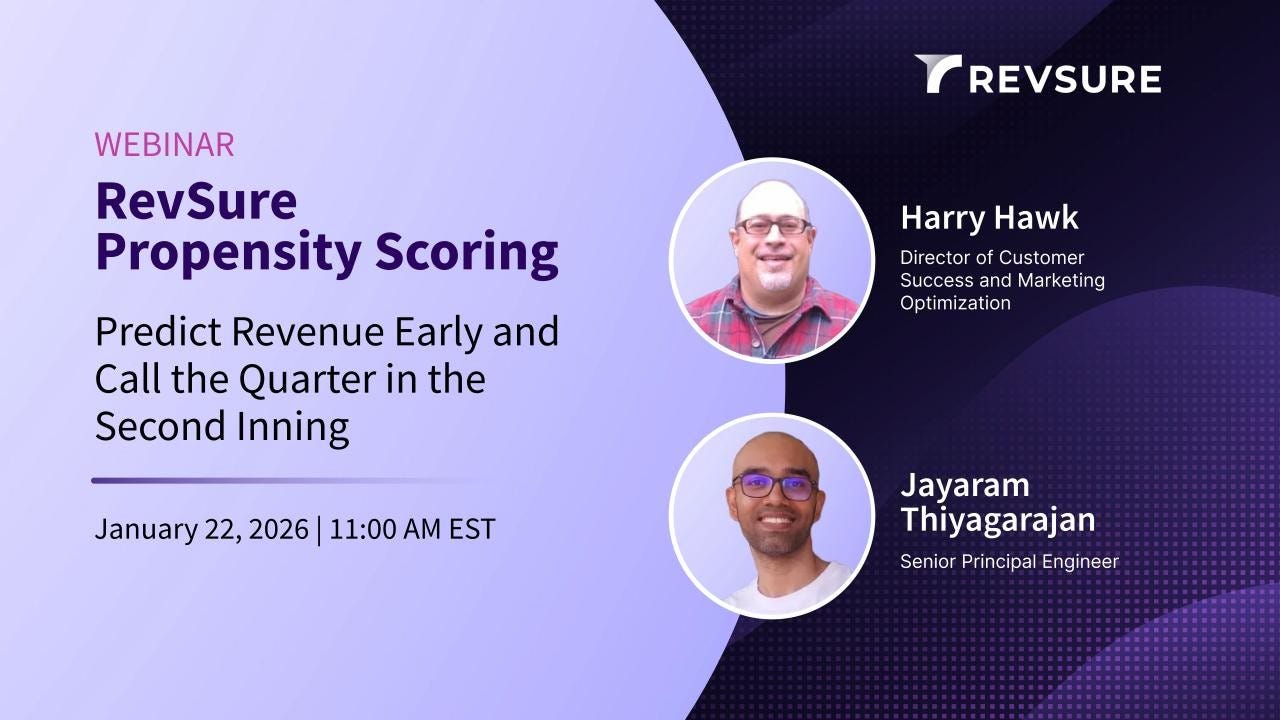
Upcoming Event | Predict Revenue Early with True Propensity Scoring
Most lead scoring looks smart until you need it to actually predict revenue. Rules-based models and “current-state” scores describe what’s happening today, but they don’t tell you what will convert tomorrow.
In this short webinar, Harry Hawk and Jayaram Thiyagarajan walk through why RevSure Lead Propensity Scoring is different: it’s truly predictive, validated, and consistently outperforms traditional approaches. You’ll also see real cross-tenant results showing how a small high-propensity segment drives the majority of the won pipeline, early enough in the quarter to change the outcome.
–
AI agents are quickly becoming table stakes. The real competitive advantage is what comes next: coordination, context, and control across the full funnel. If you’re navigating agent proliferation inside your GTM stack and want a clearer path forward, we’d love to share what we’re seeing across enterprise teams and how RevSure is approaching context-aware execution without the chaos.
Until next week, Team RevSure