On this page
CMOs deal with tough questions all the time. What happens if we cut events? What if we put more money into paid media? Should we shift the budget from demand capture to brand, or the other way around? These choices carry risk. Yet, most budget changes happen without a clear sense of their impact. Teams often rely on past results, incomplete data, and educated guesses, hoping for the best.
In today’s uncertain environment, hope isn’t a strategy. That’s why scenario planning is now essential for CMOs, and Marketing Mix Modeling (MMX) plays a key role.
The Risk Hidden in Budget Decisions (and Why “What-If” Is So Hard)
Moving budget around sounds simple: take money from channels that aren’t working and put it into those that are. But in B2B, these choices rarely have quick or isolated effects. Cutting one channel can hurt another. Spending more can lead to diminishing returns. Many investments affect pipeline and revenue weeks or even months later.
If you can’t model these effects, changing the budget brings hidden risks. Channels that look inefficient might actually help with later conversions. Short-term wins can create long-term gaps in the pipeline. In some cases, moving spend only changes when results show up, not the total outcome. The biggest risk is not knowing the consequences until it’s too late to fix them.
That’s why traditional analytics struggle with 'what-if' questions. Most tools only look at the past. They show what happened, not what could happen if things change. Attribution models show which channels were involved in a deal. Dashboards show current performance. Forecasts can look ahead, but only until the market shifts.
But none of these approaches can consistently answer questions like:
- What happens to the pipeline if we reduce event spend by 20%?
- How much incremental revenue will paid media actually generate if we scale it?
- Will reallocating the budget change outcomes, or just shift credit?
To answer these questions, you need more than performance reports. You need to understand incremental impact, lag effects, and how channels work together, not just basic efficiency.
What Scenario Planning Really Means: Pressure-Testing Spend Before It Moves
Scenario planning lets CMOs test possible outcomes before making budget decisions. Instead of reacting after the fact, leaders can model different budget options and see how they might affect pipeline, revenue, efficiency, and timing.
Response curves are central to scenario planning. These models predict how results change as spending changes. This matters because spending more doesn’t always mean getting more results. Doubling your spend doesn’t double your pipeline. Early investments often bring strong returns, but results level off as channels get saturated. The key question is: where does extra spending still add value, and where does it stop?
This turns planning from a one-time task into an ongoing process. Instead of debating opinions, teams can weigh trade-offs using real data. Scenario planning doesn’t replace judgment, but it improves decisions by showing the real links between cause, effect, and timing.
Why MMX Is Essential for Scenario Planning
Not all models are right for scenario planning. Attribution models often fall short when things change because they rely on past paths and touchpoints, not true incremental impact. When you move the budget, those paths change, so attribution becomes less reliable. Traditional forecasts can help, but many assume channels, costs, and buyer behavior stay the same. That kind of stability is missing in today’s market.
MMX (Marketing Mix Modeling) is built specifically to model change in spend and its downstream impact. Instead of tracking what touched a deal, MMX estimates what really drove extra impact and how that changes as spending shifts. It looks at past performance, spend levels, timing, and results to find true causes, not just surface links.
A strong MMX approach can account for:
- Incremental contribution by channel, based on modeled lift
- Lag effects between investment and pipeline or revenue outcomes
- Cross-channel interactions across the funnel
- Diminishing returns and saturation points as spend scales
That’s why MMX matters for scenario planning. It helps CMOs move beyond dashboards and attribution to a system that answers 'what happens if we change something?' with real evidence.
When this modeling uses a unified, full-funnel data foundation, like RevSure’s Full Funnel AI Platform, the results reflect real go-to-market dynamics rather than just separate channel reports. This makes scenario planning something leaders can trust, not just a theory.
Scenario Planning in Action: A Decision Every Team Recognizes
Here’s a common situation: paid media results are dropping, while events seem expensive but promising. Without scenario planning, leaders usually do one of two things: cut events to save money in the short term, or spend more on paid media to boost the pipeline right away.
But both choices can have unexpected results. Cutting events might lower short-term costs per opportunity, but can quietly weaken high-intent demand and late-stage conversions later. Spending more on paid media may quickly increase leads, but results can level off after a while, raising customer acquisition costs and reducing real gains.
Scenario planning changes the conversation by making those trade-offs clear before any budget moves. With MMX-powered scenario planning, leaders can test both options and see how they affect outcomes over time. What happens to the pipeline and revenue if events are reduced? How much extra lift does more paid spend actually create? Does one channel depend on another to perform?
Often, the answer isn’t clear, and that’s the point. Scenario planning reveals effects that static reports miss, especially in B2B, where sales cycles are long, buyer journeys are complex, and channels influence results at many stages.
RevSure Scenario Planner: Turn “What-If” Into Modeled Confidence
RevSure’s Scenario Planner helps CMOs model, compare, and make spend decisions quickly and clearly. It lets leaders forecast the impact of marketing spend changes across channels using predictive ROI curves and saturation points, so teams can see likely outcomes before making changes.
Instead of relying on last quarter’s performance to predict the future, RevSure helps marketing teams see where extra investment still brings real value, and where spending has started to flatten. This makes it easier to avoid common planning mistakes, like over-investing in channels that are already saturated or cutting channels that quietly help with downstream conversion.
With the Scenario Planner, teams can easily change allocations, compare results to previous quarters, and invest more in top channels. More importantly, they can get marketing, finance, and sales working together with a shared model, making planning faster and more confident instead of a long debate over assumptions.
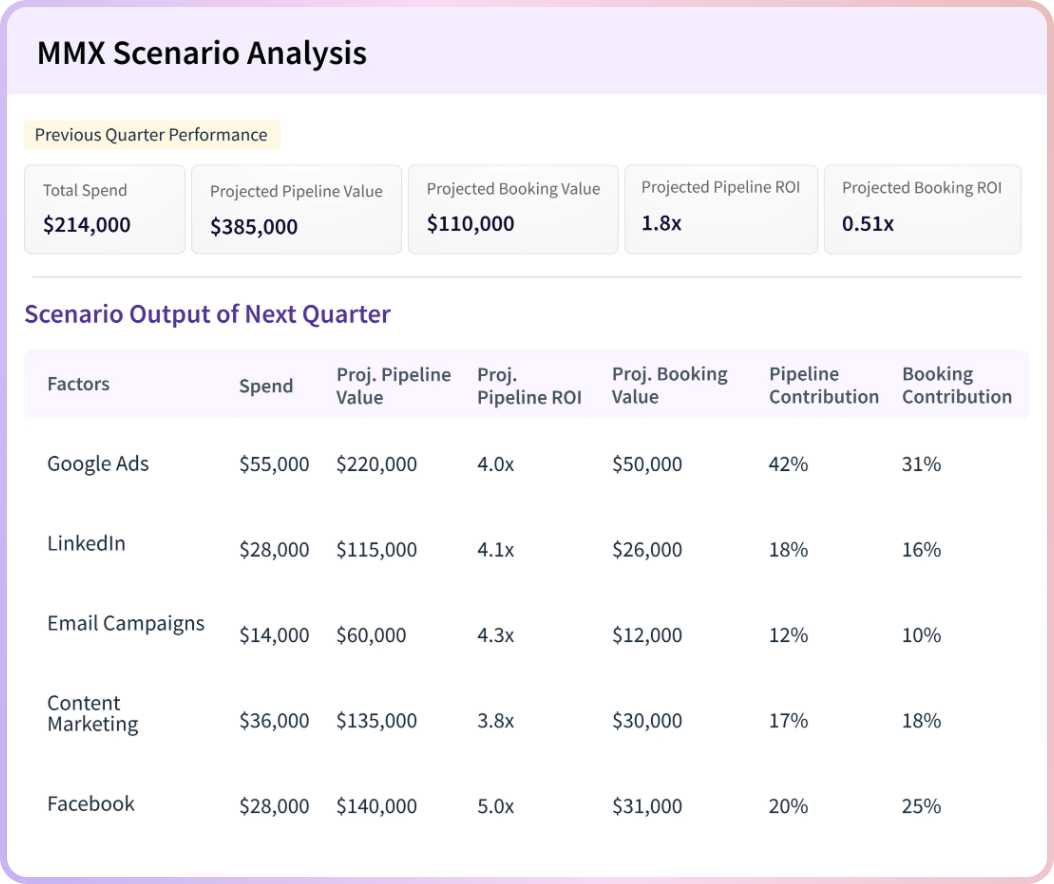
Since RevSure updates scenario insights as new data comes in, leaders can respond quickly to changes in performance instead of waiting for slow-moving metrics.
From Confidence Theater to Real Confidence
Many budget decisions are made with surface-level confidence, based on past performance, simulated metrics, or last quarter’s attribution. But this confidence fades quickly when things change, channels get saturated, or pipeline problems show up too late to fix.
Scenario planning replaces false confidence with real confidence. You know the trade-offs. You see the risks before making decisions. You model outcomes instead of just guessing.
This is especially useful when budgets are closely watched, and marketing leaders need to show financial discipline. Today, CMOs are judged not just on creativity, but also on pipeline, revenue, efficiency, and how well they run operations.
That’s what scenario planning unlocks. It gives leaders a way to test decisions before committing, reduce risk without slowing down, and allocate budget with intention.
The future of marketing leadership isn’t about making better guesses. It’s about modeling what’s likely to happen before it does.