On this page
In enterprise sales, deals are not won or lost on activity alone; they are shaped by people. Who is involved, how they influence decisions, and where they sit within the organization often determine the trajectory of an opportunity. Yet, despite the critical role of stakeholders, most revenue systems treat contacts as flat records rather than dynamic participants in a buying process.
This creates a fundamental gap. Teams track accounts and opportunities with precision, but lack a consistent, structured understanding of the individuals driving those deals forward, or holding them back.
RevSure’s Buyer Persona Model is designed to address this challenge. It introduces a standardized, intelligent framework for identifying and classifying stakeholders across the buying journey, enabling revenue teams to move from fragmented contact data to actionable stakeholder intelligence.
The Missing Layer in Revenue Intelligence
Enterprise buying has evolved. Decisions are no longer made by a single individual, but by committees composed of diverse roles, each with different priorities, levels of influence, and decision authority. However, most systems fail to capture this complexity in a meaningful way.
Contacts are often added inconsistently, roles are manually assigned (if at all), and there is little standardization in how stakeholders are categorized across deals. As a result, organizations struggle to answer critical questions:
- Are we engaging the right stakeholders in this deal?
- Do we have access to the economic buyer?
- Is this opportunity single-threaded or multi-threaded?
Without clear answers, execution becomes reactive rather than strategic. RevSure’s Buyer Persona Model introduces structure where there was previously ambiguity, enabling organizations to systematically understand and manage stakeholder dynamics.
From Contacts to Structured Personas
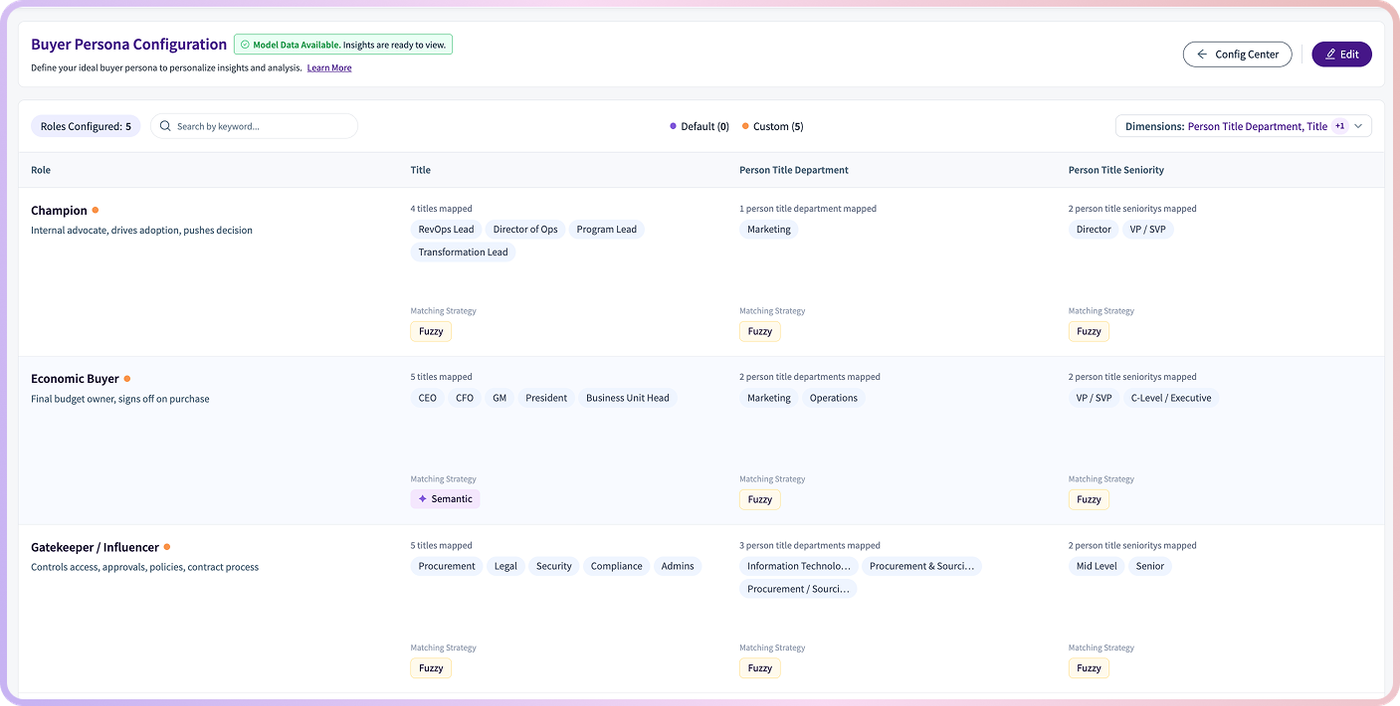
At its core, the Buyer Persona Model transforms how contacts are interpreted within the revenue system. Rather than existing as standalone entries, contacts are automatically classified into meaningful roles such as Champions, Economic Buyers, and Gatekeepers. This classification is not dependent on manual tagging. Instead, it is driven by a combination of job titles, seniority, department, and semantic matching logic.
This approach allows RevSure to infer stakeholder roles with a high degree of accuracy, even in complex organizational environments. The result is a consistent, scalable way to understand who is playing what role in every opportunity. Teams no longer need to rely on subjective judgment or incomplete data. They gain a standardized lens through which stakeholder influence can be evaluated.
Intelligence That Adapts to Enterprise Complexity
One of the defining challenges of stakeholder mapping is variability. Organizations differ widely in how they structure teams, define roles, and assign responsibilities. A title that signals decision authority in one company may not carry the same weight in another. Static models often fail because they cannot account for this diversity.
RevSure’s Buyer Persona Model is built with flexibility at its core. It supports configurable logic that allows organizations to tailor how roles are assigned based on their specific context.
This ensures that persona classification is not only automated but also aligned with the nuances of each business. Whether operating in a highly centralized enterprise or a distributed organizational structure, teams can maintain accuracy in how stakeholders are mapped.
This adaptability is critical for ensuring that the model remains reliable at scale.
Operationalizing Stakeholder Intelligence
The true value of the Buyer Persona Model lies in its ability to make stakeholder data actionable. Once contacts are classified into structured personas, that information can be applied across revenue workflows. Teams can evaluate deals not just by stage or value, but by the quality and completeness of stakeholder engagement. This enables a more disciplined approach to execution.
With the Buyer Persona Model, organizations can:
- Identify gaps in stakeholder coverage across opportunities
- Ensure engagement with key decision-makers such as economic buyers
- Detect over-reliance on single-threaded relationships
- Improve deal strategy by understanding influence dynamics within accounts
This shifts stakeholder management from an ad hoc activity to a measurable component of pipeline health.
Strengthening Forecasting and Deal Confidence
Forecasting accuracy is often limited by incomplete visibility into deal dynamics. Even when pipeline data appears strong, the absence of the right stakeholders can introduce hidden risk. Deals may stall because key decision-makers are not engaged, or because internal alignment has not been achieved within the customer organization.
By introducing structured persona intelligence, RevSure enables teams to incorporate stakeholder quality into their assessment of deals.
Leaders can evaluate not just whether a deal is progressing, but whether it is supported by the right relationships. Opportunities with strong multi-persona engagement can be prioritized with greater confidence, while those lacking critical roles can be flagged for intervention.
This adds a new dimension to forecasting, one that reflects the human factors behind revenue outcomes.
Driving Consistency Across the Revenue Organization
Another key benefit of the Buyer Persona Model is consistency. In many organizations, stakeholder roles are interpreted differently across teams. What one sales representative considers a “champion,” another may not. RevOps teams often struggle to enforce standardization, leading to fragmented data and misaligned insights.
RevSure addresses this by establishing a unified framework for persona classification. Because roles are assigned automatically based on defined logic, teams operate from a shared understanding of stakeholder types. This consistency improves collaboration, strengthens reporting, and ensures that insights derived from the data are reliable.
It also reduces the burden on individual contributors, allowing them to focus on engagement rather than data hygiene.
A Foundation for Advanced Revenue Strategies
As revenue organizations mature, the need for deeper intelligence grows. Account-based strategies, multi-threading initiatives, and advanced deal inspection frameworks all depend on a clear understanding of stakeholder roles. Without structured persona data, these strategies are difficult to execute effectively.
The Buyer Persona Model provides the foundation for these initiatives.
By standardizing how stakeholders are identified and classified, RevSure enables organizations to build more sophisticated approaches to account engagement. Teams can design strategies that account for influence networks, align messaging to specific personas, and ensure that outreach is targeted and effective. This elevates stakeholder management from a tactical activity to a strategic capability.
A New Standard for Stakeholder Visibility
Enterprise revenue success is no longer defined solely by pipeline volume or activity levels. It is defined by the quality of engagement within each deal. RevSure’s Buyer Persona Model brings clarity to that engagement by transforming contacts into structured, meaningful personas. It enables organizations to see not just who is involved, but how they influence outcomes.
In doing so, it closes one of the most critical gaps in modern revenue systems. Because in complex buying environments, understanding the deal means understanding the people behind it.