On this page
For more than a decade, B2B marketing budgets grew faster than accountability. Pipeline was expanding, demand was strong, and inefficiencies were easy to ignore. If one channel underperformed, teams compensated by spending more in other channels. If attribution was unclear, revenue growth still justified the investment.
That margin for error is gone.
Recent industry research shows that B2B marketing budgets have flattened or declined, while pressure from finance has increased. CMOs are being asked to do more with less, and to prove impact with far greater rigor. In many organizations, marketing is now one of the most scrutinized line items in the GTM budget.
In this environment, traditional budget allocation methods are breaking down. They rely on backward-looking assumptions, incomplete attribution, and channel-level metrics that don’t map to revenue reality. They explain what happened, but not what to do next.
This is why Marketing Mix Modeling (MMX) is emerging as the future of B2B budgeting. Not as a reporting upgrade, but as a strategic capability, one that helps GTM leaders understand which investments actually drive pipeline and revenue, how impact unfolds over time, and where each dollar truly earns its return.
The Problem with Traditional B2B Budget Allocation
Most B2B organizations still allocate budgets using a familiar mix of tactics:
- Last year’s spend plus or minus a percentage
- Channel-level ROI based on incomplete attribution
- Platform-specific dashboards optimized for clicks, not revenue
- Gut feel informed by lagging quarterly results
All these methods have the same problem: they focus on the past, while the market keeps moving forward. In B2B, buying journeys are long and unpredictable, so it’s hard to track what’s working. Buyers use many channels over several months. Revenue often comes in long after the money is spent. By the time you know what worked, it’s too late to make changes.
This leads to making budget decisions based on guesses instead of real evidence:
- Channels get overfunded because they “feel” important
- High-impact interactions are undervalued because they don’t convert immediately
- Spend decisions optimize for activity, not outcomes
When budgets were expanding, this inefficiency was survivable. Now, it’s a liability.
Why B2B Needs a Different Budgeting Model
B2B marketing is fundamentally different from consumer marketing and from what most analytics tools were designed to support.
Key challenges include:
- Long sales cycles with delayed revenue feedback
- Multiple stakeholders influencing a single deal
- Offline and online interactions that don’t map cleanly to attribution models
- Revenue outcomes that depend on combinations of channels, not individual ones
Optimizing each channel in isolation doesn’t work when performance emerges from the system as a whole. What GTM leaders need is not more dashboards, but a way to understand how different investments interact to drive pipeline and revenue over time.
To make this change, you need to look at the whole funnel. That means analyzing campaign data, CRM signals, and revenue results together. Modern platforms like RevSure’s Full Funnel AI Platform are built to do exactly this.
What Marketing Mix Modeling Actually Does
Marketing Mix Modeling is built to answer a key question: How does each marketing investment help build pipeline and revenue, both on its own and with others, over time? Unlike attribution models that try to give credit to single touchpoints, MMX looks at the big picture. It studies past data across channels, spending, timing, and results to find out:
- The true incremental impact of each channel
- Diminishing returns as spending increases
- Lag effects between investment and revenue
- Cross-channel interactions that amplify or suppress performance
Rather than asking, “Which touchpoint closed the deal?”, MMX asks, “What mix of investments made this deal happen?”
For B2B organizations, that distinction is everything. This is exactly the problem RevSure addresses with its AI-powered Marketing Mix Modeling (MMX), designed specifically for complex B2B GTM environments.
How RevSure Makes Marketing Mix Modeling Work for B2B
RevSure MMX is part of RevSure’s Marketing Optimization platform, which unifies Marketing Mix Modeling, Multi-Touch Attribution, and Incrementality Testing to deliver a comprehensive view of what actually drives pipeline and bookings across complex B2B funnels. Instead of forcing teams to choose between attribution or modeling, RevSure connects both- capturing short-term influence while quantifying long-term, incremental impact.
What RevSure MMX Delivers
RevSure’s MMX is purpose-built to model full-funnel B2B performance across paid, organic, brand, offline, and sales-led motions. Key capabilities include:
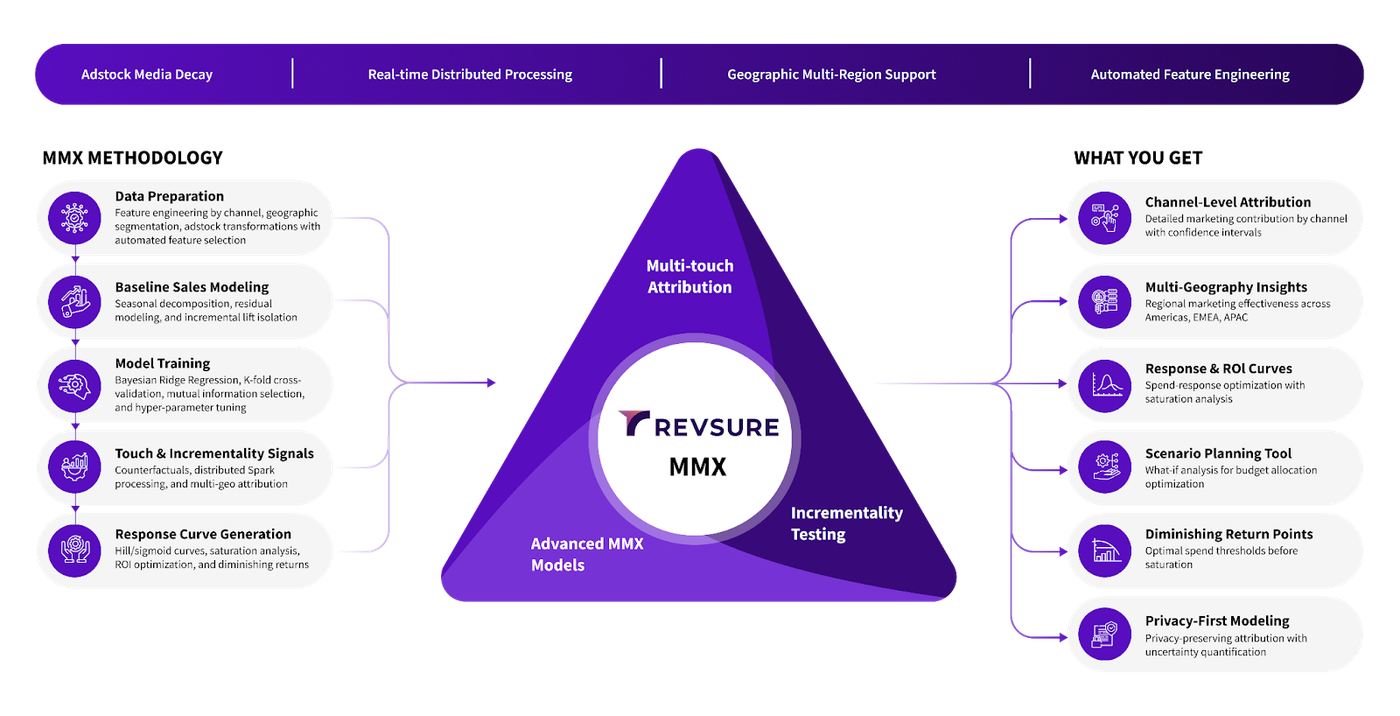
- True channel-level contribution across pipeline and bookings—not just clicks or leads
- Multi-stage funnel modeling to understand impact at different points (Leads, MQLs, Opportunities, Revenue)
- Lag and carryover effects that account for long B2B sales cycles and delayed revenue impact
- Cross-channel interaction analysis to capture how investments work together, not in isolation
- Response and ROI curves to identify optimal spend levels and diminishing returns
- Scenario planning and what-if analysis to evaluate budget shifts before committing spend
Unlike legacy MMM approaches that deliver static, retrospective reports, RevSure MMX is designed to be operational and continuous. Models are retrained quarterly, or more frequently as conditions change, and scored daily, ensuring insights stay current as GTM strategies evolve. This allows teams to move from post-hoc analysis to in-flight decision-making, where budget adjustments can be made while impact still matters.
RevSure MMX uses Bayesian modeling that does not rely on cookies or user-level tracking, making it resilient in a rapidly changing data and privacy landscape. It supports multi-geo and multi-region modeling across the Americas, EMEA, and APAC, while unifying marketing, sales, brand, and external market signals into a single analytical framework. By incorporating sales activity and macroeconomic factors alongside marketing investments, RevSure provides a more complete and realistic view of what drives pipeline and revenue.
To enable true full-funnel visibility, RevSure MMX supports a broad range of GTM channels across digital, organic, sales-led, brand, and offline motions. This includes paid media such as LinkedIn, paid social, paid search, display, and programmatic; organic and owned channels like SEO, content, website engagement, email, and organic social; direct and sales-led activities including SDR outreach, sales efforts, and direct mail; as well as brand campaigns, events, webinars, podcasts, and other offline initiatives. External signals, such as macroeconomic and industry trends, are also incorporated to contextualize performance.
The result is Marketing Mix Modeling that doesn’t live in spreadsheets or quarterly decks. RevSure MMX turns budgeting into a repeatable, revenue-driven system, giving GTM leaders clarity on where investment actually matters, how impact unfolds over time, and how to allocate budget with confidence.
From Reporting Tool to Strategic Advantage
In the past, MMX was viewed as a heavy analytics project- expensive, slow, and disconnected from daily decisions. That’s changing now. Modern Marketing Mix Modeling uses unified data and AI to become part of everyday operations.
This shift turns MMX into a strategic capability:
1. Budgeting Tied Directly to Revenue Impact
MMX links spending decisions to outcomes such as pipeline creation, deal speed, and closed-won revenue. Instead of focusing on channel metrics, teams focus on real business results. RevSure’s platform makes this possible by connecting marketing actions directly to revenue outcomes.
2. Scenario Planning Instead of Static Plans
Rather than locking budgets annually, GTM leaders can model scenarios:
- What happens if we shift 10% of our budget from paid search to events?
- How does increasing brand spend today affect the pipeline six months from now?
- Where does incremental budget actually produce incremental revenue?
With AI-driven modeling, you can answer these questions before making decisions, instead of waiting until after the results are in.
3. Cross-Team Alignment Around a Single Truth
Marketing, sales, and finance teams often use different metrics and ways of thinking. MMX gives everyone a shared, results-focused view of performance. This helps teams work together and feel more confident about budget decisions.
4. Resilience in Uncertain Markets
When markets change, old assumptions stop working. MMX helps organizations adjust by showing which actions really drive growth and which ones don’t anymore.
From Optimization to Intelligence
The real value of Marketing Mix Modeling isn’t just better spreadsheets. It’s about building smarter organizations. When MMX is part of GTM decision-making:
- Budgets adapt as conditions change
- Spend reflects revenue reality, not platform metrics
- Strategy is informed by evidence, not habit
Marketing teams move from justifying their costs to actively driving growth. This is how MMX shifts from being just analytics to becoming true intelligence, especially when combined with predictive and causal tools that go beyond traditional attribution models. RevSure’s analytics and measurement features are built for this difference.
The Future of B2B Budgeting
In the next stage of B2B growth, the most successful teams won’t be the ones with the largest budgets. They’ll be the ones who know how to use their resources wisely. Marketing Mix Modeling gives teams that insight. It shows where investments make a real difference, how results develop over time, and how to allocate resources confidently.
As GTM environments get more complex and budgets get tighter, MMX will become essential, not optional. It will be the base for smart budgeting. The future of B2B marketing isn’t about spending more; it’s about spending wisely. Marketing Mix Modeling is the way to achieve that clarity.