On this page
As we’ve explored throughout this series, Agentic AI is rapidly moving from experimentation into the core of go-to-market execution. Organizations are increasingly embedding AI into workflows, using it to interpret signals, prioritize opportunities, and coordinate execution across marketing, sales, and customer teams. The pace of adoption is striking. According to RevSure’s 2026 State of Agentic AI in B2B GTM research, 76% of organizations are already deploying or implementing Agentic AI, with 41% actively using it and another 35% rolling it out.
Despite this rapid momentum, the path toward agentic execution is not uniform. Organizations do not become agentic overnight. Instead, they move through a progression of maturity stages as their systems, data foundations, and operating models evolve. Understanding these stages helps leaders evaluate where their teams stand today and what must happen next.
Stage One: Data Readiness
Every agentic transformation begins with data readiness. Before AI systems can interpret signals or act autonomously, they must operate on inputs that are consistent, governed, and trustworthy. In many organizations, this foundational work represents the most significant challenge.
Customer data often lives across multiple platforms. CRM records may contain inconsistent fields or incomplete account relationships. Marketing engagement signals are frequently separated from sales activity or product usage data. Attribution models and pipeline definitions may vary between teams.
Without alignment at the data layer, AI systems cannot operate with confidence. Agents may interpret incomplete signals or prioritize accounts based on inconsistent context. Data readiness, therefore, becomes the prerequisite for everything that follows.
This is where many organizations begin their journey with RevSure. Rather than relying on fragile point-to-point integrations, RevSure establishes a unified GTM data foundation through its data graph architecture, which connects signals across CRM systems, marketing platforms, sales engagement tools, product usage data, and third-party intent sources. By normalizing these inputs and enforcing consistent definitions, the platform creates the governed data layer required for reliable AI reasoning.
In effect, RevSure transforms fragmented GTM signals into a single source of contextual intelligence that AI systems and human teams can trust.
Stage Two: Embedded AI Workflows
Once organizations establish unified data foundations, the next stage involves embedding AI directly into execution workflows. This is where many organizations currently operate.
AI models assist marketing teams in optimizing spend allocation and campaign targeting. Sales teams receive prioritization signals that highlight the most promising opportunities. RevOps teams rely on AI-driven forecasting models to predict pipeline creation and revenue outcomes. At this stage, AI improves efficiency and decision quality, but the overall GTM system remains largely human-orchestrated. Humans still coordinate the majority of execution decisions across the funnel. This phase delivers meaningful gains in productivity and visibility, but it does not yet represent a fully agentic GTM.
RevSure supports organizations in this phase by embeddingspecialized AI agents directly into key GTM workflows. Marketing optimization agents continuously analyze campaign performance and attribution signals to guide channel allocation. Pipeline acceleration agents interpret buyer engagement signals to surface the most relevant accounts and next-best actions for sales teams. Revenue predictability agents monitor pipeline health, forecast readiness, and identify risks earlier in the funnel.
Each of these agents focuses on a specific dimension of GTM performance, helping teams improve execution while still maintaining human oversight and governance.
Stage Three: Cross-System Orchestration
The final stage occurs when AI begins coordinating decisions across the entire GTM ecosystem. Instead of optimizing individual workflows, agentic systems interpret signals from multiple systems simultaneously and dynamically adjust execution strategies. Marketing spend may shift automatically based on pipeline quality signals. Sales engagement may prioritize accounts showing coordinated buying behavior. Customer teams may receive early alerts about expansion or risk signals based on engagement and usage patterns.
In this stage, AI does not replace human leadership. Instead, it becomes the operational layer that continuously interprets signals and executes decisions across the funnel. Human teams focus on strategy, governance, and creative engagement, while AI manages the complexity of coordination at scale.
RevSure enables this orchestration through its AI reasoning engine, which unifies behavioral signals with deep contextual understanding of GTM dynamics such as ICP definitions, buying group structures, persona engagement patterns, and historical pipeline performance. Through its Model Context Protocol (MCP) and unified API architecture, AI agents operate on shared intelligence across systems rather than isolated datasets.
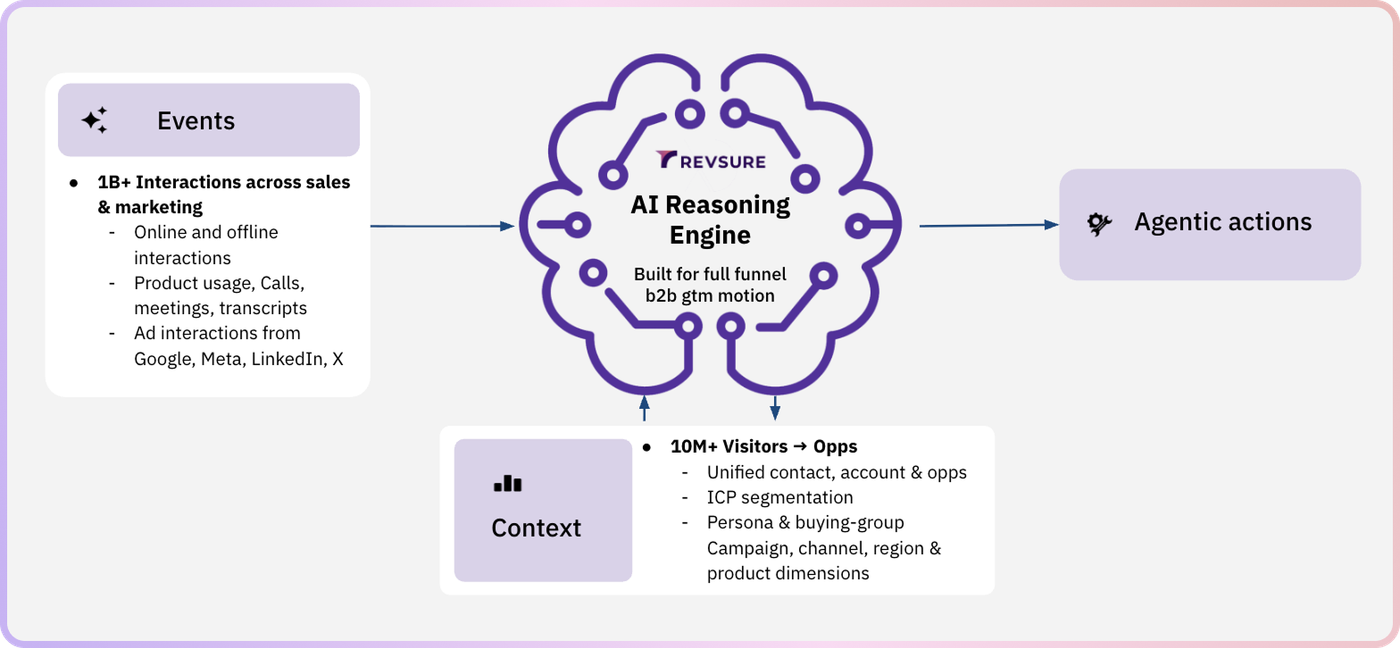
This architecture allows RevSure’s network of agents to coordinate actions across marketing, sales, and customer systems, creating a synchronized execution layer where decisions are informed by full-funnel context rather than siloed insights.
Why Most Organizations Are Still in Transition
The research suggests that many organizations are currently positioned between the first two stages. Foundational data work is underway, and AI is increasingly embedded in workflows. However, full orchestration across systems remains limited by fragmented integrations and inconsistent governance structures. This is why many leaders feel close to readiness but still hesitate to scale autonomy fully.
Closing this gap requires continued investment in integration, governance frameworks, and shared definitions of GTM success. Organizations must move beyond isolated AI deployments toward coordinated systems capable of acting on unified intelligence.
—
Agentic maturity is not defined by how many AI tools an organization deploys. It is defined by how deeply AI is integrated into the operating model of GTM execution. To explore where organizations currently stand and what the next stage of agentic maturity looks like, download The 2026 State of Agentic AI in B2B GTM report.