On this page
At first glance, today’s GTM teams appear well-prepared. They track website engagement, intent signals, product usage, campaign results, outbound replies, pipeline changes, and growth indicators. Dashboards are full of data, and alerts are frequent. Despite this, execution often falls short.
Follow-ups are delayed. Sales claims leads were not ready. Marketing insists the signals were clear. RevOps must explain why dashboards present conflicting information. Everyone is busy, but true collaboration is lacking.
The issue lies not with the people, but with the systems they use. Most GTM systems are built to collect signals, not coordinate action. They prioritize visibility over timing and insight over execution.
Signal chaos begins in the gap between awareness and coordinated action.
What Signal Chaos Looks Like in Practice
Signal chaos rarely feels dramatic. It emerges as minor issues that accumulate over time. Marketing responds to engagement; sales follows up later; and customer success notices usage changes without deal context. RevOps addresses problems after the quarter ends. Each team operates logically within its own tools, but the organization does not move as one.
Signals exist, but each team interprets them differently. Teams debate priorities, and critical timing is often missed.
The result is predictable: slow responses, inconsistent buyer experiences, and internal uncertainty about which signals matter most.
Awareness Is Not Coordination
A common misconception in GTM is that increased visibility leads to better execution. Dashboards provide awareness, alerts notify, and reports explain outcomes; however, none of these guarantee accurate coordination.
In most organizations, signals are sent to analytics tools, requiring teams to interpret them, decide on next steps, and communicate them. Each stage introduces delays and subjective judgment. By the time action occurs, buyer interest may have diminished.
Signal orchestration changes how teams operate. Instead of just sharing insights and hoping teams align, orchestration builds alignment into the system. Signals are understood in context, prioritized as priorities shift, and translated into coordinated action across teams and tools.
Why Timing Matters More Than Signal Volume
Most GTM teams assume that more signals lead to better decisions. In reality, timing is what determines whether a signal creates value or gets wasted.
A high-intent signal that is acted on immediately can accelerate a deal. The same signal, if delayed by even a few days, often loses impact as buyer attention shifts or competitors step in.
This is where many systems fall short. They surface signals, but they do not ensure those signals are acted on at the right moment. Teams still depend on manual interpretation, internal communication, and delayed execution.
Effective GTM systems treat timing as a core part of signal quality. It is not just about what happened, but when it happened and how quickly the organization responds.
When timing is built into the system, signals become triggers for coordinated action rather than just inputs for analysis.
From Fragmented Signals to a Unified Signal Graph
The core of signal orchestration is something most GTM systems still lack: a single view of buyer behavior over time, across roles, and across channels. In most setups, signals are scattered. Website activity is in the analytics tools. Campaign engagement is in marketing automation. Sales activity is in CRM. Product usage is tracked elsewhere. Each system captures part of the picture, but none show the full momentum.
A unified signal graph brings all those pieces together.
It does more than log events. It connects accounts, personas, interactions, and timing into a continuously updated view of evolving buying behavior.
This distinction is important because individual signals rarely provide the whole picture. A content download, login, or ad click can have various meanings in isolation. When signals converge across the buying group and gain momentum, they yield more profound insights.
That’s when interest becomes real momentum.
Why Static Prioritization Fails
Many GTM teams attempt to address signal chaos with scoring models, but these often lose credibility over time. Static scores fail to account for velocity, context, and change, assuming buyer behavior is linear and predictable. As a result, teams either pursue too many “hot” leads or lose trust in the scores entirely.
Signal orchestration introduces a new approach to prioritization. Rather than assigning fixed scores to individual events, it analyzes patterns over time, tracking how engagement grows, spreads, or slows, and aligns with funnel stages. ICP prioritization becomes continuous and adaptable.
Where Signal Chaos Shows Up Most Clearly
Signal chaos often shows up in ways we all recognize:
- Signals get evaluated in isolation most of the time.
- Prioritization is driven by static rules for most teams.
- Sequential handoffs between teams rather than parallel action
- Insights living in dashboards rather than inside execution workflows
Coordination Changes the Buyer Experience
The most significant impact of orchestration isn’t just better internal efficiency. It’s a more consistent experience for buyers. In chaotic systems, buyers get mixed messages. Outreach lacks context; messaging varies by team. Timing feels wrong.
Orchestrated systems behave differently.
When necessary signals appear, marketing, sales, and customer success all act together using shared information. Conversations build on one another rather than starting over. Engagement feels planned rather than reactive. To the buyer, it feels like the company understands what’s going on and responds appropriately.
Why Adding More Tools Rarely Works
When signal chaos is apparent, the first reaction is often to add more technology- another intent provider, another dashboard, another automation rule. But this usually makes things worse.
More tools increase signal volume but do nothing to improve coordination. Without orchestration, every new input adds noise, not clarity. The real problem isn’t a lack of data. It’s not having a system that consistently connects data to action in real time.
How RevSure Approaches Signal Orchestration
RevSure’s approach to orchestration is based on one main idea: signals only matter if you act on them while they’re still relevant.
RevSure works as an event-driven, real-time orchestration layer that listens to buyer, account, and pipeline signals as they occur, then triggers coordinated GTM actions immediately. There are no static dashboards to watch or delayed batch jobs to wait for. Signals are reviewed in context and turned into action across the GTM stack while intent is still forming.
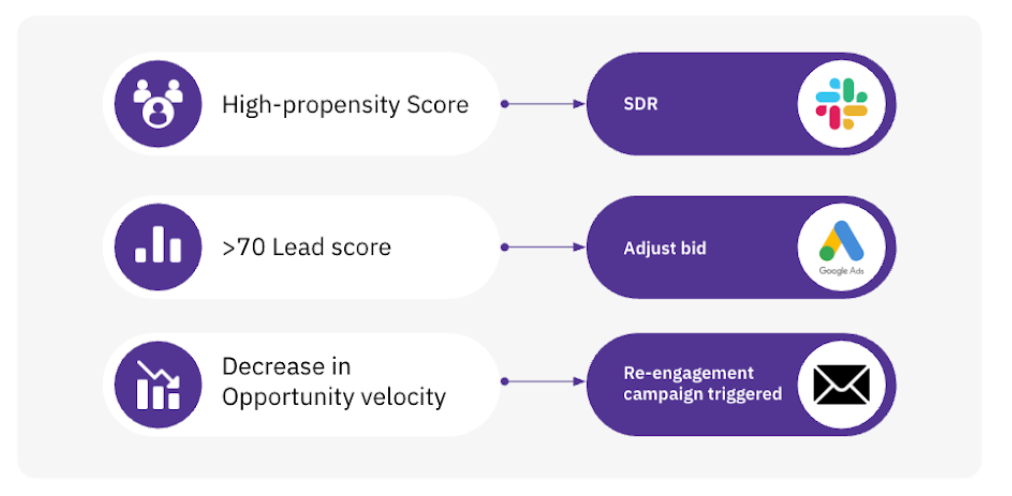
Behind the scenes, RevSure brings together three things that are usually separate: live signal collection, AI-driven decisions, and actions across multiple systems. Events from web activity, CRM updates, marketing platforms, and enrichment sources are combined into one data graph. AI models and rules decide what matters right now. Actions are carried out directly across CRM, ad platforms, engagement tools, collaboration systems, and data warehouses.
The result is orchestration that’s built for the funnel, focused on revenue, and well-managed. It helps GTM teams move together in real time, without needing people to connect systems under pressure.
Why Orchestration Is Becoming the Real Advantage
Today, having access to data is just the starting point. Most organizations can buy the same tools and data feeds. What sets leaders apart is how well they coordinate their actions.
Teams that orchestrate signals well respond faster to real buyer intent. They reduce internal friction, focus their efforts where momentum is real, and deliver a more consistent experience for buyers.
These benefits add up over time. Faster responses lead to better conversion. Better coordination speeds up the pipeline. Consistency builds trust.
As orchestration systems improve, another challenge appears: the limits of human throughput. Even with unified signals and intelligent prioritization, manual steps slow things down. This is where agentic GTM models come in.
Agentic execution takes orchestration further by allowing AI agents to interpret signals, choose next steps within defined rules, act across systems, and learn from results. People move from making every decision to focusing on oversight and strategy. It only works when orchestration is solid. Without coordination, automation amplifies chaos. With orchestration, it accelerates the advantage.
What Signal Orchestration Ultimately Enables
At its best, signal orchestration enables:
- Shared intelligence across marketing, sales, and customer success
- Dynamic prioritization based on momentum, not static thresholds
- Coordinated action without manual handoffs
- Faster, more relevant engagement at critical moments
From Signal Chaos to Signal Leadership
Every GTM team has signals. Very few have true synchronization.
Signal chaos keeps teams in the loop, but slows them down.
Signal orchestration turns insight into coordinated action.
Agentic execution turns coordination into a lasting advantage. The future of GTM won’t belong to teams with the most dashboards or the loudest alerts. It will belong to teams with systems that understand behavior in context and move together when it matters because winning today isn’t just about knowing more.
It’s about acting together, at the right time, with clarity and purpose.