On this page
Modern GTM teams are surrounded by signals. Intent data shows when accounts are researching solutions. Product analytics surfaces usage patterns. Marketing platforms track engagement with content, events, and campaigns. Website analytics reveals who is visiting and what they’re exploring. Sales tools capture meetings, conversations, and account activity.
Visibility into buyer behavior has never been richer.
Yet for many organizations, these signals rarely translate into immediate action. They appear in dashboards, reports, or analytics tools where teams review them periodically- during pipeline reviews, campaign retrospectives, or weekly sales meetings. By the time someone notices the signal and decides what to do next, the moment of highest buyer interest may already have passed.
The problem is not a lack of insight. It’s the delay between seeing the signal and acting on it.
Pipeline momentum is often decided in short windows of buyer activity. A research phase may last days. Buying committee engagement may spike briefly as teams evaluate options. Product exploration may signal readiness to move forward. When GTM teams respond slowly, those windows close before engagement happens.
Collecting more signals rarely solves this problem. Most organizations already have plenty of behavioral data. The real opportunity lies in operationalizing those signals, turning them into immediate actions that keep opportunities moving forward.
This shift defines the emerging model ofsignal-based GTM execution. Instead of passively observing buyer behavior, organizations design structured plays that respond to signals the moment they appear. Signals become triggers for coordinated activity across marketing, sales, and customer teams. In other words, signals stop being reports and start becoming motion.
From Observing Signals to Acting on Them
Traditional GTM workflows are built around observation first and action later. A sales rep checks an engagement dashboard and notices an account spike. A marketer reviews campaign performance and adjusts targeting the following week. A customer success manager reviews product usage trends in a monthly report and schedules a check-in call.
Each step depends on someone noticing the signal, interpreting it, and deciding how to respond. While this process works, it introduces latency at every stage. That latency matters more than ever.
Today’s B2B buying journeys are fragmented and fast-moving. Buyers research independently across multiple channels, involve larger decision committees, and move in and out of evaluation phases quickly. The signals they leave behind, content engagement, product exploration, and multi-threaded account activity, often represent short-lived windows of intent.
If outreach happens days later, the context may already be gone. Signal-based plays aim to remove that delay. Instead of waiting for someone to interpret the signal manually, organizations define the actions that should occur when certain patterns of behavior emerge. When those patterns appear, the system automatically activates the corresponding response.
This approach shifts GTM execution from periodic reactions to continuous responsiveness. Marketing, sales, and customer teams respond to buyer behavior while the context is still relevant. The difference between noticing a signal and acting on it immediately can determine whether interest turns into opportunity or fades away.
What Signal-Based Plays Look Like in Practice
At its core, signal-based GTM follows a simple flow: detect meaningful buyer behavior, evaluate it in context, and trigger the appropriate action.
Across the funnel, this approach supports several practical types of plays:
- Lead velocity plays: When multiple stakeholders from the same account engage with product-related content, the account can automatically be prioritized for sales outreach, ensuring teams focus on accounts entering active evaluation.
- Budget reallocation plays: When engagement spikes within a particular segment, industry, or region, marketing teams can shift campaign focus to capture emerging demand instead of waiting for campaign cycles to end.
- Content activation plays: When buyers repeatedly interact with product education or solution-focused content, follow-up resources can activate automatically to support deeper evaluation.
- Customer health and expansion plays: Product usage patterns can signal both churn risk and expansion opportunities, prompting proactive outreach from customer success teams.
In each case, the signal determines the timing of the response. Plays are no longer tied to marketing calendars or rigid outreach cadences. They are driven by live buyer behavior. This approach helps GTM teams operate at the pace of the buyer rather than the pace of internal processes.
Designing Effective Signal-Based Playbooks
Turning behavioral signals into effective GTM actions requires more than simply adding automation. Not every signal represents meaningful intent, and poorly designed workflows can generate noise instead of clarity. Effective signal-based playbooks typically follow three key principles:
- Signals gain meaning through context.
A single action rarely indicates strong intent. Downloading a whitepaper or attending a webinar might simply reflect casual research. But when multiple signals appear together, repeat visits, product page engagement, and activity from multiple stakeholders, the pattern becomes far more meaningful. - Plays should be modular and adaptable.
GTM strategies evolve as markets change and new data sources become available. Signal-based playbooks work best when designed as flexible frameworks that allow teams to adjust logic, incorporate new signals, or modify workflows without rebuilding the system from scratch. - Feedback loops improve signal quality over time.
Some signals consistently correlate with pipeline acceleration, while others generate little impact. Measuring the outcomes of triggered plays helps teams refine which signals truly matter and prioritize them more effectively.
Over time, these feedback loops help signal-based systems become smarter. Instead of reacting to every data point, they learn which patterns actually influence revenue outcomes. In this sense, signal-based playbooks behave less like static automation flows and more like adaptive systems that improve with each cycle.
Operationalizing Signal-Based Plays with Real-Time Orchestration
Designing signal-based playbooks is only part of the equation. The real challenge is operationalizing them at scale.
Signals arrive continuously, from website activity, product usage, CRM changes, marketing engagement, and third-party intent providers. Without a system that can ingest these signals, evaluate them in context, and activate the right response instantly, signal-based plays remain theoretical.
This is where real-time GTM orchestration becomes essential.
RevSure’s Real-Time Revenue Orchestration framework enables teams to transform live funnel signals into immediate GTM actions across their entire stack. Instead of relying on dashboards, delayed batch updates, or manual follow-ups, the system listens for meaningful events across the funnel and triggers API-driven workflows within milliseconds.
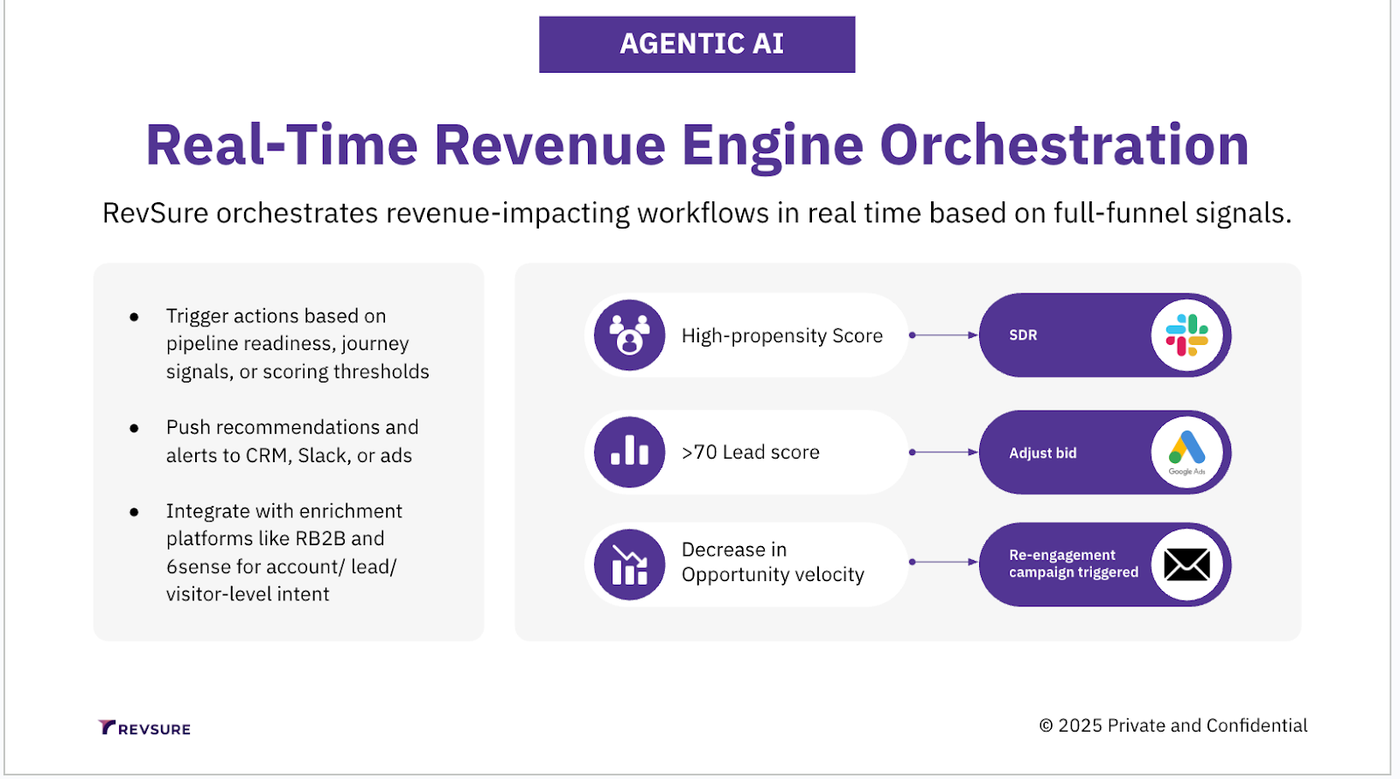
At a high level, this orchestration model operates through three connected layers:
- Signal ingestion: Behavioral and system events are captured across websites, CRM platforms, marketing automation systems, product analytics tools, and third-party enrichment providers. These signals are normalized into a unified data model covering accounts, leads, opportunities, and campaigns.
- Decisioning: AI-driven scoring models and rule-based logic evaluate signals in real time. Factors such as buyer propensity, pipeline velocity, engagement patterns, and funnel health determine whether a signal represents a meaningful GTM opportunity.
- Activation: Once a threshold is met, actions are triggered instantly across the GTM stack—updating CRM records, adjusting ad audiences, prioritizing sales outreach, notifying account owners, or initiating marketing engagement workflows.
This architecture allows GTM teams to operationalize the detect → decide → act model without relying on manual intervention. For example, when a high-intent account suddenly shows pricing-page engagement from multiple stakeholders, orchestration workflows can automatically:
- Enrich the account record in the CRM
- Route the opportunity to the appropriate sales owner
- Trigger SDR outreach tasks
- Sync the account into high-priority advertising audiences
Similarly, if opportunity velocity drops or engagement declines, orchestration can initiate re-engagement workflows or notify account teams before pipeline risk becomes visible in reporting.
The goal is not simply faster automation. It is coordinated, event-driven GTM execution, where signals across the funnel continuously guide marketing investment, sales prioritization, and customer engagement. By connecting signal intelligence directly to activation systems, orchestration platforms like RevSure allow organizations to move beyond analyzing signals and begin acting on them in real time.
Turning Signals into Systemic GTM Acceleration
Signals represent one of the most underutilized assets in modern GTM organizations. Companies already invest heavily in tools that surface buyer activity, yet many still rely on manual interpretation to decide what to do next. As a result, signals often remain informational rather than operational. Signal-based plays close that gap.
By connecting behavioral signals directly to predefined responses, organizations can convert buyer activity into coordinated action across marketing, sales, and customer teams. Engagement patterns trigger outreach. Demand signals guide investment decisions. Product usage informs retention and expansion strategies.
When this approach is implemented effectively, several shifts begin to emerge across the GTM organization:
- Buyers are engaged when their interest is highest.
- Sales teams focus their time on accounts showing real buying activity.
- Marketing programs adapt faster to emerging demand signals.
- Customer teams identify health changes earlier and respond proactively.
Most importantly, the organization begins operating from a shared understanding of buyer behavior rather than isolated departmental metrics.
In today’s market, speed alone is no longer the differentiator. Many companies can automate campaigns or scale outreach. The real advantage lies in precision, responding to the right signals at the right moment.
Signal-based GTM ultimately transforms behavioral insight into coordinated execution. Instead of reviewing signals after the fact, teams use them to guide action as opportunities develop.