On this page
In B2B marketing and sales, the adoption of AI is no longer a luxury—it’s a necessity. Predictive and generative AI have emerged as game-changers, empowering businesses to streamline operations, improve pipeline generation, and drive greater predictability in outcomes.
However, successfully integrating these technologies into a go-to-market (GTM) strategy requires more than just selecting the right tools—it calls for a customer-centric and data-driven approach.
This blog explores how predictive and generative AI can transform B2B GTM strategies, highlighting practical use cases, common challenges, and actionable insights.
The Customer-Centric Approach to AI in GTM Strategies
Amid the buzz around AI, organizations often focus on the technology itself rather than its potential to solve real business problems. The most successful AI initiatives begin with a clear understanding of business goals and customer needs. This approach ensures that AI delivers relative value—worth, utility, and importance—aligned with the priorities of three key stakeholders:
- Customers: AI must enhance the customer experience, meeting or exceeding their expectations.
- Businesses: By addressing pain points and driving success, AI creates measurable value for the organization.
- Teams: Internally, AI must improve workflows, productivity, and the quality of decision-making.
Starting with customer-centric business goals ensures that AI is adopted as a tool for delivering outcomes, not just as a shiny new addition to the tech stack.
The Five Core Capabilities of AI in B2B Marketing
AI can be broken down into five primary capabilities, each of which serves distinct purposes within GTM strategies:
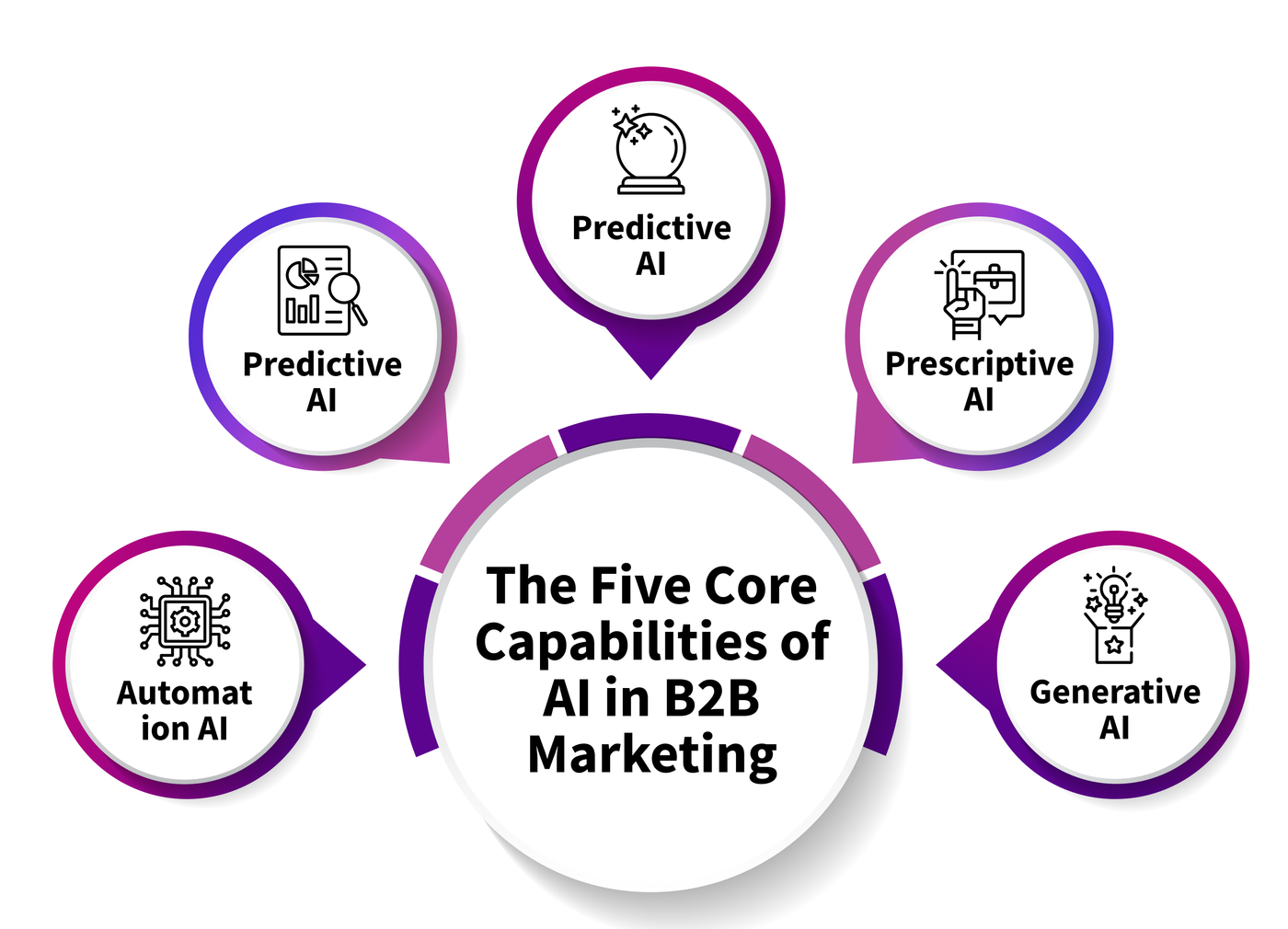
- Automation AI: Automates repetitive tasks, allowing teams to focus on high-value activities.
- Perceptive AI: Analyzes large datasets to uncover patterns and generate insights.
- Predictive AI: Forecasts trends and outcomes based on historical data to guide planning and decision-making.
- Prescriptive AI: Recommends optimal next steps to improve customer engagement and business outcomes.
- Generative AI: Creates new content and facilitates natural language interactions with data.
While each capability adds value independently, combining predictive and generative AI can unlock even greater potential by enabling actionable insights and real-time execution.
Check out one of our recent webinars that discusses each of these in depth.
Real-World Use Cases for Predictive and Generative AI
Applications of Predictive AI
Predictive AI uses historical data to forecast future outcomes, making it a critical tool for improving GTM strategies. Key use cases include:
- Audience Segmentation: Predictive models analyze customer behavior, preferences, and demographics to group customers with similar attributes. This enables more personalized and effective marketing campaigns.
- Opportunity Scoring: AI prioritizes leads and opportunities most likely to convert, helping teams focus their efforts on high-value prospects.
- Sales Forecasting: By examining past sales data, predictive AI helps sales teams adjust strategies and estimate future revenue with greater accuracy.
- Channel and Content Recommendations: AI evaluates engagement data to suggest the most effective content and channels for reaching target audiences.
Applications of Generative AI
Generative AI is widely recognized for its ability to create content, but its applications extend beyond ideation. Notable use cases include:
- Natural Language Data Queries: Teams can interact with large datasets using simple language queries, making data insights more accessible.
- Content Creation: AI assists in drafting and refining marketing materials, videos, and imagery.
- Personalized Messaging: Generative AI tailors content based on customer preferences, driving better engagement.
- Conversational Automation: Modern AI-driven chat tools offer enhanced self-service options, delivering superior customer experiences compared to traditional chatbots.
Combined Applications
By integrating predictive and generative AI, businesses can achieve transformative results, such as:
- Dynamic Dashboards: Predictive insights presented through generative AI interfaces allow teams to create dashboards on demand.
- Informed Content Creation: Predictive intelligence helps shape the messaging and format of content, while generative AI speeds up creation.
- Personalized Recommendations: AI combines customer data with predictive insights to suggest the next-best actions in real-time, improving customer engagement.
Overcoming Common Challenges in AI Integration
While the potential of AI is immense, many organizations face hurdles in its adoption. The most common challenges include:
- Technology-First Mindset: Many organizations start by seeking AI tools without a clear understanding of their business problems or objectives. This approach often leads to misaligned solutions.
- Undefined Business Requirements: Teams may fail to articulate what they need AI to achieve, resulting in tools that do not meet their needs or require resources they lack.
- Data Quality Issues: Predictive AI depends on high-quality, integrated data from multiple sources. Poor data can undermine the effectiveness of AI models.
To address these challenges:
- Focus on identifying specific business problems before selecting AI tools.
- Clearly define business requirements and evaluate potential solutions based on how well they align with these needs.
- Invest in robust data integration and cleansing to ensure AI models are built on reliable, comprehensive datasets.
Redefining Attribution with Predictive AI
Attribution has long been a pain point for B2B marketing and sales teams. Traditional attribution models often rely on rule-based approaches, such as first-touch or last-touch attribution, which fail to account for the complexity of modern hybrid GTM motions. Predictive AI offers a fresh perspective by transforming attribution into a forward-looking, actionable process.
Key advancements include:
- Full-Funnel Perspective: AI analyzes the entire buyer journey, integrating data from marketing, sales, and partner interactions.
- Predictive Insights: AI forecasts the ROI of marketing campaigns, helping teams refine spend and prioritize efforts.
- Actionable Recommendations: AI not only identifies high-performing channels but also suggests specific actions to improve results in real-time.
By adopting a predictive AI-driven approach to attribution, organizations can shift from reactive measurement to proactive decision-making.
Building a Strong Data Foundation for AI
The effectiveness of predictive AI depends on the quality and scope of the data it analyzes. To maximize the value of AI, businesses must:
- Integrate data from diverse sources, including CRM systems, marketing automation platforms, and paid ad channels.
- Capture key touchpoints across the GTM motion, from digital ads to in-person events.
- Establish a unified revenue data graph that harmonizes data from all stages of the buyer journey.
This foundation enables organizations to generate accurate predictions, identify actionable insights, and improve pipeline performance.
Connecting AI Insights to Pipeline and Revenue Impact
While predictive and generative AI can surface powerful insights, their real value emerges when those insights are tied directly to pipeline and revenue outcomes. Many organizations successfully deploy AI to analyze engagement patterns, segment audiences, or generate content, but the challenge often lies in translating these insights into measurable business results.
By integrating AI outputs with CRM systems and pipeline analytics, GTM teams can better understand how AI-driven insights influence opportunity creation, deal progression, and win rates. For example, predictive models identifying high-intent accounts or opportunities can help teams prioritize outreach, while generative AI can accelerate the creation of personalized engagement strategies for those accounts.
This alignment enables marketing, sales, and revenue operations teams to work from a shared view of pipeline impact. Instead of treating AI insights as isolated analytics, organizations can use them to guide resource allocation, refine targeting strategies, and improve conversion rates across the funnel.
Ultimately, connecting AI insights with pipeline performance helps transform AI from an experimental technology into a strategic driver of predictable revenue growth.
The Future of AI in B2B Marketing and Sales
The potential of predictive and generative AI in B2B marketing and sales is vast. From refining campaign effectiveness to enabling data-driven pipeline predictions, these technologies are reshaping how businesses approach their GTM strategies. However, success requires a strategic approach—one that prioritizes customer value, aligns AI initiatives with business goals, and builds on a foundation of high-quality data.
As organizations embrace AI, those who take the time to define clear objectives and invest in the right tools and processes will be best positioned to unlock its transformative potential.
For more insights on the role of AI in GTM strategies, download our Future of Attribution ebook or connect with us to explore how predictive and generative AI can elevate your pipeline performance.