On this page
For B2B marketing leaders, one question never seems to go away: Which marketing investments are actually driving revenue?
In theory, marketing attribution should answer this. But in reality, B2B customer journeys are rarely simple. Buyers interact with dozens of touchpoints over months, sometimes years. Channels influence each other, offline initiatives shape demand in ways that can’t always be tracked, and the final conversion often happens long after the initial marketing interaction.
Traditional attribution models struggle to capture this complexity. This is why many modern revenue teams are turning to Marketing Mix Modeling (MMM), a statistical approach that helps quantify the true contribution of marketing channels to business outcomes.
In a recent RevSure webinar, Ram Arunachalam, VP of Data and Analytics, and Akash Sharma, Data Scientist at RevSure, explored how marketing mix models actually work behind the scenes. Their discussion focused not only on what MMM is, but also on how these models are built, why they are particularly valuable for B2B companies, and how they help marketing leaders make more confident budget decisions.
Understanding how these models operate reveals why they are becoming an essential part of modern go-to-market strategy.
Why Marketing Mix Modeling Matters in B2B
Most attribution models attempt to track the path of an individual buyer. They analyze interactions like clicks, ad impressions, or email opens and then assign credit to the touchpoints that led to a conversion. While this approach works reasonably well for short consumer purchase cycles, it becomes far more difficult in B2B environments.
A typical B2B sales cycle can span several months. Multiple stakeholders are involved in decision-making. Marketing and sales teams engage prospects through a variety of channels, including digital ads, content marketing, webinars, events, and direct outreach. Some of these interactions are measurable at the user level, while others influence buying behavior in ways that cannot easily be tracked.
Marketing mix modeling approaches the problem from a different angle. Instead of analyzing individual journeys, MMM analyzes aggregated marketing and business data over time. By examining historical patterns in marketing activity and revenue outcomes, the model estimates how different channels contribute to results such as pipeline, bookings, or ARR.
The inputs typically include marketing spend, impressions, clicks, campaign activity, and other performance signals. These are evaluated alongside business outcomes across a time series framework. By analyzing how changes in marketing activity correspond to changes in revenue or pipeline, the model can estimate the contribution of each channel.
This top-down perspective makes MMM particularly useful for B2B companies where attribution signals are incomplete or fragmented.
MMM and Multi-Touch Attribution Serve Different Purposes
One common misconception is that marketing teams must choose between marketing mix modeling and multi-touch attribution. In reality, the two approaches answer different questions and work best when used together.
Multi-touch attribution begins with the conversion event and analyzes the individual touchpoints that led to it. By examining user-level interactions, it distributes credit across channels that influenced the journey.
Marketing mix modeling works in the opposite direction. It starts with overall marketing activity and uses statistical modeling to estimate how that activity contributed to business outcomes. The result is that the two approaches complement each other. Multi-touch attribution is useful for understanding short-term campaign performance and user journeys, while MMM provides a broader strategic perspective on marketing effectiveness over time.
When combined with experimentation and incrementality testing, these approaches form a comprehensive attribution ecosystem that gives revenue teams a far more complete understanding of marketing performance.
A Model That Captures the Full Marketing Ecosystem
One of the biggest advantages of marketing mix modeling is its ability to capture marketing impact beyond immediate responses. Many marketing activities influence buyer behavior gradually, creating effects that unfold over time. For example, a brand campaign may increase awareness and interest long before a prospect eventually converts. Content marketing may shape perceptions and build trust months before a buyer enters a sales conversation. Even performance campaigns often contribute to long-term brand visibility that supports future demand.
MMM is designed to capture these dynamics.
Because it analyzes historical data across extended time periods, it can detect relationships between marketing activity and business outcomes that occur weeks or months later. It can also identify interactions between channels that influence overall performance.
Another powerful capability is the ability to model diminishing returns. Every marketing channel eventually reaches a point where additional spend produces smaller incremental gains. Marketing mix models estimate these response curves, helping marketers understand how much additional pipeline or revenue each additional dollar of spend is likely to generate.
This insight is particularly valuable when planning budgets, as it helps teams determine whether they are over-investing in certain channels while under-investing in others.
Want to see the model explained live? You can watch the webinar recording here.
The session dives deeper into how the models are built, how they are evaluated, and how marketers can use the results to guide budget allocation decisions.
Building the Foundation: The Role of Data
For any marketing mix model to produce reliable insights, it must begin with a strong data foundation.
At RevSure, the modeling process starts with a unified data model that integrates information from across the go-to-market ecosystem. Marketing platforms, CRM systems, advertising channels, and other operational tools contribute data that represents different stages of the revenue funnel.
This unified dataset becomes the foundation for the model. It enables analysts to evaluate marketing impact across the entire funnel, from early demand generation to pipeline creation and eventual bookings.
Because B2B marketing performance is influenced by multiple factors beyond campaign activity, the model also incorporates control variables such as seasonality, macroeconomic trends, and competitive conditions. These elements help separate marketing-driven impact from broader market fluctuations that may affect revenue outcomes.
Once the raw data is assembled, it must be transformed into features that the model can analyze.
Transforming Marketing Signals into Model Inputs
Marketing data is rarely ready for modeling in its raw form. Before the modeling process begins, several transformations are applied to ensure the model accurately represents real-world marketing dynamics.
The first transformation accounts for what is known as adstock effects. Advertising does not influence buyers instantly and then disappear. Instead, it leaves a lingering impression that gradually fades over time. Adstock modeling captures this phenomenon by estimating how long marketing exposure remains in a potential buyer’s memory.
The second transformation addresses lag effects. In B2B environments, the time between a marketing interaction and a final conversion can be significant. A campaign that runs in January may contribute to a deal that closes months later. Lag modeling allows the system to capture these delayed impacts.
Finally, the model separates organic baseline performance from marketing-driven performance. Trends and seasonality are incorporated to ensure that recurring demand patterns are not mistakenly attributed to marketing activity.
These transformations allow the model to better reflect the reality of B2B marketing influence.
Why Bayesian Modeling Is Used
At the core of the RevSure marketing mix model is a Bayesian regression framework. Unlike traditional regression models that produce a single estimate for each variable, Bayesian models estimate a distribution of possible values.
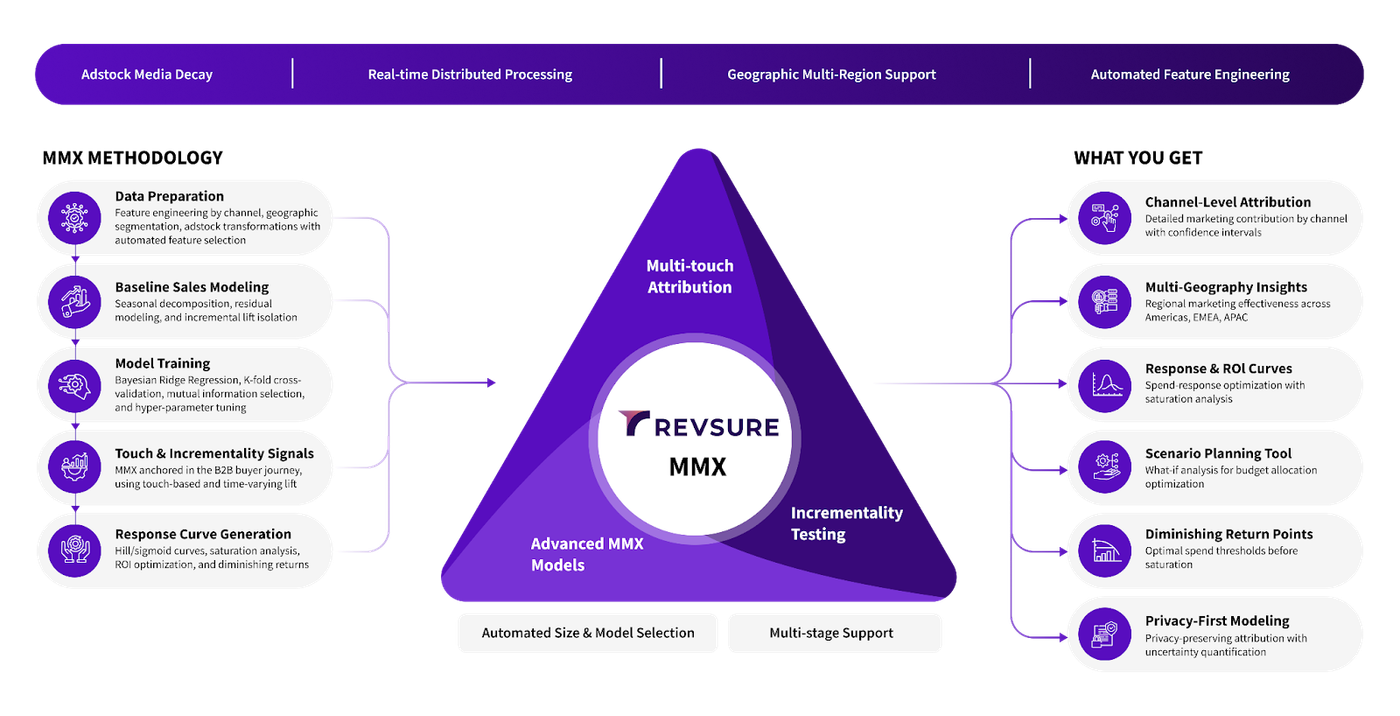
This approach is particularly well-suited for B2B data environments, which often contain noisy signals, sparse observations, and high correlations between variables. Marketing channels frequently interact with one another, making it difficult for simpler models to isolate their individual contributions.
Bayesian modeling addresses this challenge by incorporating prior assumptions and updating them as new data becomes available. These priors act as stabilizing forces that prevent the model from producing unrealistic estimates when data is limited or highly variable. The model then evaluates the posterior distributions that emerge from the data. These distributions represent the likely range of contributions each channel makes to the final outcome.
To ensure reliability, the modeling process also incorporates cross-validation techniques that evaluate performance across multiple training iterations. This helps confirm that the model’s predictions remain stable and generalizable.
Capturing the Ripple Effects of Marketing
Another concept discussed in the webinar is the halo effect in marketing. Marketing spend rarely translates directly into revenue. Instead, it triggers a chain of intermediate signals that eventually lead to business outcomes.
A campaign may generate impressions, which drive website visitors. Those visitors may engage with content, register for events, or download resources. Over time, these interactions convert into leads, opportunities, and eventually revenue.
Marketing mix models incorporate these ripple effects by including intermediate metrics such as impressions, visitors, and engagement signals. By modeling how these intermediate signals influence downstream outcomes, the system gains a more nuanced understanding of how marketing investments drive revenue. This ability to model indirect impact is one of the reasons MMM provides insights that simpler attribution approaches often miss.
Turning Insights into Budget Decisions
The final outputs of the model translate complex statistical analysis into actionable insights for marketing leaders, with many teams now adopting automated marketing mix modeling to continuously optimize budget allocation and decision-making. One of the most valuable outputs is the response curve, which illustrates how different levels of spend influence revenue outcomes. By examining these curves, marketers can identify the point at which additional spend begins to produce diminishing returns.
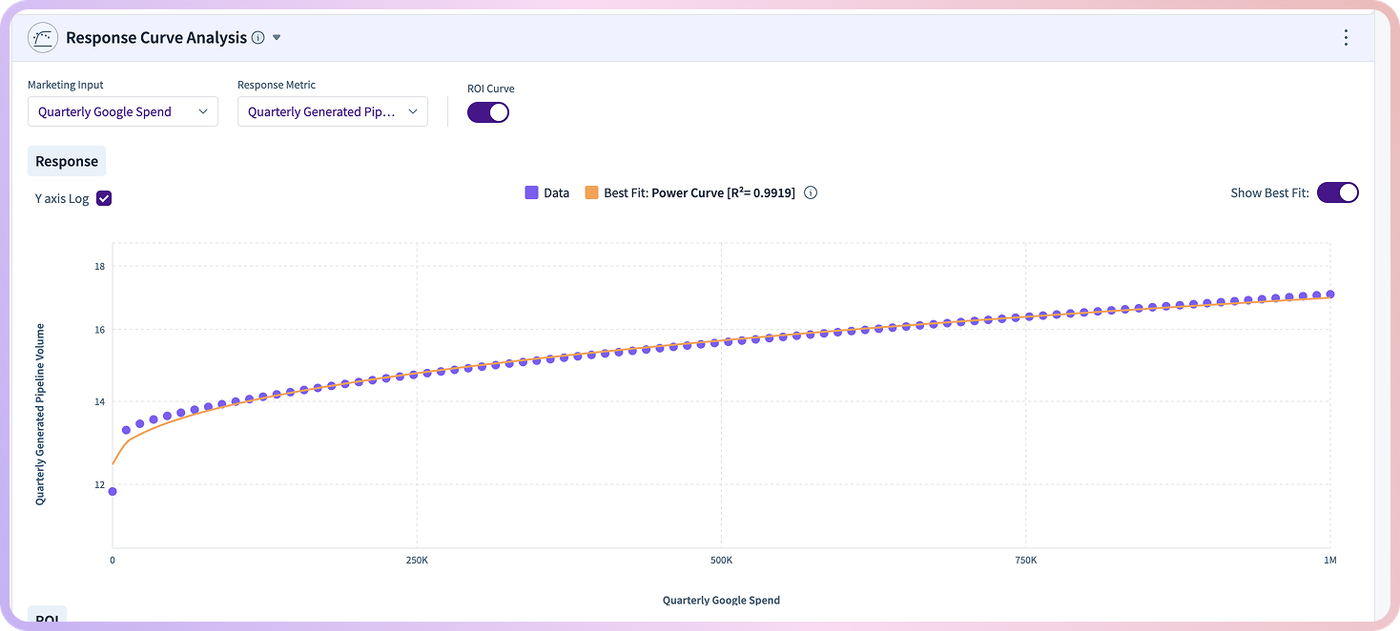
This enables teams to answer questions that are central to strategic planning. They can determine whether certain channels are oversaturated, whether the budget should be shifted to emerging opportunities, and how much incremental revenue can be expected from increased investment.
In addition to response curves, the model also produces channel-level contribution estimates that show how different marketing activities influence pipeline and bookings across time periods.
These insights are presented through reporting interfaces that allow marketers to explore different scenarios and simulate budget allocation strategies.
The Future of Marketing Measurement
As B2B marketing continues to evolve, measurement challenges will only grow more complex. Privacy changes, fragmented buyer journeys, and the increasing importance of brand marketing all make it harder to rely solely on traditional attribution methods. Marketing mix modeling offers a way forward by providing a broader analytical framework that captures both direct and indirect marketing impact.
When integrated into a unified revenue platform, MMM becomes even more powerful. It enables organizations to connect marketing activity with sales outcomes, align marketing and revenue teams around shared metrics, and make budget decisions based on comprehensive data rather than isolated campaign performance. Ultimately, the goal is not simply to measure marketing effectiveness but to optimize it continuously.
Final Thoughts
Marketing mix modeling represents a significant shift in how B2B organizations evaluate marketing performance. By combining statistical modeling with full-funnel data visibility, it allows companies to move beyond surface-level attribution and gain deeper insight into how their marketing investments drive revenue.
For marketing leaders responsible for allocating millions of dollars in budget, this level of clarity is invaluable. As Ram and Akash explained in the webinar, the real power of MMM lies not only in measuring marketing’s impact but in enabling smarter decisions about where to invest next.