On this page
B2B attribution software is often bought for the right reason and for the wrong assumption.
The reason is obvious. Revenue leaders want clarity. They want to know which channels create pipeline, which campaigns influence conversion, which accounts are actually moving, and where to invest the next dollar. In a market where every budget decision is scrutinized, attribution feels like the system that should finally connect activity to outcomes.
The assumption is where things break. Most teams assume attribution is a reporting problem. Buy the tool, connect the systems, pick a model, and the answers should appear.
But attribution is not a reporting problem. It is a data architecture problem, an identity problem, a buyer journey problem, and increasingly, an activation problem. That is why so many teams end up disappointed. The dashboards look polished, but the underlying logic cannot stand up to the complexity of enterprise B2B.
At RevSure, that complexity is the starting point, not the edge case. The platform was built around the idea that attribution only works when it sits on top of a unified GTM data foundation, one that can normalize fragmented systems, stitch anonymous and known journeys, account for account-level buying behavior, and push insights back into execution systems. That matters because the market no longer needs another attribution dashboard. It needs a system that can explain how revenue actually happens.
So before you buy B2B attribution software, ask these 11 questions. More importantly, ask whether the platform you are evaluating can answer them in a way that reflects how modern enterprise GTM actually works.
1. What is the system actually attributing?
This is the first question because it is the most revealing. A surprising number of attribution platforms still operate as if leads are the end goal. Some can show campaign influence on opportunity creation. Fewer can connect that influence all the way through to open pipeline, stage progression, bookings, and revenue outcomes.
That distinction matters. If the system is primarily attributing form fills or MQLs, it will optimize your business toward measurable activity, not business impact. Enterprise teams do not need another way to glorify lead volume. They need to understand what creates a qualified pipeline, what accelerates opportunity movement, and what correlates with bookings.
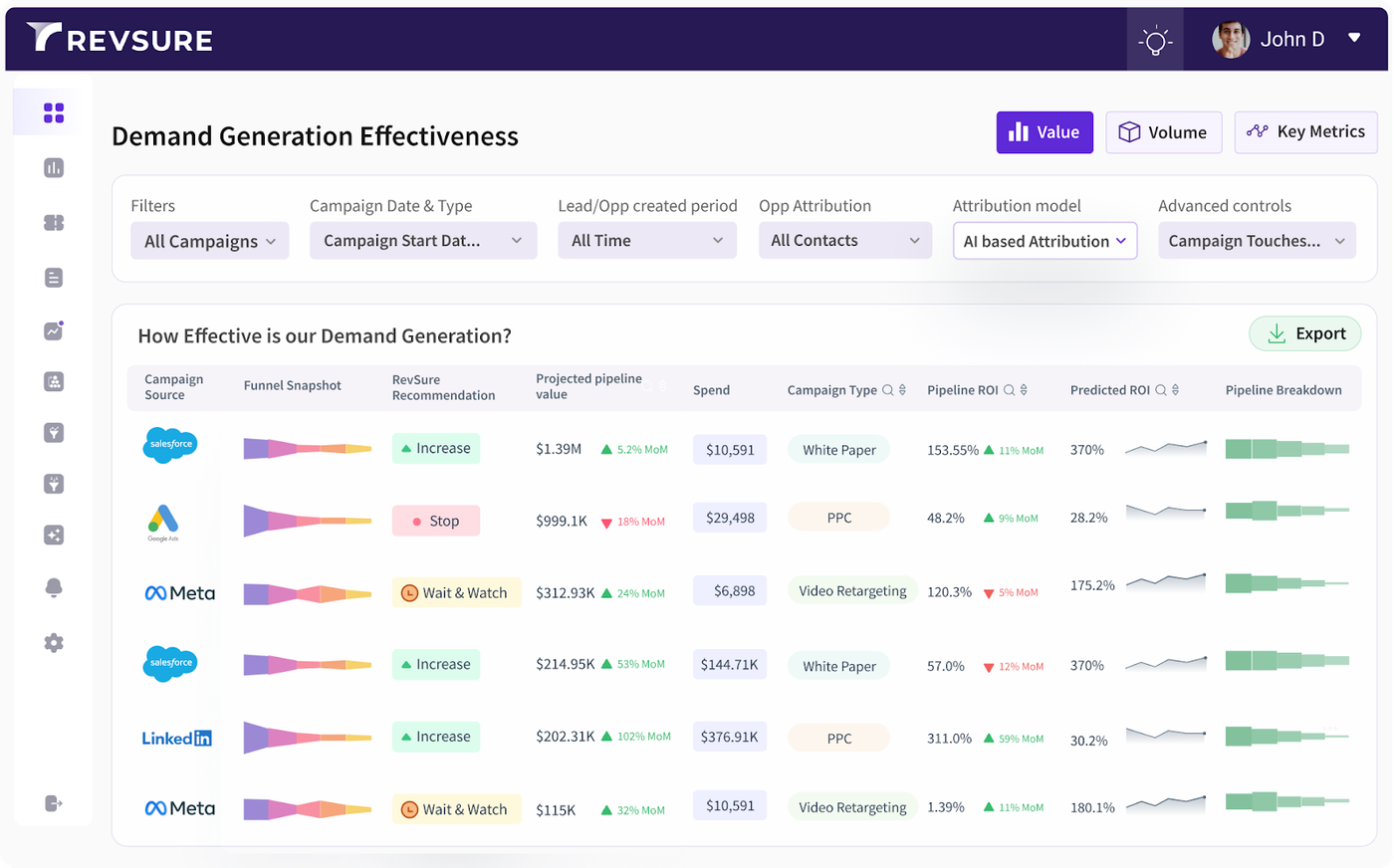
RevSure’s approach is stronger here because attribution is not isolated from the rest of the revenue model. Its views already connect campaign influence to pipeline and revenue through modules, like Demand Generation Effectiveness, Funnel Conversion Attribution, and full-funnel journey intelligence. That means the question is not just “which campaign generated a touch,” but “which activities contributed to pipeline creation, movement through funnel stages, and eventual revenue.” That sounds like a subtle shift, but it is the difference between measuring marketing activity and measuring business outcomes.
2. Is attribution built on a unified GTM data foundation?
Most attribution problems begin before modeling ever starts. They begin in disconnected systems.
CRM says one thing. Marketing automation says another. Ad platforms use different campaign naming conventions. Sales engagement tools create activity data that rarely reconciles cleanly with marketing records. Without a normalized data layer, attribution becomes an exercise in stitching together inconsistencies and hoping the dashboard looks coherent enough to trust.
This is one of the clearest areas where RevSure’s architecture matters. RevSure does not treat attribution as a thin analytics layer placed on top of existing tools. It starts by ingesting data across the GTM stack and building what it calls a GTM Data Graph, which connects leads, contacts, accounts, campaigns, opportunities, website events, sales engagements, and enrichment data into a single system of truth. It supports more than 40 out-of-the-box integrations across CRM, MAPs, paid media, ABM tools, sales engagement platforms, enrichment providers, data lakes, chat tools, gifting tools, and more. Historical data can also be ingested, with two to three years recommended so AI and ML models have enough signal to learn from.
That foundation is what makes the attribution layer durable. RevSure standardizes and harmonizes fields, supports attribute mapping through the UI, handles discrepancies in field names and formats, derives campaign structure from UTM parameters where needed, and supports configurable strategies for linking leads, contacts, accounts, and opportunities. In other words, the attribution outputs are only as reliable as the data model beneath them, and RevSure is unusually explicit about solving that layer first.
3. How does it handle identity resolution across anonymous and known journeys?
Most B2B buying starts in the dark. Buyers visit a website anonymously, consume content, compare vendors, and only later reveal themselves through a form fill, a meeting, or a CRM record. If attribution begins only once someone becomes known, then the early and often decisive part of the journey is already lost.
This is one of the core reasons generic attribution tools struggle in enterprise B2B. They are good at tracking known contacts. They are much weaker at connecting the path from an anonymous visitor to an account to an opportunity.
RevSure addresses this with a much deeper identity model. Its first-party pixel captures website activity, supports cookieless tracking, and can be loaded from a customer’s domain. On top of that, RevSure uses a configurable fingerprinting system across multiple levels, incorporating signals like IP, location, device, OS, browser, and session context to connect interactions across pages, sessions, and devices. It also enriches data through third-party partners and reverse IP mapping, then uses deterministic and probabilistic matching to associate anonymous activity with existing leads, contacts, and accounts. When there is no existing match, it can create records in-platform and connect them later as more signals emerge.
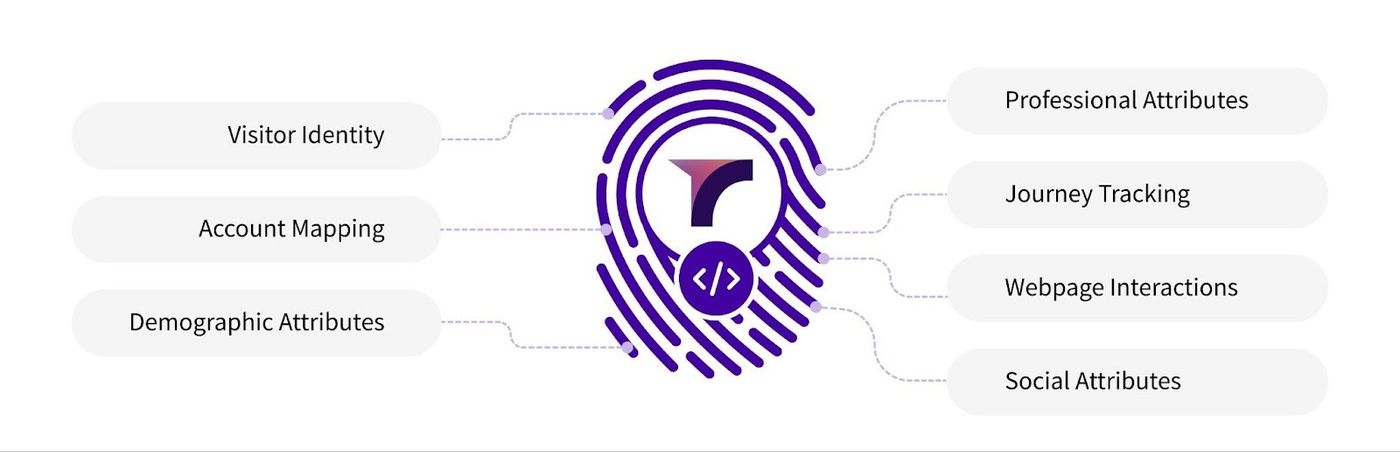
That is not just an identity feature. It is the reason RevSure can genuinely map the buyer journey from anonymous to known to opportunity to closed-won. Without that continuity, attribution is always working with a partial story.
4. Can it represent buying groups, not just individual leads?
B2B buying is rarely a single-threaded journey. Enterprise opportunities involve multiple stakeholders, multiple functions, multiple sessions, and multiple channels over time. A lead-centric attribution model may tell you who filled out the form. It usually cannot explain how the buying group evolved toward a decision.
This is where many platforms fall apart in practice. They were built around individual conversion paths and then adapted for account-based motions. But enterprise buying does not work that way. Influence accumulates across the account.
RevSure’s design is much closer to how real GTM teams think. Its account journey views show multi-touch campaign data, channel influence across funnel stages, and detailed touchpoints across the full account timeline. Account Prioritization modules bring together online and offline touches, number of contacts and opportunities, account-level intelligence, and AI-driven propensity models. The platform also supports configurable lead-to-account and lead-to-opportunity mapping even when CRM data is incomplete. That matters because enterprise attribution must explain not only who engaged, but how engagement across the account contributed to pipeline and bookings.
5. What attribution models are available, and how flexible are they?
A lot of attribution software still treats model variety as the headline feature. First-touch, last-touch, linear, maybe time decay. But the real question is not whether multiple models exist. It is whether the system can adapt those models to your GTM motion.
RevSure does well here because it combines broad model coverage with customization. Out of the box, it supports first-touch, last-touch, any-touch, linear, U-shaped, J-shaped, inverse J-shaped, influenced attribution, AI-based attribution, and custom approaches. More importantly, clients can create custom attribution logic without code. Exclusions can be applied. Filters can be defined. AI-based models can be tuned around sales motions, regions, and verticals. Custom attribution methodologies from source systems can also be ingested where necessary.
This is important because attribution should not force the business into a fixed template. It should allow the business to ask different questions in different contexts. A marketing leader may want to understand top-of-funnel influence. RevOps may need to understand stage progression. Finance may care about bookings contribution. A rigid model cannot answer all of those well. RevSure’s flexibility is one of the more enterprise-ready aspects of the platform.
6. How does it account for offline touchpoints and the dark funnel?
Every attribution vendor says they want to measure the buyer journey. The real test is whether they only mean the digital part of it.
Enterprise deals are shaped by field events, outbound calls, in-person meetings, gifting, referrals, partner activity, communities, executive relationships, and internal selling motions that don’t always show up cleanly in web analytics. If your attribution system ignores those interactions, it will systematically over-credit what is easy to track and under-credit what often matters most.
RevSure’s answer is practical rather than theoretical. If offline or sales activity exists in a connected system like Salesforce, it is ingested. If it does not, it can be uploaded through CSV or brought in through custom objects and integrations. The platform classifies both digital and offline touchpoints into channels and includes them in journey views and attribution models. This does not magically “solve” the dark funnel, but it does something more useful: it reduces the blind spots by making offline influence part of the same data model instead of leaving it outside the analysis.
7. Can it handle long, non-linear enterprise sales cycles?
Most enterprise deals do not move in a straight line. They slow down, re-accelerate, expand, involve new stakeholders, and pick up new touches across months or even years. That means attribution systems built around short windows or simplistic session logic are inherently flawed for enterprise use cases.
RevSure handles this better because it is designed to preserve historical continuity. It recommends ingesting two to three years of historical data. It tracks historical changes to custom attributes. It can use source-system history objects or build internal history off syncs and CDC events. Funnel stages and timestamps can be customized based on how the customer actually defines lifecycle progression, rather than forcing a generic model onto the business. The only automatically generated stage is “Visitor,” which captures the pre-funnel anonymous journey before known conversion points begin.
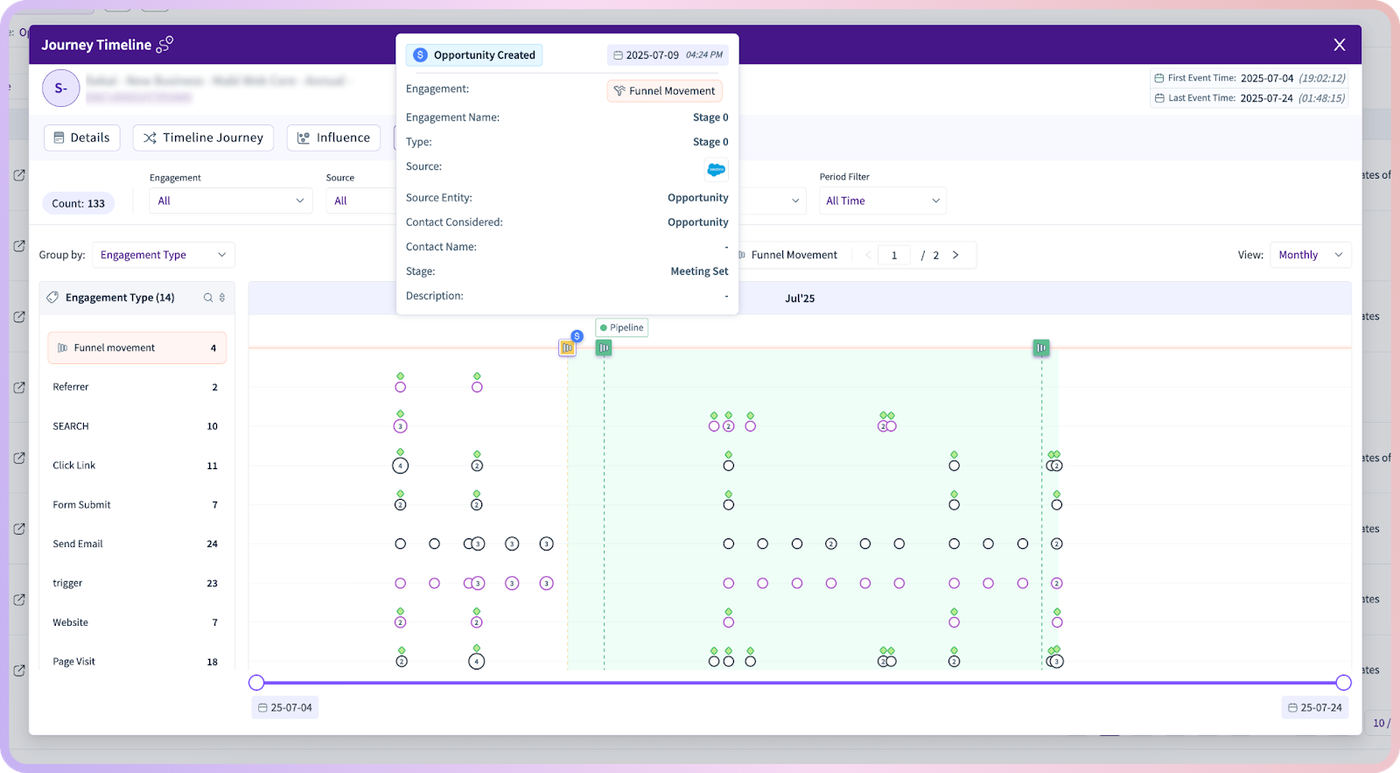
The practical outcome is that RevSure can distinguish between pipeline creation, stage movement, and later influence across longer cycles. That is critical because enterprise attribution is as much about timing as it is about touchpoints.
8. Is the system transparent and extensible enough for enterprise teams?
Attribution only becomes strategically useful when people trust it. And trust requires transparency.
That means understanding how the data is structured, how records are matched, where the outputs come from, and whether advanced users can inspect or extend the system rather than simply consume a black-box dashboard.
RevSure does relatively well here because it supports both business-user and analyst workflows. Business users can work through drag-and-drop dashboards, natural-language prompts in Reli, and customizable filters and views. Advanced users can access daily refreshed reporting tables in BigQuery, query data through BI tools, use APIs, or reverse ETL datasets into Snowflake, Redshift, BigQuery, object stores, and other destinations. Raw and aggregated data can be exported. The data schema is documented for external use. Reporting tables, entity tables, attribution outputs, and raw source dumps can be accessed outside the application.
This matters because enterprise teams rarely want attribution trapped inside one UI. They want it connected to their broader analytics and operating environment. RevSure’s data portability makes it easier for attribution to become part of the company’s decision system rather than a standalone reporting product.
9. Does it activate insights, or just display them?
This is where a lot of attribution software quietly fails. It provides analysis but does not change execution.
In mature GTM organizations, attribution should influence what happens next. It should update sales priorities, improve targeting, shape audience creation, inform campaign reallocation, and push high-value signals back into the systems where teams already work.
RevSure is notably stronger on this than a typical attribution vendor. Scores, journeys, and summaries can be written back into Salesforce and HubSpot. Lead, account, and opportunity propensity models can be pushed into CRM objects and used to trigger workflows. Attribution data and journey data can be written back through custom objects. Deep-funnel conversion events can be pushed into ad platforms to improve optimization. Lists and audiences can be created dynamically and activated. Sales-facing alerts can be sent through Slack. Reli can surface AI-powered summaries and recommendations in the workflow.
That is a different operating philosophy. Attribution is not the endpoint. It is an input into prioritization and action.
10. Will sales, marketing, and RevOps all use it?
A lot of attribution tools are really marketing dashboards wearing a broader label. That becomes a problem quickly because revenue is not created by marketing alone, and any system perceived as “marketing’s version of the truth” will struggle to gain adoption across functions.
RevSure has a more cross-functional posture. Marketing gets campaign intelligence, MMM, incrementality testing, funnel attribution, and content-to-pipeline views. Sales gets account prioritization, journey timelines, lead and opportunity alerts, next-best actions, stalled deal detection, and pipeline projections. RevOps gets a unified data model, custom reporting, exportability, configurable funnel stages, and the ability to write data back into core systems. Role-based access and customizable user views mean the same underlying truth can be presented differently to executives, marketers, sellers, and analysts.
That cross-functional utility is not cosmetic. It is one of the strongest signals that a system can become operationally important rather than simply informational.
11. What does implementation, support, and long-term viability actually look like?
The final question is often treated as a procurement detail, but it should be strategic. Attribution systems fail as often in implementation as they do in architecture. If onboarding is vague, if mapping is overly manual, if reporting requires constant vendor intervention, or if support disappears after go-live, the system will not become embedded in the business.
RevSure’s implementation story is relatively strong and very enterprise-oriented. Typical implementations run five to six weeks, with initial value often visible in three to four. Pre-onboarding includes a discovery questionnaire, automated mapping with editable post-connection controls, and formal data validation against source systems. The onboarding program covers system connections, funnel configuration, taxonomy review, attribution setup, dashboard delivery, training, and recurring executive check-ins. Long-term support includes weekly or monthly advisory, setup for new integrations and views, and ongoing enablement.
From a company perspective, RevSure also presents as a more stable enterprise partner than many early-stage point solutions. Its roadmap is explicitly centered on deeper GTM planning and optimization, agentic AI orchestration, and continued investment in integrations and enrichment. That matters because attribution software is not a six-month experiment for enterprise teams. It becomes part of the operating stack.
The real conclusion: don’t buy attribution as a dashboard
If you step back from these 11 questions, the pattern is clear. The future of attribution is not about adding more models or prettier reporting. It is about building a system that can unify GTM data, resolve identity, represent real buying behavior, support long sales cycles, surface trustworthy insights, and push those insights back into execution.
That is the RevSure narrative, and it is stronger when stated plainly. RevSure does not really “win” by offering a larger menu of attribution reports. It wins when the buyer realizes that attribution alone is too narrow a category. What enterprise teams actually need is a revenue intelligence system that makes attribution possible, credible, and actionable.
That is why RevSure’s strengths show up repeatedly across these 11 questions:
- a broad integration layer and a normalized GTM Data Graph rather than disconnected data stitching
- full-funnel identity resolution across anonymous, known, account, and opportunity levels
- multi-touch, multi-model, AI-supported attribution with no-code customization
- activation through CRM write-backs, ad platform signals, prioritization, alerts, and audience workflows
And that is also why the conversation should not end at attribution. Once the foundation is in place, adjacent capabilities like pipeline coverage prediction, campaign performance prediction, MMM, incrementality testing, deep funnel optimization, and AI-driven prioritization become possible in the same operating layer.
That is not a sales message. It is a category message. Enterprise B2B has outgrown attribution tools that only explain the past. The next generation of systems has to help companies understand what is happening, why it is happening, and what to do next.
So before you buy B2B attribution software, ask these 11 questions carefully. If the answers stop at dashboards, model names, and surface-level integrations, you are probably buying another reporting layer.
If the answers point toward unified data, full-funnel identity, cross-functional activation, and enterprise-grade operating depth, you are evaluating something much more valuable.