On this page
You Think Forecasting Starts with Deals? Think Again.
We’re wired to think in straight lines. A lead becomes an MQL, which becomes an SQL, which becomes a deal, and then, hopefully, a win. But forecasting revenue based on what’s in the pipeline today ignores the most critical part of the journey: how those leads even got there.
Forecasting from the top down? That’s linear thinking and mirrors a traditional top down forecasting approach.
Forecasting from the ground up? That’s funnel intelligence powered by bottom up models.
At RevSure, we believe the most accurate revenue forecasts start at the first touchpoint, long before the opportunity is created, using bottom up sales forecasting rather than surface-level pipeline math.
Let’s Talk About Lucy
Let’s say Lucy joins your Enterprise Sales team with a $1M quota this quarter. The rule of thumb? She needs 3x coverage, $3M in pipeline, to confidently hit her goal.
But here’s the catch.
Some of that pipeline isn’t real. Some deals don’t have a budget. Some were created without proper qualification. Which means it’s not really pipeline, it’s noise.
Only SALs (Sales Accepted Leads) count as True Pipeline.
So Lucy doesn’t need $3M in open pipeline. She needs $3M in qualified, accepted, and real pipeline to stand a chance, something only a realistic forecast model can reveal.
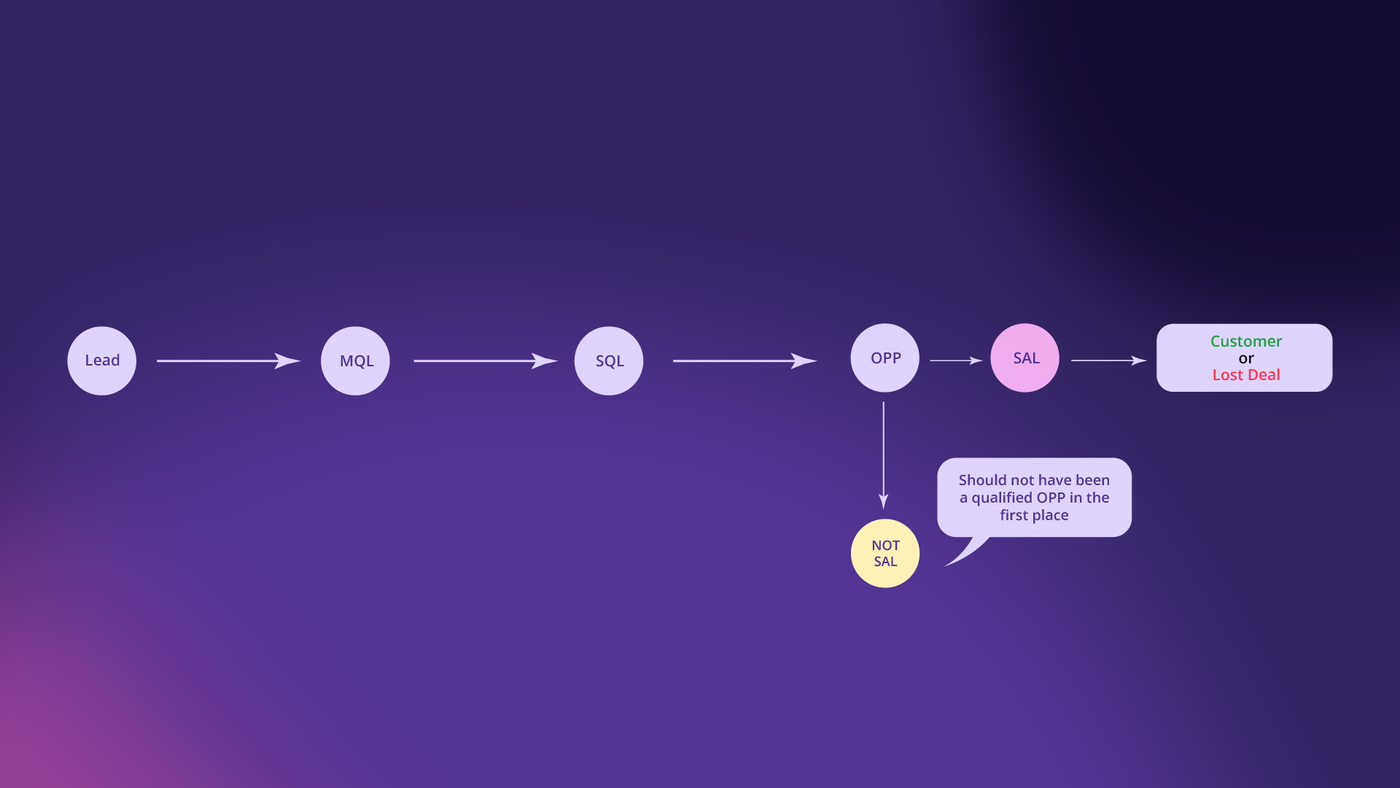
Why the Marketing Funnel Is Where Forecasting Really Begins
If we trace pipeline back far enough, we land at the top of the funnel.
- A lead submits a form
- It gets scored and becomes an MQL
- An SDR qualifies it to create an SQL
- An Opportunity is opened
- Sales accepts it (or doesn’t) as an SAL
Each stage is a filter. A gate. A chance to lose, or improve, forecast confidence. When Sales forecasts revenue without accounting for funnel quality, they're flying blind using incomplete sales data. RevSure’s Full‑Funnel Analytics connects MQLs to SALs and closed revenue in a single unified flow for better forecasting, across different forecasting menthods.
Bottom-Up Forecasting ≠ Pipeline Math
Forecasting isn’t just about plugging in historical win rates and multiplying. That’s a partial picture and often a time consuming exercise with limited accuracy.
Let’s say:
- Lucy has a $3M pipeline
- Her win rate is 30%
- Forecast? $900K expected to close
Sounds solid. But what if 25% of her opportunities shouldn’t have been created at all? The real win rate is lower, and now her revenue projection is off.
Bottom-up forecasting accounts for funnel health, not just pipeline size and highlights bottom up vs top down forecasting differences clearly.
It asks:
- How many MQLs do we need to generate X SALs?
- How many SALs convert to Closed-Won?
- Where are the drop-offs, and why?
This is how teams perform bottom up forecasting with confidence.
Not All MQLs Are Created Equal: The Cohort Effect
Bottom-up forecasting becomes significantly more powerful when you stop treating all leads as equal.
An MQL from a paid campaign targeting enterprise accounts does not convert at the same rate as an MQL from a generic content download. Similarly, SALs sourced from inbound intent behave differently than SALs created through outbound prospecting.
If forecasting assumes uniform conversion rates across all sources, segments, or deal sizes, the math becomes dangerously optimistic.
Cohort-based forecasting solves this.
Instead of asking, “What’s our average MQL → Win rate?”, leading teams ask:
- What is the MQL → SAL → Win rate by source?
- How do enterprise vs. mid-market cohorts convert?
- Which channels produce higher ACV and faster velocity?
- Which segments consistently underperform expectations?
By layering cohort performance into bottom-up forecasting, revenue projections shift from broad assumptions to precision modeling. Pipeline stops being a blended average and becomes a segmented, risk-adjusted forecast.
This is where forecast confidence accelerates, not from more pipeline, but from better understanding of which pipeline actually converts.
Example: The Iceberg in the Funnel
Imagine your site form broke for two weeks. Nobody noticed. Now your MQLs are down, but that won’t affect pipeline until next month, and revenue the month after.
Top-down forecasting won’t catch this or account for changing market trends.
Bottom-up forecasting would have seen the drop in MQLs — and modeled the impact on future growth rates and pipeline coverage.
Forecasting isn't about what you see now. It’s about what you should expect later, based on what’s already broken.
Funnel Visibility = Forecast Confidence
With a bottom-up approach, you’re not just asking “What’s the pipeline coverage?”
You're asking:
- How many MQLs are needed this month to hit our Q target?
- How many SQLs must be generated to feed our reps?
- How many Opportunities should each SDR create, and from which sources?
You’re reverse-engineering revenue with precision using predictive forecasting methods. Every team has a role. Every stage has a responsibility. Forecasting becomes a system, not a spreadsheet. RevSure’s Pipeline Health Insights track how many true SALs are in your funnel and whether that covers future quotas with confidence.
This Is What RevSure Was Built For
At RevSure, we’re building a platform that connects top-of-funnel signals with pipeline health and forecast accuracy. We help RevOps teams:
- Track MQL → SAL → Win conversion rates
- Identify stage-level bottlenecks
- Forecast based on real funnel math
- Give Marketing, SDRs, and Sales aligned targets
Bottom-up forecasting isn’t about control. It’s about clarity across pipeline, performance, and revenue projection accuracy.
Final Word: Forecast Like a Time Traveler
Bottom-up forecasting turns Sales Ops into time travelers, using past patterns, funnel signals, and sales data to predict future revenue with near-scientific precision.
Want to see how many MQLs you need to hit your revenue goal? Try RevSure, book a demo today!