On this page
The short version
A B2B win-back campaign is outreach that reopens closed-lost deals once the real reason they stalled has changed. RevSure, the agentic GTM platform built on the Full Funnel Data Graph, gives the work to a Digital SDR, which reads why each deal was really lost, checks whether the champion is still there, finds what has changed at the account and drafts outreach for a rep to approve.
A sales team with a few years of history usually has hundreds of closed-lost opportunities in its CRM. In the illustrative example account used in this guide, there were 774. Each one carries a loss reason, and most of those reasons were chosen from a pick-list by a rep closing out the record. Before a win back campaign can work, someone has to find out which of those 774 deals were lost for a reason that no longer applies.
That reading is slow, so most teams either leave the deals alone or send one "checking in" email to the whole list. This guide covers what a B2B win-back program needs, why the loss reason field is the weakest place to start, and how RevSure's Digital SDR works through closed-lost deals one at a time.
What is a win-back campaign in B2B sales?
A win-back campaign in B2B sales is planned outreach to accounts whose opportunities closed as lost, timed to a change that makes the original objection weaker. That change might be a new fiscal year, a new budget owner, a merger, a hiring push or a problem that has grown since the last conversation.
In consumer marketing, win-back usually means emailing lapsed customers a discount. B2B win-back works on deals that never closed, with a buying group that already knows the product, and the offer is rarely a price cut. What the seller brings back is the reason to talk again: proof that they remember what stopped the deal and a specific reason the timing is better now.
Closed-lost deals are an unusual kind of pipeline. The account has already been qualified, the pain has been described on calls, and somebody inside the company once argued for the purchase. A closed-lost record with a timing objection is often warmer than most new outbound targets, provided the team knows that the objection was timing.
Why are closed-lost reasons in the CRM so often wrong?
Closed-lost reasons are usually a single picklist field filled in by the rep at the moment the opportunity is closed. The options are broad ("no budget", "went dark", "timing", "chose to do nothing"), the rep has a quota to chase, and the field is often required, so something gets picked. Four patterns make the result unreliable.
The picklist is too coarse. "No budget" can mean the buyer had no money this year, had money but spent it elsewhere, or never got the economic buyer involved. Each needs a different win-back message, and the field cannot tell them apart.
The real reason was said on a call. Buyers explain themselves in meetings and emails: the team is on vacation, planning for next quarter has frozen new projects, procurement wants a cheaper option. That explanation sits in the call recording, not in the field.
Reps choose the reason that protects the forecast story. A rep is more likely to record "timing" or "no decision" than a reason that implies the deal was poorly qualified. This is rarely deliberate, but it skews closed-lost analysis toward vague, blameless categories.
The reason goes stale. A deal lost to "timing" in June is a different prospect by the following budget cycle. The field records the moment of loss and is never updated.
A closed-lost analysis built only on the picklist says most deals died of timing or budget, which nobody can act on. The useful version reads each deal's conversation history and records the objection in the buyer's terms.
What should you check before reopening a closed-lost deal?
Reopening a deal is cheap to do badly and expensive to do well. The checklist below covers the facts a rep, or a digital worker, needs before a win-back message is written.
A rep can run this checklist for three deals. Nobody runs it for 774, which is why win-back programs tend to stop at the list.
Why does champion tracking matter for win-back?
Champion tracking means watching whether the people who backed a deal are still in their roles, and a champion change is the single fact most likely to change a win-back plan. If the champion is still there, the message goes to someone who already argued for the purchase and only needs a reason to raise it again. If the champion has left, the account needs a new route in, and the former champion becomes a prospect at their new company.
A CRM rarely records either case: the contact keeps the same title on the opportunity long after the person has moved on. RevSure's guide to buying groups covers why the CRM loses track of people in general. For win-back, the point is narrower: check the champion before writing anything, because the answer decides who the first email goes to.
How does a Digital SDR run a win-back play?
A digital worker is a managed AI worker that owns a defined job inside a GTM team. RevSure's Digital SDR page lists the jobs it covers, and win-back draws on four of them: buying committee discovery ("Identify likely buying-group members, roles, coverage gaps, and relevant contacts"), intent and signal monitoring, personalized outreach, and the daily prioritization queue. The lead ranking guide covers how that queue is built for new leads. RevSure's Lost Deals Win-Back play points the same jobs at closed-lost opportunities.
Here is how the play works on an illustrative example account, with names masked.
It starts with every closed-lost opportunity. The Digital SDR read all 774 closed-lost opportunities in the example tenant, ordered by amount, and shortlisted candidates by value and recent activity. After review, two deals remained, worth $925K combined.
It pulls the real loss reason from engagement history. For each deal, it read the engagement signals on the opportunity to establish the objection, the pain and the stakeholder map, rather than inferring them from the stage.
It confirms the people. It matched the champion and other named stakeholders on each deal to actual contact records, then ran a job-change check on both champions. Neither had moved: both were still at the same company, in the same or a higher title.
It sizes the buying group. It counted engaged and not-yet-engaged ICP contacts at each account, which showed in both cases that the deal had been worked through far fewer people than the account held.
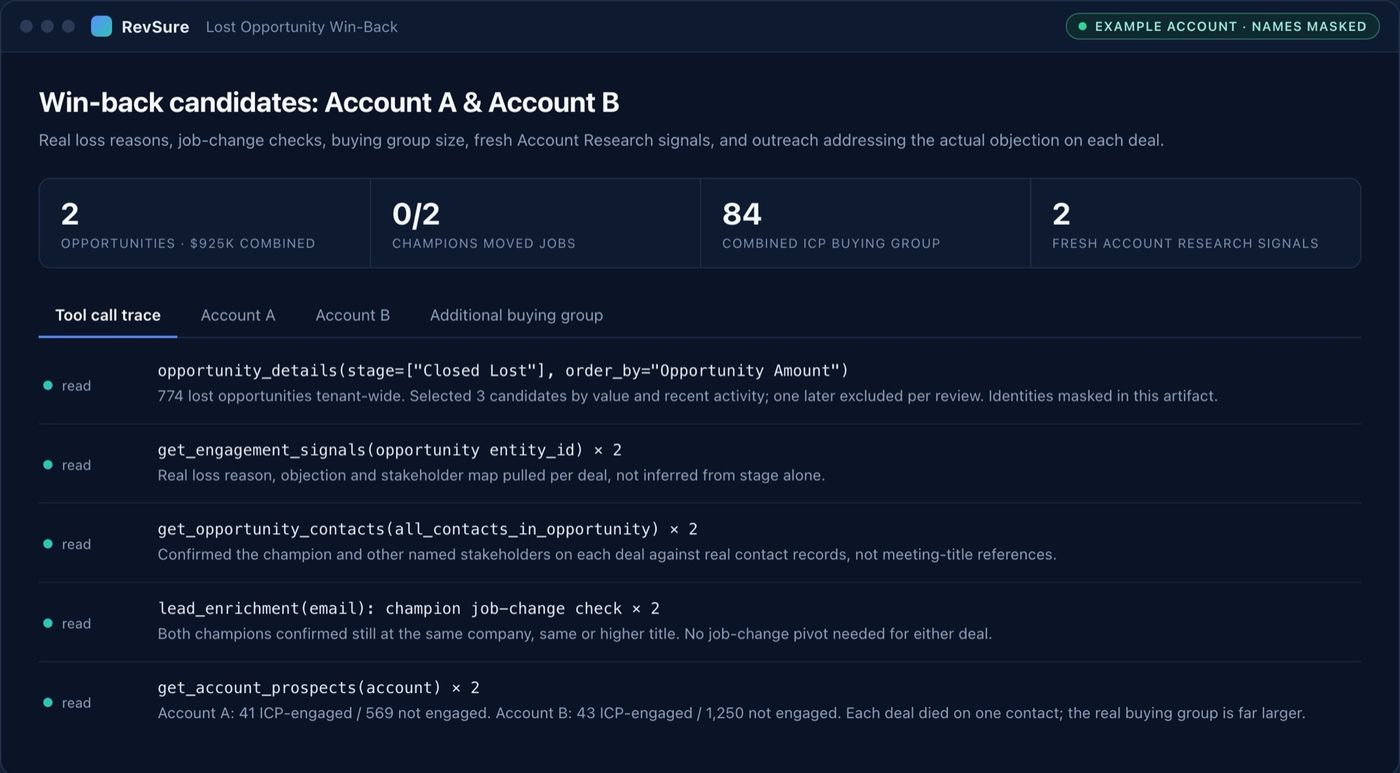
The win-back play's tool call trace on an illustrative example account. Every step is a read: no message goes anywhere until a rep has seen it.
The larger of the two deals, Account A, was worth $625K and closed as lost on 9 June 2025. Its champion was a Digital Marketing Manager. The engagement history showed the objection plainly: internal timeline delays, with team vacations and Q3 planning pushing the project back. The buyer had not rejected the product. The pain they had described was specific too: they could not get ad-level or geo-level daily LinkedIn spend from LinkedIn's API themselves. The economic buyer had been identified before the deal closed.
A picklist would most likely have filed that deal under "timing" next to dozens of others. The engagement history turned it into a deal with a known blocker, a known pain, a known budget owner and a champion who was still in their seat.
What does a good win-back email say?
A good win-back email opens on the reason the deal stopped and the specific thing that has changed since. Generic re-engagement ("just checking in", "wanted to see if priorities have shifted") asks the buyer to do the work of remembering why they were interested. The message should do that work for them.
For Account A, the Digital SDR handed off to an account research step to answer one question: what has actually changed since the last conversation? It found four things.
- The budget window had arrived. It was now FY26, the period the champion had pointed to.
- The account had kept acquiring companies since the deal closed, which adds GTM data complexity rather than reducing it.
- Revenue was growing 34% year over year in Q1 2026, with growth prioritized over margin, which puts pressure on GTM efficiency spend.
- A recent multi-hour service outage was noted as a watch-out: context for the rep if it came up, and kept out of the pitch.
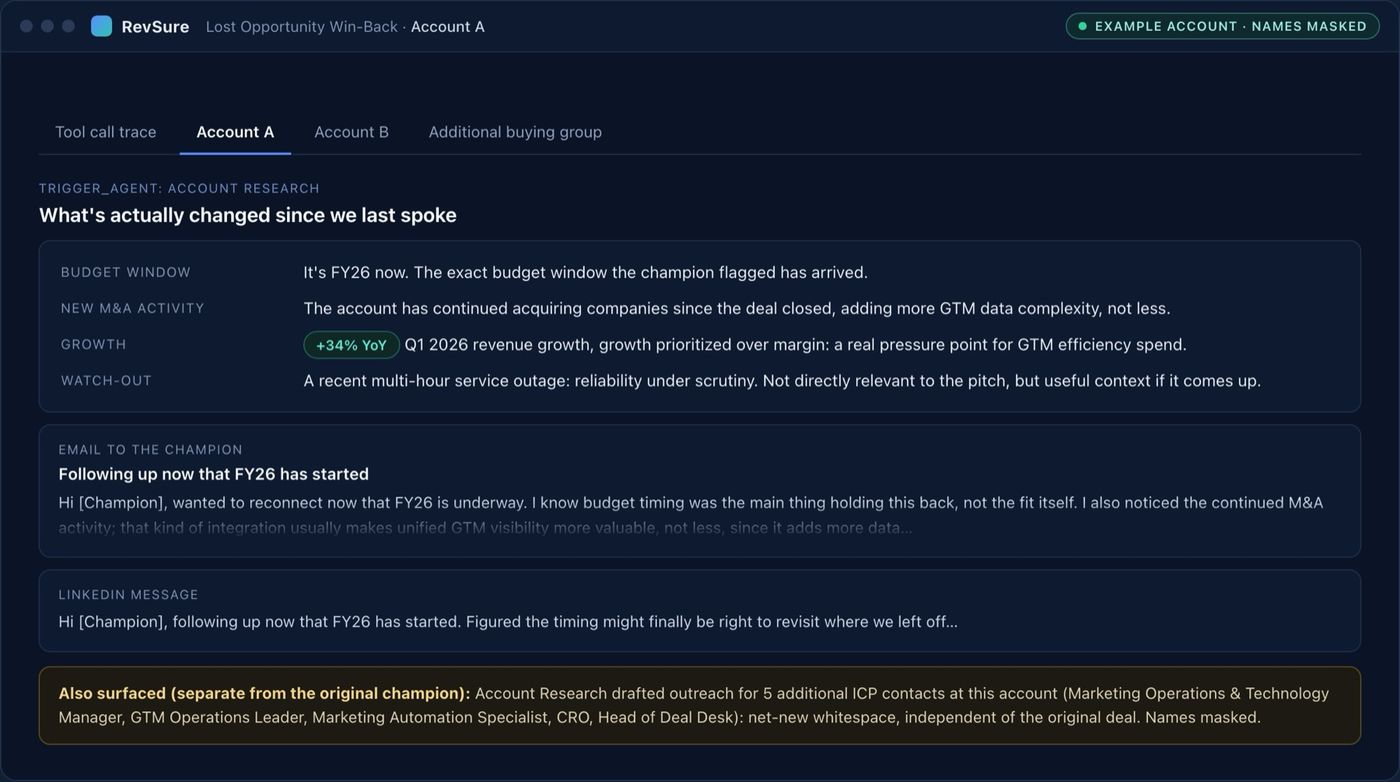
What changed at Account A, and the drafts that came out of it. The email to the champion leads with budget timing because that was the objection.
The draft email to the champion, titled "Following up now that FY26 has started", opens on budget timing, says that timing was the main thing holding the deal back rather than fit, and connects the continued M&A activity to the value of unified GTM visibility. A shorter LinkedIn message makes the same point, and neither draft goes back over the original pitch: both answer the objection the buyer actually gave.
The play also surfaced five additional ICP contacts at the account, including a GTM Operations Leader, a CRO and a Head of Deal Desk, and drafted outreach to each of them separately from the champion thread. That second track is new pipeline at a known account, kept apart so it does not interrupt the conversation with the person who already backed the deal.
Who approves win-back outreach before it is sent?
A person on the customer's team approves every win-back message before it is sent. The Digital SDR does the reading, checking and drafting; the rep decides whether to reopen the deal, which draft to use and what to change in their own voice.
RevSure's Digital SDR page is specific about the split. Under personalized outreach, the human role retained is "High-value personalization, calls, and objections", and under buying committee discovery it is "Relationship strategy and sensitive contact selection." A win-back message to a champion on a $625K deal is high-value personalization by any definition. The page also states the supervision model: "Your SDR leader and reps set strategy and approve exceptions. RevSure's own GTM engineers manage the Digital SDR day to day and are accountable for the completion and quality of the work it delivers."
In the Account A example, the rep sees the loss reason, the champion check, the changes at the account and the drafts, then decides whether to send, edit, wait or call. The outage note exists for that judgment: a rep who knows about it will not open with reliability claims that week.
Where win-back fits next to open pipeline
Win-back is the closed-lost end of the same discipline as catching slipping deals. The Deals at Risk agent watches open opportunities for signs that a close date is about to move. Win-back picks up the deals that did move all the way to lost and asks whether the reason still holds.
The cost of ignoring closed-lost is easy to miss because it never appears on a report. A $625K deal with a timing objection, an identified economic buyer and a champion still in the role looks the same in the CRM as a deal lost to a competitor: one row with stage "Closed Lost" and a picklist value. The difference only shows up when something reads the history behind the row, checks the people and looks at what has happened at the account since. A team that does that for every closed-lost deal, and lets a rep make the final call on each message, will find some of its next quarter's pipeline already sitting in last year's losses.
FAQs
What is a win-back campaign in B2B?
A B2B win-back campaign is outreach to accounts whose opportunities closed as lost, timed to a change that weakens the original objection, such as a new fiscal year, a merger or a new budget owner. It targets buyers who already know the product, so the message focuses on what stopped the deal and why the timing is different now.
Why are closed-lost reasons often inaccurate?
Most closed-lost reasons come from a picklist the rep fills in when closing the record. The options are broad, the rep is moving on to live deals, and vague categories like "timing" or "no decision" are the easiest to pick. The buyer's actual explanation usually sits in call recordings and emails, which the field never captures.
How do you do a closed-lost analysis?
Start from the closed-lost opportunities above a value threshold, then read the conversation history on each one to record the objection in the buyer's words. Group deals by real reason rather than picklist value, check whether each champion is still at the account, and flag deals whose blocker, such as budget timing, has since passed.
What is champion tracking in sales?
Champion tracking is monitoring whether the people who supported a deal are still in their roles. If a champion stays, a closed-lost deal can be reopened through them. If they change jobs, the account needs a new contact and the former champion becomes a warm prospect at their new company. CRMs rarely update this on their own.
When should you reach out to a closed-lost deal?
Reach out when the reason the deal stalled has changed. For a timing objection, that is usually the budget window the buyer named. For other objections it might be a leadership change, an acquisition or growth that makes the original pain larger. Outreach without a change to point to tends to read as a generic follow-up.
How does RevSure's Digital SDR help with win-back?
RevSure's Digital SDR reads closed-lost opportunities, pulls the real loss reason from engagement history, checks whether champions have changed jobs, sizes the buying group and researches what has changed at each account. It drafts outreach that addresses the original objection, and a rep on the customer's team approves each message before anything is sent.