On this page
The short version
A digital worker is AI software assigned to a job: it runs a defined workstream, such as qualifying inbound leads or keeping CRM data clean, and hands back finished work that a person reviews. RevSure, the agentic GTM platform built on the Full Funnel Data Graph, deploys digital workers for sales, marketing and RevOps teams under human supervision. This guide covers the definition, the parts and how to evaluate one.
In September, a data analyst at a fast-growing logistics software company described the plan their leadership had set. "We want to triple our revenue in the next 3 years, and we don't want to add any head count, and we are already running pretty lean," the analyst told RevSure in a meeting.
The same people who were expected to triple revenue had no appetite for another dashboard. "They want me to say like, hey, did you know that X is happening? Maybe if we tried Y, Z would happen," the analyst said.
That request describes the job a digital worker is built for. The team did not need more software to operate. They needed the analysis done, the follow-up sent and the answer delivered in a sentence, without hiring the people who would normally do it.
What is a digital worker?
A digital worker is AI software that is assigned a job and delivers the output of that job. Instead of answering one prompt or completing one task, it owns a defined workstream, for example inbound qualification, campaign reporting or CRM data cleanup, and produces finished work on a schedule: a ranked list of leads with outreach drafted, a weekly spend review, a set of corrected records.
Four properties separate a digital worker from other AI software:
- It is scoped to a role. A digital worker has a job description, such as a Digital SDR or a Digital RevOps Analyst, with the responsibilities that role carries.
- It delivers output, on a cadence. The unit you buy is work completed: meetings booked, accounts researched, records fixed, a forecast brief written.
- It works from shared context. It reads the same resolved account, contact and pipeline data the rest of the team relies on, so its work fits what marketing, sales and RevOps already know.
- It is supervised. People set its goals, approve exceptions and check its work at agreed decision points.
RevSure describes the supervision model on its Digital Workers page: "Your team sets the strategy and approves exceptions. RevSure's own GTM engineers manage the digital worker day to day and are accountable for the completion and quality of the work it delivers."
Where did the term "digital worker" come from?
The phrase is older than generative AI. For most of the last decade, "digital worker" and "digital workforce" were the language of robotic process automation (RPA): software robots that log into applications and repeat a fixed sequence of clicks and keystrokes, such as copying invoice fields into an ERP. IBM's definition still reflects that heritage: "software-based labor that can independently run meaningful parts of complex, end-to-end processes by applying a range of skills" (IBM).
RPA digital workers are dependable when the process is fixed and the screens never change. Go-to-market work rarely looks like that. Deciding which lead to call, what to say to a buying group after a champion leaves, or why a campaign's numbers disagree with the CRM takes judgment over messy, incomplete data.
Large language models changed what a digital worker can do. An AI agent can read an email thread, weigh signals and choose among tools. A GTM digital worker coordinates several of those agents around one job, reads from a governed context layer, and routes the decisions that matter to a person.
What is a digital worker made of?
A GTM digital worker has five layers. Taking the Digital SDR as the example, each layer answers a different question about how the work gets done.
The layers explain why two products can both be called digital workers and behave very differently. Strong agents with thin context write fluent outreach to the wrong person. Rich context without defined decision points lets a worker act on its conclusions before anyone has checked them, and without a defined workstream nobody can say whether the week went well. The workstream layer is what makes the output measurable, because it says in advance what "done" looks like.
What does a digital worker deliver?
Here is the Digital SDR's prioritization step in a live run on a real inbound lead flow, with every name masked. The worker read engagement across three accounts and surfaced 14 leads, wrote 11 outreach drafts and posted the shortlist to the sales team's Slack channel with the reason each lead made the list.
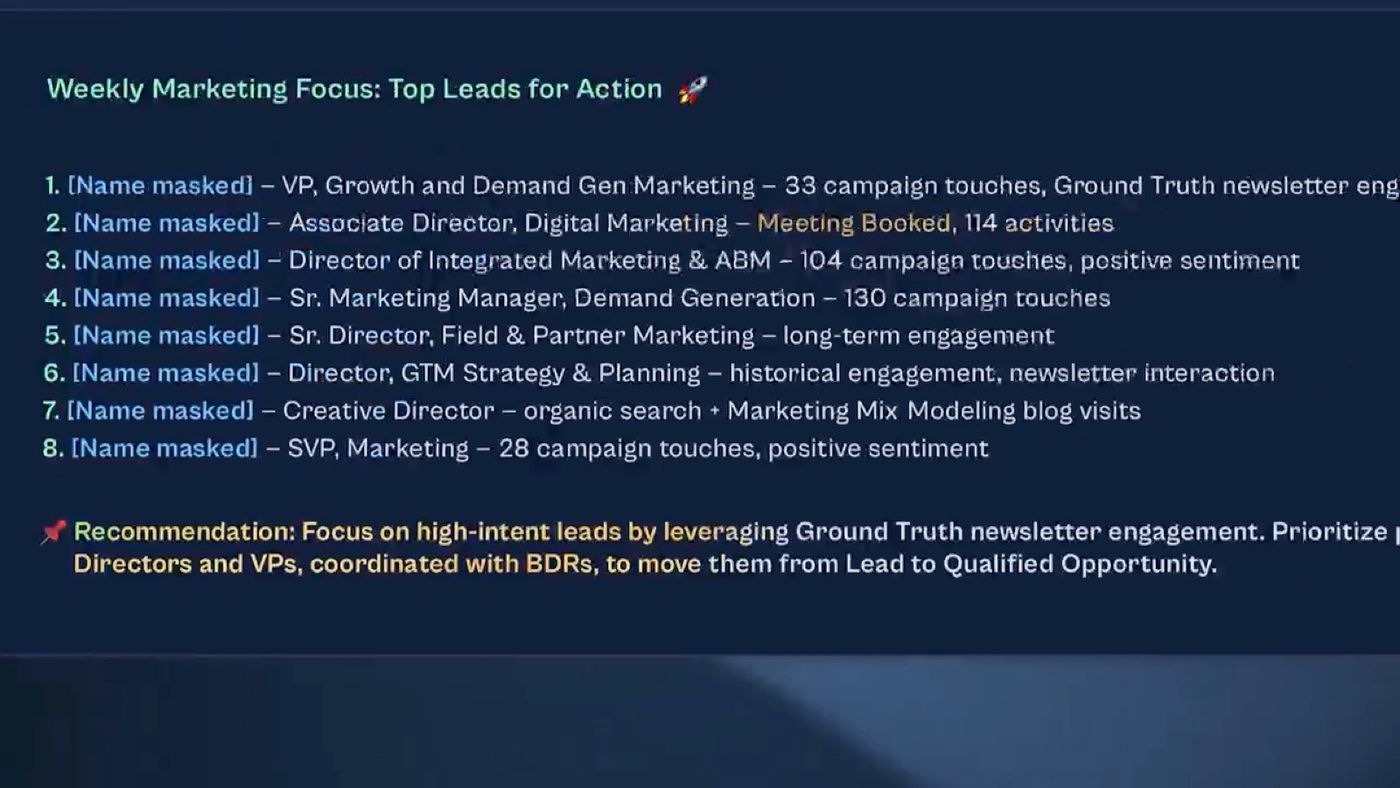
The handoff a rep sees on Monday morning. Each lead carries its title and the evidence behind its rank: campaign touches, a booked meeting, newsletter engagement, sentiment from recorded conversations.
The run also caught something a ranking alone would have missed. One account carried a "Strong Qualify" label in the CRM, yet the only meeting behind it dated from mid-2024. The worker flagged the label as stale instead of passing the account to sales as a hot prospect.
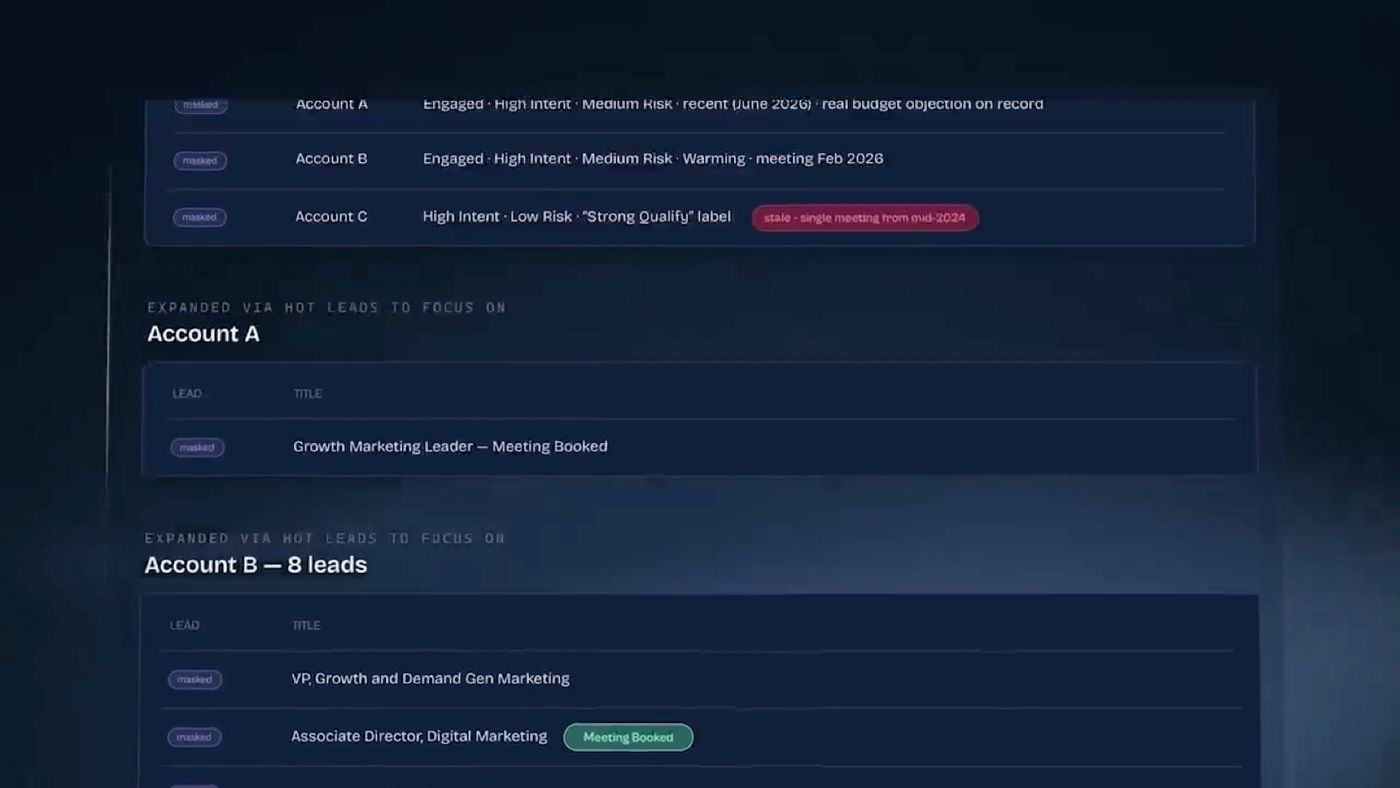
Context changes the answer. The stale label sits in the CRM; the meeting history that contradicts it sits in the conversation data. The worker reads both.
A rep reviewing that list does not have to trust a score. The evidence is on the page, and the rep keeps the decision about who to call.
Which digital workers do GTM teams use?
Digital workers are usually defined by the GTM role whose workstream they take on. RevSure's include:
- Digital SDR: detects intent, qualifies buyers, books meetings and hands off to account executives.
- Digital Demand Gen Manager: builds audiences, launches campaigns, activates media and nurtures demand.
- Digital ABM Manager: prioritizes accounts, maps buying groups, triggers plays and tracks account progression.
- Digital Marketing Analyst: attributes pipeline, finds leakage, recommends spend reallocation and reports return.
- Digital RevOps Analyst: cleans data, flags forecast risk, monitors routing and balances capacity.
- Digital Product Marketer: tracks competitors, shapes positioning, supports launches and enables the field.
Each one runs on the same context layer, which matters most at the handoffs between them. When the Digital ABM Manager marks an account as in play, the Digital SDR working that account already knows it.
How do you evaluate a digital worker?
A demo shows a digital worker at its best on an example someone chose. Six questions keep an evaluation on the everyday job:
- Which workstream does it own, and what does "done" look like? Ask for the deliverables by name and the cadence they arrive on.
- What context does it read? A worker that sees one tool's records will repeat that tool's blind spots. Ask whether leads, contacts and accounts are resolved to one identity before the worker acts.
- Where do people approve? Ask to see the decision points, especially before anything reaches a customer or changes a CRM record.
- Who answers for quality? Someone has to be accountable when the output is wrong. Find out whether that is your team, the vendor or both.
- How is the work measured? Output measures (meetings booked, records fixed) should sit next to outcome measures (pipeline created, forecast accuracy).
- What happens on an exception? A good worker escalates with evidence attached, so the person deciding can see why.
Start with one defined workstream, prove the output against the questions above, then expand. Human-in-the-loop design and agent permissions are covered in more depth in RevSure's guide to approval points in agentic GTM.
What a digital worker changes
The logistics analyst's leadership set a target that rules out the usual answer. Hiring their way to three times the revenue was off the table, and more dashboards would not help a team that did not want to read charts. What they needed was the work itself, done every week, checked by someone accountable, with the answer delivered in plain words.
That is the bar to hold any digital worker to. Ask what finished work arrives each week, who checked it before it reached you, and what your team no longer has to do as a result. A product that cannot answer those questions is still a tool your team will have to run.
FAQs
What is a digital worker?
A digital worker is AI software assigned to a job. It owns a defined workstream, such as qualifying inbound leads, running campaign reporting or cleaning CRM data, and delivers finished work on a schedule. People set its goals, approve exceptions and review its output at agreed decision points.
What is the difference between a digital worker and an AI agent?
An AI agent completes a task when prompted or triggered. A digital worker coordinates several agents around a whole workstream, works from shared business context and delivers defined output against a service level. In RevSure's Digital SDR, for example, eight agents handle signal monitoring through handoff.
Is a digital worker the same as RPA?
No. The term began in robotic process automation, where a digital worker is a software robot repeating scripted steps in applications. A GTM digital worker uses AI agents that reason over context, choose among tools and escalate decisions to people, which suits work that changes with every account.
What is a digital employee?
"Digital employee" is often used as a synonym for digital worker: AI software that takes on the responsibilities of a role. In B2B go-to-market teams, the useful test is whether it delivers finished work for that role, under human supervision, or is a tool someone still has to operate.
Do digital workers replace SDRs and marketers?
Digital workers take on repeatable workstreams such as research, prioritization, reporting and data cleanup. People keep strategy, judgment calls, approvals and customer relationships. Teams use them to add capacity without adding headcount, with people supervising the work.
Which digital workers does RevSure offer?
RevSure's digital workers include the Digital SDR, Digital Demand Gen Manager, Digital ABM Manager, Digital Marketing Analyst, Digital RevOps Analyst and Digital Product Marketer. Each runs on the Full Funnel Data Graph, and RevSure's GTM engineers supervise them alongside the customer's team.