On this page
The short version
Account research is the work a rep does before first contact: reading what has changed at a company, who has engaged, who is in the buying group and what angle to open with. RevSure, the agentic GTM platform built on the Full Funnel Data Graph, runs that research as one step of its Digital SDR, reading from the context layer and handing reps a brief with outreach drafted for review.
Picture a familiar account. Open its CRM record and it looks cold. There is no open opportunity. Four of the six contacts are tracked, 72 more sit in enrichment data, and the account is labelled pre-pipeline. A rep working down a call list would treat it like any other company on the list and open with the standard pitch.
The Digital SDR’s account research, run through Claude and RevSure, uncovered a much richer picture for one of our client: one of the account they were targeting had been acquired in November 2025, a meeting had already happened, and merger timeline delays were the main pain point. The champion was active, a new CMO had been identified but not yet contacted, and a working session on funnel definitions was already scheduled. It also found 209 new contacts at the acquiring company.
None of that is hidden. It is spread across a call record, an engagement history, a news event and a contact database, and in this example it takes 17 tool calls to assemble. Most teams already pay for sales intelligence data that holds pieces of it. This post covers what account research should do with that data, why it so often gets skipped, and how RevSure's Digital SDR does it before a rep picks up the phone. The account, which we call Client ABC, is illustrative; the steps are the ones the Digital SDR runs.
What is account research in sales intelligence?
Account research is the preparation a seller does on a target company before contacting it: what the company does, what has changed recently, who there has engaged, who is likely to be involved in a purchase and what the seller should say first. Its output is a brief a rep can read in a few minutes and act on.
Sales intelligence is the wider category. It covers the data sellers use to find, prioritize and prepare for buyers: firmographics, contact details, intent and engagement signals, technographics and news. Account intelligence is the slice of that data organized around one company rather than one lead, so that every contact, touch, meeting and opportunity rolls up to the account they belong to.
Account research turns those fields into a judgment: this company is mid-acquisition, the person who will sign has not been reached, and the right opening is the integration problem they already told us about.
What should a pre-call account brief contain?
A useful brief answers a short list of questions, each from a different source. The table below sets out the sections, the question each one answers, where that data normally lives and what goes wrong when a rep calls without it.
Most briefs cover the first row well, because company context is the easiest to look up. The rows that change the conversation are further down: the change event, what was said on the last call and the gaps in the buying group.
Why do reps skip account research?
Most reps agree research matters. What stops them is the cost of doing it on a busy day.
The sources are scattered. Each row in the table above lives in a different system. A rep preparing properly opens the CRM, the marketing automation platform, the call recorder, a news search and a contact database, then tries to work out which records belong to the same company and the same people. On a day with a long call list, that preparation is the first thing to go.
Identity rarely lines up. The VP of Marketing who read five articles is a lead in marketing automation, a contact in the CRM and an attendee name in a meeting recording. Unless those records are resolved to one person attached to one account, the rep sees three partial pictures and may not connect them.
The facts go stale. An acquisition, a new executive or a meeting last week can change the right opening entirely. Research done once at the start of a quarter does not catch them, and few teams have time to redo it before every touch.
The output is not reused. Research ends up in a rep's notes, and the account executive who takes the meeting starts again.
So strategic accounts get a careful brief, and most other prospects get a template.
How does a Digital SDR build account intelligence from the context layer?
A digital worker is AI software assigned to a job that delivers finished work under human supervision. RevSure's Digital SDR runs the sales development workstream, and its second step is "prioritize and research". The Digital SDR page describes that step's output as a "queue rank + account/buying-group brief", with account research, contact research and buying-committee discovery as the skills behind it.
Two of the Digital SDR's agents do most of this work. Buying Committee Discovery identifies likely buying-group members, roles, coverage gaps and relevant contacts. Outbound Prospecting builds prioritized account and contact lists from the ideal customer profile, triggers, whitespace, territory and propensity, and delivers research briefs.
What makes the research quick is where it reads from. Instead of opening five systems and reconciling them on the spot, the Digital SDR reads from RevSure's context layer, where the CRM, marketing automation, call, web and enrichment data are already resolved in the Full Funnel Data Graph to one identity per account and contact. The same layer is available to Claude through the RevSure MCP connector, which is how the run below was carried out. RevSure's guide to Claude connectors explains how that connection is set up and why one connector to a context layer behaves differently from one connector per tool.
What does a Digital SDR's account research look like? A worked example
The example follows one illustrative account, Client ABC, through account research, an action plan, a prospect list and a hot leads handoff, with every name masked. In this example the Digital SDR makes 17 tool calls, runs 3 agents and produces 5 outreach drafts.
Account details. The first read resolves the account and returns the pre-pipeline view from the opening: industry, size and contact counts, with no open opportunity.
Engagement signals. The second read asks for meeting and chat signals. There is no chat intelligence on this account. There is a meeting, and the signal card summarizes it.
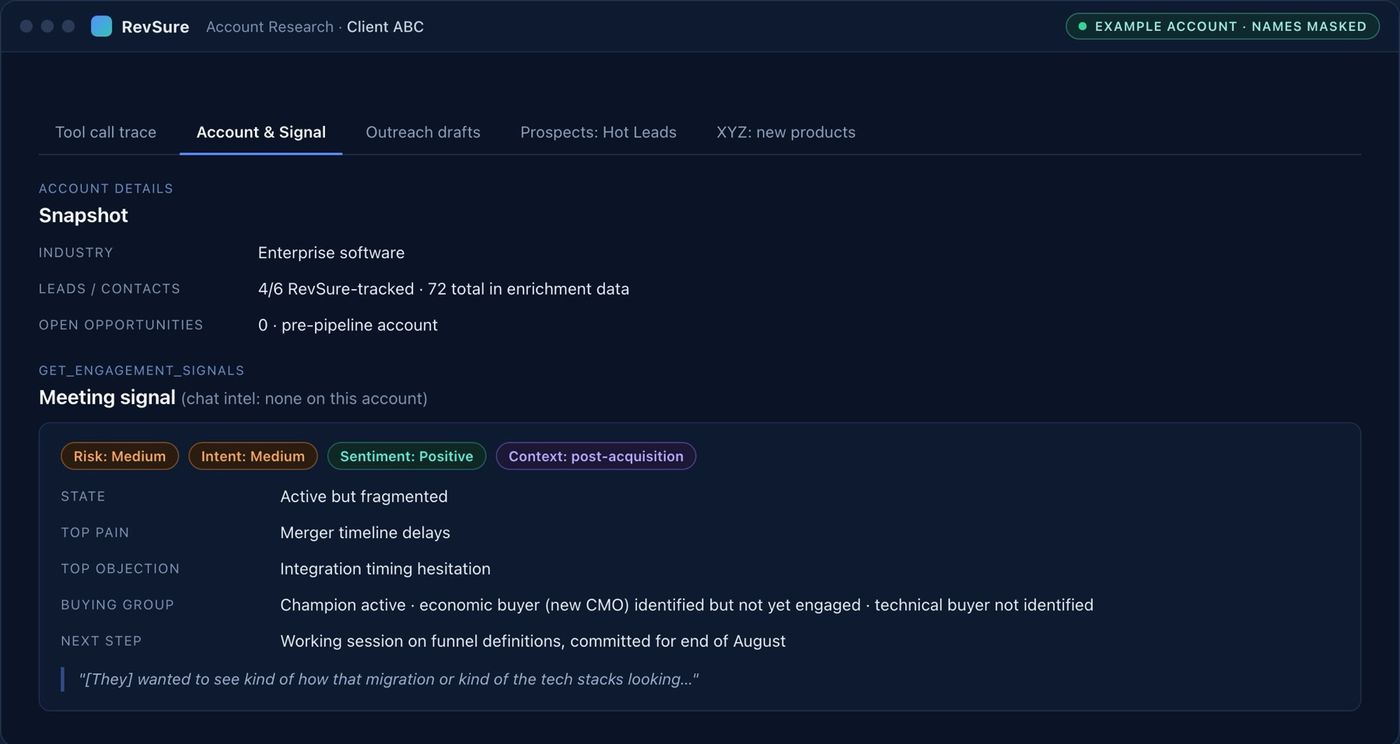
The meeting signal for Client ABC, an illustrative account. Risk and intent are medium, sentiment is positive, and the context is post-acquisition. The top pain is merger timeline delays and the top objection is hesitation over integration timing.
The buying group row on that card is the part a rep most wants before a call. The champion is active. The economic buyer, a new CMO, has been identified but not yet engaged. No technical buyer has been identified. The agreed next step is a working session on funnel definitions, committed for the end of August. A deal at this stage with one engaged champion and an unreached economic buyer is the shape RevSure's guide to buying groups describes in more depth.
Company research. The Digital SDR then verifies the company's profile: industry, company size and revenue band, the CEO, competitors and the acquisition itself. The acquisition by Company XYZ, completed in November 2025, sets the angle for everything that follows. Every outreach angle leads with GTM data unification across the newly combined company, because that is a live problem for the buyer rather than a hypothetical one.
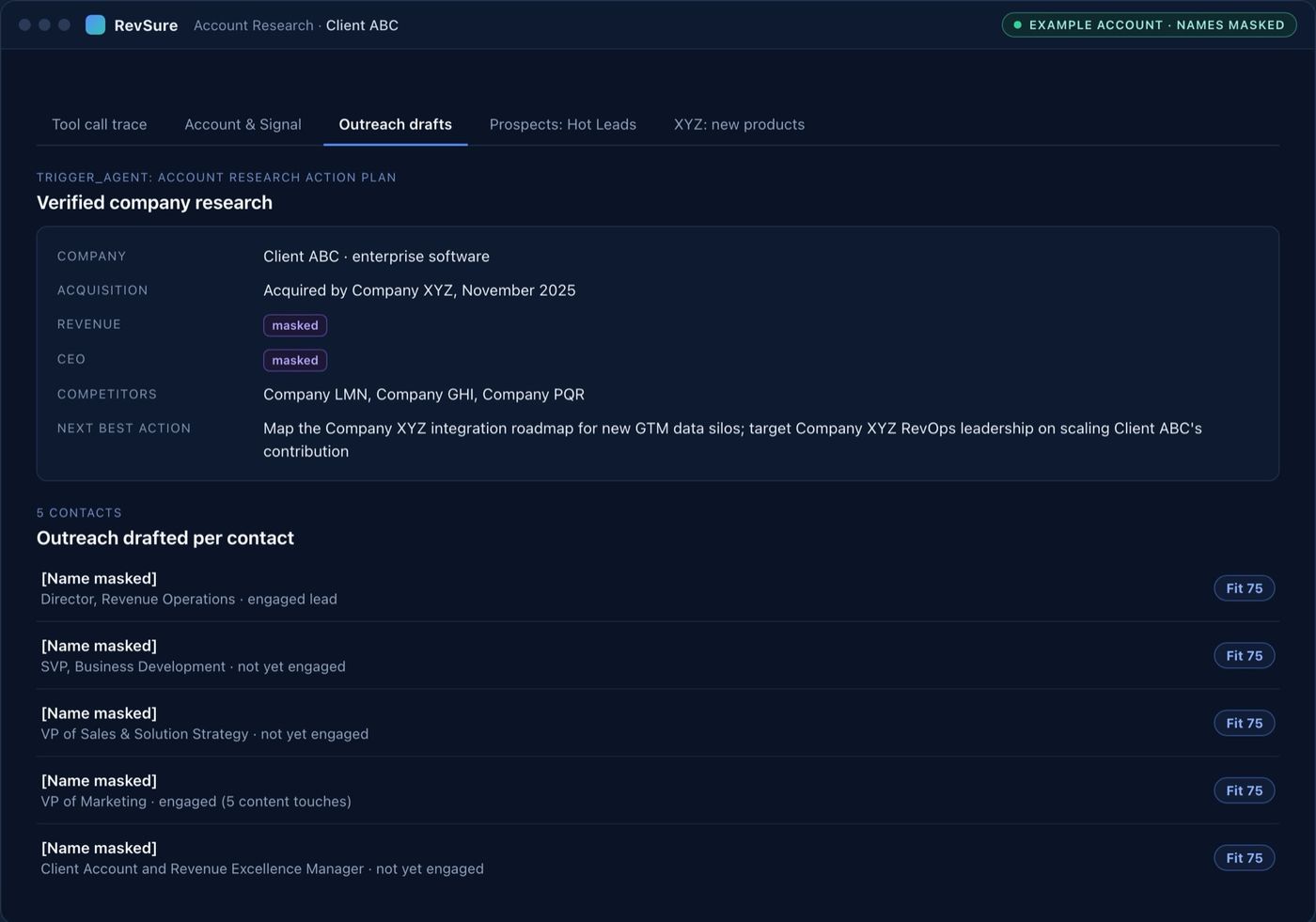
Verified company research and outreach drafted per contact, from the Client ABC example. Each of the five contacts shows a role, whether they have engaged and an ICP fit score.
The next best action is specific: map the acquirer's integration roadmap for new GTM data silos, and approach the acquirer's RevOps leadership. The five contacts cover revenue operations, business development, sales strategy, marketing and revenue excellence. Two have engaged, including a VP of Marketing with five content touches. Three have not. Each gets an outreach draft written for their role and their history with the account.
Net-new contacts. The acquisition widens the account. The Digital SDR finds 209 net-new contacts at the acquiring company, people who are not yet in the seller's data. It tags each one by function from their job title and says plainly that those tags are keyword-classified for triage, not verified, so the rep knows how far to trust each field.
Prospect list and handoff. Finally it filters the contacts against the ideal customer profile into a final prospect list and hands it off to a hot leads channel in Slack, where the sales and marketing teams already work.
The brief changes what the rep says. A generic first call to a "pre-pipeline" account would miss the acquisition, the meeting and the unreached CMO. The researched version opens on the integration problem the buyer has already raised.
Where does a person review the research and outreach?
Account research feeds outreach, and outreach reaches customers, so the decision points matter. The Digital SDR works with "approved messaging, guardrails, and human checkpoints on every sequence," according to its page. RevSure's GTM engineers review the queues, messages and handoffs the worker produces, and the customer's SDR leader and reps set strategy and approve exceptions.
In the example, the output is drafts. The five messages, the prospect list and the next best action arrive for a person to read, edit and approve. Sensitive choices stay with people: the Digital SDR page lists "relationship strategy and sensitive contact selection" as the human role in buying committee discovery. In a mid-acquisition account, deciding whether to approach the acquirer's RevOps leadership before the new CMO has engaged is exactly that kind of choice.
How is a digital worker different from an account research agent?
In 2025 RevSure introduced its Account Research Agent, which produces a structured account profile on demand: overview, technology stack, stakeholder map, strategic insights and competitors. That profile is still the core of the research, and the Digital SDR builds on it.
The Digital SDR puts the research inside a workstream. The brief is produced because an account has risen in the queue, which is the subject of RevSure's guide to ranking the leads sales should call. It reads meeting signals and engagement history as well as company facts. It finds the missing members of the buying group and the net-new contacts who fit the profile. It drafts outreach per contact, and it hands the result to the team that acts on it, so the research feeds straight into the next step of the job.
What the rep knows before dialing
Before RevSure's Digital SDR ran, Client ABC was a pre-pipeline account with four tracked contacts and no obvious reason to call this week. By Monday morning the rep has a brief that says the company has been acquired, what was said in the last meeting, that the person with the budget has not been reached, and which of the 209 people at the acquirer are worth a look, with five drafts waiting for approval.
So the rep's first call picks up where the last meeting left off. The email to the new CMO opens on the merger integration work their own team has already named, and the rep walks into the working session on funnel definitions already knowing the buying group around it. Every reply, meeting and touch that follows lands on the same account in the Full Funnel Data Graph, so the next brief starts from there. That is the job RevSure gives the Digital SDR: do the reading every time, so the rep can spend the call on the buyer.
FAQs
What is account research in sales?
Account research is the preparation a seller does on a target company before contacting it. A good brief covers company context, recent change events such as an acquisition, engagement history, past meeting signals, the buying group, net-new contacts who fit the ideal customer profile, and the angle the first message should take.
What is the difference between sales intelligence and account intelligence?
Sales intelligence is the broad category of data sellers use to find and prepare for buyers, including firmographics, contacts, intent signals and news. Account intelligence organizes that data around one company, rolling every contact, touch, meeting and opportunity up to the account, so a rep can see the whole relationship in one place.
What should a pre-call account brief include?
It should include the company's size and market, any recent change such as an acquisition or new executive, who has engaged and with what, what was said on past calls, which buying group roles are covered or missing, relevant net-new contacts, and a specific reason to reach out now to each person.
How does AI do account research?
An AI agent or digital worker reads the systems where account data lives, such as the CRM, marketing automation, call recordings and enrichment data, and writes a brief. It works best when those sources are already resolved to one identity per account and contact, so it is not reconciling raw exports on every request.
How does RevSure's Digital SDR research accounts?
Account research is part of the Digital SDR's "prioritize and research" step. Its agents read from RevSure's context layer, built on the Full Funnel Data Graph, to assemble company context, engagement and meeting signals, the buying group and net-new contacts, then draft outreach per contact for people to review and approve.
Does a person review outreach before it is sent?
Yes. The Digital SDR runs on approved messaging, guardrails and human checkpoints on every sequence. RevSure's GTM engineers review the queues, messages and handoffs it produces, and the customer's SDR leader and reps set strategy and approve exceptions, including sensitive contact choices.