On this page
The short version
AI lead scoring uses machine learning to rank leads by how likely they are to buy, from fit, engagement and intent signals. RevSure, the agentic GTM platform built on the Full Funnel Data Graph, gives the job to a Digital SDR, which rolls leads up to accounts, shows the evidence behind each rank, drafts outreach and hands the list to a rep who decides who to call.
Almost every B2B team with a CRM already has a lead score. It sits in a field on the lead record, it climbs when someone opens an email or registers for a webinar, and on Monday morning an SDR still opens a list view and decides, mostly by instinct, which people to call first. AI lead scoring was supposed to make that decision easier, and on the prediction side it often has. What it rarely changes is the work between the number and the phone call: finding out why the lead scored, who else at the company is involved, whether the CRM's story about the account is still true, and what to say.
That work is the first job RevSure gives its Digital SDR: before any meeting is booked, produce a short list a rep trusts enough to act on this week. Below are the mechanics of lead scoring, where the score stops being useful, and a live run on RevSure's own inbound lead flow.
What is AI lead scoring?
AI lead scoring is the use of machine learning to estimate how likely each lead is to become pipeline or revenue, based on patterns in the leads that converted before. It replaces or supplements a points model, where marketing operations assigns fixed values by hand: ten points for a director title, five for a pricing page visit, minus twenty for a student email address.
Predictive lead scoring, the first wave, trained a model on historical conversions and returned a probability or grade that rarely explained itself. Newer approaches add agents that read conversations, account history and intent, and can say in words why a lead ranks where it does. All of them still end in the same place: a value on a record that a person has to interpret.
How does lead scoring work?
Almost every lead scoring model combines four ingredients, and how each one is handled decides whether the final number means anything.
Fit. Does the person and their company look like your buyers? Title, seniority, company size, industry and technology in use. Fit changes slowly, which makes it a poor guide to timing. A perfect-fit VP who has never engaged belongs on a target account list and will not look hot until they do something.
Engagement. What has this person done with you? Email clicks, webinar attendance, content downloads, site visits, replies, meetings. Engagement counts activity without weighing it. A hundred newsletter opens and one booked meeting can produce similar point totals while meaning very different things.
Intent. What is the company researching beyond your own properties? Third-party intent shows topic interest at the account level, usually without naming the person doing the research. It says something is happening at the company, not which person to call.
Decay. How old is each signal? A webinar from last week and a webinar from last spring should not count the same. Many points models never subtract anything, so a lead that was busy eighteen months ago can carry a high score into a quarter where nobody there has opened a single email.
Two structural problems sit on top of those ingredients.
The first is the unit being scored. B2B purchases are made by groups, yet most scores are attached to individual leads. Five people at one company each doing a little can look unremarkable lead by lead, while one enthusiastic individual at a company with no budget can top the list. Rolling lead activity up to the account, so the people and the company can be read together, is what RevSure's Hot Accounts agent does for account scoring.
The second is the CRM's own labels. Qualification stages and rep-entered tags were true when someone set them, and they rarely expire. A scoring model that takes "qualified" at face value inherits whatever the CRM believed on the day that field was last touched.
Why do sales teams ignore lead scores?
When reps skip the score, the usual explanation is distrust of the model. The problem tends to be more mechanical. A score answers "how likely" and leaves four other questions to the rep:
- Why this lead? A grade of A or a value of 87 carries no reason. Without the evidence, the rep has to open the activity history and reconstruct it.
- Who else is involved? A lead-level score does not show the other people at the account or how they relate to the deal.
- Is the record still true? If the account's status was set two years ago, the score may be resting on a conclusion nobody has rechecked.
- What do I say? Even a correct score does not tell the rep which pain the person has already described or which objection is on record.
Each question takes minutes per lead to answer by hand, and a rep with a full queue does not have those minutes. So the sort order defaults to last activity, and lead prioritization happens in each rep's head. RevSure's earlier piece on agentic, real-time lead scoring covers keeping scores current as buyers move. Someone still has to do the work the score leaves behind.
What changes when a Digital SDR owns lead prioritization?
The Digital SDR is one of RevSure's digital workers: AI assigned to the SDR workstream, from detecting signal to handing a qualified meeting to an account executive. Its Prioritization job, in the words of the role page, is to "continuously rank leads and accounts and prescribe next-best actions across the SDR workload."
Owning the step end to end means the worker produces a finished list instead of a field value. That changes what the team receives.
What does Digital SDR lead ranking look like in a live run?
RevSure ran the Digital SDR's prioritization play on its own inbound lead flow and recorded the output with every account and person masked. The run covered three accounts, surfaced 14 leads, produced 11 outreach drafts and posted a hot leads list to Slack for all three accounts. The tool call trace shows the order of work.

The run as a sequence of calls. Each step leaves a record of what the worker read.
A first pass across the signals. The worker called lead details and engagement signals 13 times to build a starting shortlist: one lead each at three accounts. That is roughly what a good lead score produces.
A roll-up to the account. It then triggered the Hot Leads to Focus On agent for each of the three accounts. That step turned three individuals into 14 people. One account went from a single lead to eight, including a VP of growth and demand generation and an associate director of digital marketing with a meeting already booked. Scored separately, they were eight rows; read together, they describe one company where several functions are paying attention.
A check on the account's story. Each account came back with a short assessment. Two were engaged and showing high intent, one with a recent budget objection on record and the other with a meeting in February 2026. The third looked strongest on paper, with high intent, low risk and a "Strong Qualify" label in the CRM. The worker marked that label stale, because the only meeting supporting it was from mid-2024. A lead score would have inherited the label. The digital worker explainer shows that account view and the Slack list from the same run.
A name verification pass. The account digests listed some leads by title only. Before writing anything, the worker called lead details 11 more times to find the person behind each title-only entry. A draft addressed to the wrong director at the right account would undo everything before it.
Evidence on every line. The ranked list does not carry a score. Each person carries the reason they are on it, and the reasons vary in kind: more than a hundred logged activities alongside a booked meeting for one lead, campaign touches with positive sentiment for another, organic search visits to a blog post on marketing mix modeling for a third. A rep can disagree with any rank and see exactly what they are disagreeing with.
How does the Digital SDR write outreach for hot leads?
Hot leads are the people showing the strongest current buying signals, the ones a rep should contact this week rather than add to a nurture track. The ranking only pays off if the first message reflects why they are hot.
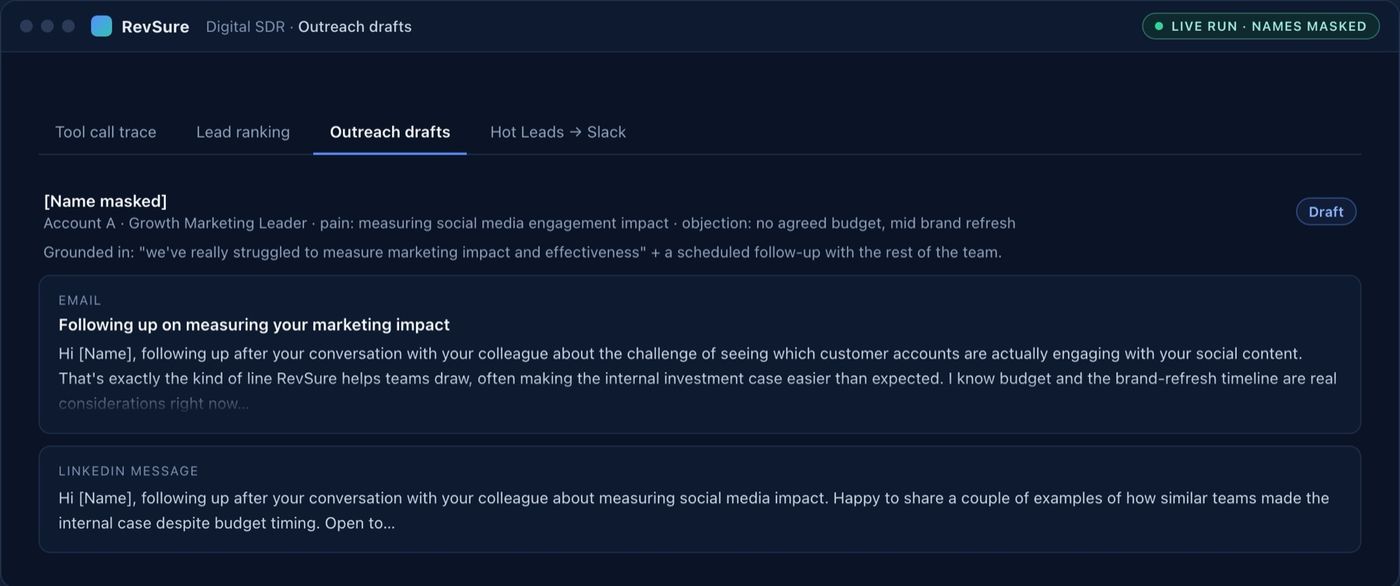
One of the 11 drafts. The header records the role, the pain and the objection; the "grounded in" line points to the conversation the draft is built from.
The card above is for a growth marketing leader at the first account. The lead had raised the difficulty of measuring marketing impact on an earlier call, and the draft card cites that conversation as its source. The email opens by referring back to it, so it reads as a continuation of something the person said. It also names budget and the brand refresh timing as real considerations, which is what a rep who had read the call notes would do. Each lead gets an email and a shorter LinkedIn message, so the rep picks the channel without rewriting.
The trace describes all 11 drafts as grounded in the pain points, hot topics and "why this surfaced" reasoning from the agent output. That grounding lets a rep send a draft with light edits, or decide quickly that a lead can wait.
Where does the rep stay in charge?
The run ends in Slack: a hot leads post for each account, with the ranked people, the evidence and the drafts ready. From there, an SDR lead or rep decides who gets a call, who gets an email, who waits and which draft needs rewriting.
That split matches how RevSure defines the role. On the Digital SDR page, the SDR leader and reps set strategy, define guardrails, approve exceptions and manage relationships, while RevSure's GTM pod handles continuous tuning of scoring, sequences and routing and reviews every Digital SDR output before it ships. RevSure's guide to human-in-the-loop AI covers approval points in more depth.
This kind of product is sometimes called an AI sales assistant. The useful distinction is who does the work between signal and decision: here the Digital SDR does the reading, ranking, checking and drafting, and the rep gets a decision to make.
How do you know whether lead prioritization is working?
Whoever produces the ranking, a model, a digital worker or a person, these checks keep it honest.
- Trace a rank back. Pick any lead on the list and ask why it is there. A set of dated signals can be checked; a bare number can only be trusted.
- Audit the labels. Pull accounts carrying a qualified or late-stage status and compare each one with its most recent meeting or reply. The gap shows how much stale context the scoring inherits.
- Compare called and uncalled. If ranked leads a rep contacted convert at the same rate as ranked leads nobody reached, the ranking is not separating anything.
- Read the drafts. If reps rewrite most outreach from scratch, the context behind the ranking is not reaching the message.
What the first job sets up
Most teams have stopped expecting lead scoring to change Monday morning. Reps still spend the first hours of the week rebuilding context the systems already hold.
The prioritization run starts the week somewhere else: each name checked, each rank carrying its evidence, a flattering account label flagged before anyone spent a call on it, and each draft built from what the lead had already said. Every later step in the SDR workstream, from qualification to the meeting handoff to an account executive, inherits that list. A team that gets this step wrong spends the rest of the week booking meetings with the wrong people.
FAQs
What is AI lead scoring?
AI lead scoring uses machine learning to estimate how likely each lead is to convert, based on patterns in past conversions. It combines fit, engagement and intent signals, and newer approaches can explain each score in words. A score on its own still leaves the rep to work out why and what to do next.
What is the difference between predictive lead scoring and AI lead scoring?
Predictive lead scoring trains a model on historical conversions and outputs a probability or grade for each lead. AI lead scoring is a broader term that also covers models and agents reading conversations, account history and intent, and stating the reasons behind a rank. The useful test is whether a score comes with evidence a rep can check.
What are hot leads?
Hot leads are prospects showing strong, recent buying signals, such as a booked meeting, repeated engagement or pain raised in a conversation, which makes them worth contacting this week. In RevSure's Digital SDR, the Hot Leads to Focus On agent surfaces them by account and posts the list to Slack with the reason each person was included.
What is lead score decay?
Lead score decay reduces the weight of a signal as it ages, so a webinar attended last week counts for more than one from last year. Without decay, points models keep old activity indefinitely and can rank a lead highly long after interest has faded. CRM labels have the same problem and need checking against recent activity.
Is the Digital SDR an AI sales assistant?
The Digital SDR goes further than an assistant that answers questions about a lead. It is a digital worker that owns the SDR workstream: ranking leads and accounts, verifying names, drafting outreach from the context on record and handing the list to a rep in Slack. The rep, supervised by the SDR lead, decides who to contact.
Does the Digital SDR contact prospects on its own?
In the prioritization run described here, the worker's output ended in Slack: a ranked list with evidence and outreach drafts ready for review. People decide who to contact and approve exceptions, and RevSure's Digital SDR page states that RevSure's GTM pod reviews every Digital SDR output before it ships.