On this page
The short version
A buying group is the set of people at one account who take part in a B2B purchase decision, from the person who needs the product to those who evaluate, approve and pay for it. RevSure, the agentic GTM platform built on the Full Funnel Data Graph, maps buying groups from CRM, marketing and conversation data so teams can see who at an account is engaged and who is missing.
In September, RevSure was walking a healthcare security software company through how its pipeline would be attributed. A filter on screen offered three ways to read a deal: the primary contact, all contacts on the account, or all contacts on the opportunity. Someone on the company's marketing team stopped the walkthrough to ask about it.
"The only reason I say that is because a lot of our opportunities, like I don't know, 70 to 80% don't have a contact," they told RevSure.
A colleague explained how that happens. When marketing believes a campaign influenced a deal, someone checks with sales and updates the lead source and campaign fields on the opportunity, "but they don't always add the contact record."
Each of those deals had people behind it who asked for demos, ran evaluations and approved budgets. The CRM kept the deals and lost most of the people. This guide covers what a buying group is, why the CRM keeps losing it, and how to rebuild it.
What is a buying group?
A buying group is the set of people at a single account who take part in a purchase decision. It includes the person who first feels the problem, the people who will use the product, the people who test whether it works with what the company already runs, the person who controls the budget, and the reviewers in procurement, legal and security who can slow or stop a deal.
A buying group belongs to one account and one decision, so the same company can have two buying groups for two products. Its membership changes as reviewers join late and early enthusiasts move on, and most members never fill in a form, so a team that only tracks leads sees a small part of it.
Pipeline is usually reported per opportunity and per lead, while the decision is made by a group, so a stalled deal often traces back to someone nobody on the selling side had spoken to. RevSure's earlier piece on buying group attribution covers how to credit marketing across that group. This guide covers the step before: finding the group at all.
Buying group vs buying committee vs persona vs account: what is the difference?
The four terms are often used interchangeably, but they describe different things.
- Account: the company you sell to, as a record in the CRM. It can hold thousands of contacts, most of whom have nothing to do with your deal.
- Buying group: the people at that account involved in one purchase decision. It is a subset of the account's contacts, plus people the CRM does not know about yet.
- Buying committee: used by most teams as a synonym for buying group. Where a distinction is drawn, "committee" suggests a formal body with named approvers, such as an evaluation team or a procurement board, while "group" includes informal influencers who never sit on it.
- Persona: a description of a type of person, such as "VP of Marketing at a mid-market software company," with their goals and objections. A persona is a template; a buying group is a list of real people, filled in deal by deal.
In practice, personas tell you which roles to expect at an account, and the buying group records who actually holds each role in this deal.
Who is in a B2B buying group?
Roles vary by deal size, industry and product, and one person often covers two. The table lists the roles most B2B sellers plan for and what tends to go wrong when each is absent.
The signals column is the one a revenue team can act on, and each signal lives in a different system: meetings in the calendar and call recorder, content views in marketing automation and on the website, questionnaires in email. Seeing a role as engaged means joining those systems to the same person and account.
Why do CRMs under-record buying groups?
The healthcare company's 70 to 80% figure, a team member's estimate rather than a report, is unusual only in that someone said it out loud. Four habits produce it in most CRMs.
Contacts are not attached to opportunities. Reps create opportunities quickly and contact roles are optional. Marketing updates the lead source or the campaign on the deal to claim influence, as the healthcare company's team described, and the people behind that influence stay on the account or nowhere. Any report that reads "contacts on the opportunity" then sees an empty deal.
Leads and contacts live in separate objects. Many CRMs store unqualified people as leads, unconnected to any account. A technical evaluator who downloaded a guide and attended a webinar can sit in the lead table for the whole deal, matched to the account only by an email domain that nobody joined.
Records carry old employers. When the email on file points at a previous company, engagement from the new address arrives as a new, unconnected person. The lost-deal review shown later in this guide found exactly that: a verified contact still at the account in the same role, whose CRM record still listed an old employer's email.
Champions change jobs. When the person who carried a deal leaves, the account can lose its only relationship, and the CRM keeps showing them as the contact of record. A former champion at a new company is also a warm start there.
The CRM is built to track deals and stages, and recording every person around a deal is extra work with no immediate reward for the rep. The buying group has to be rebuilt from the data around the CRM instead of waiting for someone to type it in.
How do you map a buying group, step by step?
Mapping a buying group turns the account record into a named list of people, each with a role and an engagement status:
- Start from the target account list. Map the accounts that matter this quarter first: open opportunities above a size threshold, priority ABM accounts and recently lost deals worth reopening.
- Collect every known person at the account. Pull contacts on the account, contacts on its opportunities, leads whose email domain matches, meeting attendees from the calendar and the call recorder, and identified website visitors.
- Resolve duplicates and stale records. Merge the lead and contact versions of the same person, and check job changes so that people who left are marked as gone and people with an old employer's email are corrected.
- Assign roles against your persona model. Use titles as a first guess, then correct with behavior: the person who asked about integrations is acting as the technical evaluator whatever their title says.
- Mark engagement for each person. Use the signals from the table above over a defined window, such as the last 90 days, so "engaged" means the same thing on every account.
- Name the gaps. For each account, list the roles with no engaged person. That list becomes the outreach plan.
Buyer intent signals and account intelligence feed steps 2 and 5. Third-party intent from partners such as 6sense and Demandbase shows that an account is researching a topic; first-party engagement, call history and opportunity data show which people are doing it. A buying group map needs both, joined to the same account.
How do you measure buying group coverage?
Coverage is the share of the buying group you are actually reaching. The simplest version counts, for each account, ICP contacts who are engaged against ICP contacts who are on file but not engaged. ICP here means people whose role and seniority fit the personas you sell to, so that a count of 1,000 employees does not pass for a buying group.
Here is what that looks like in a lost-deal review run by RevSure, with names masked. For one lost opportunity, the run read the conversation history to establish why the deal was really lost, checked whether the champion was still at the account, and counted the buying group beyond the champion.
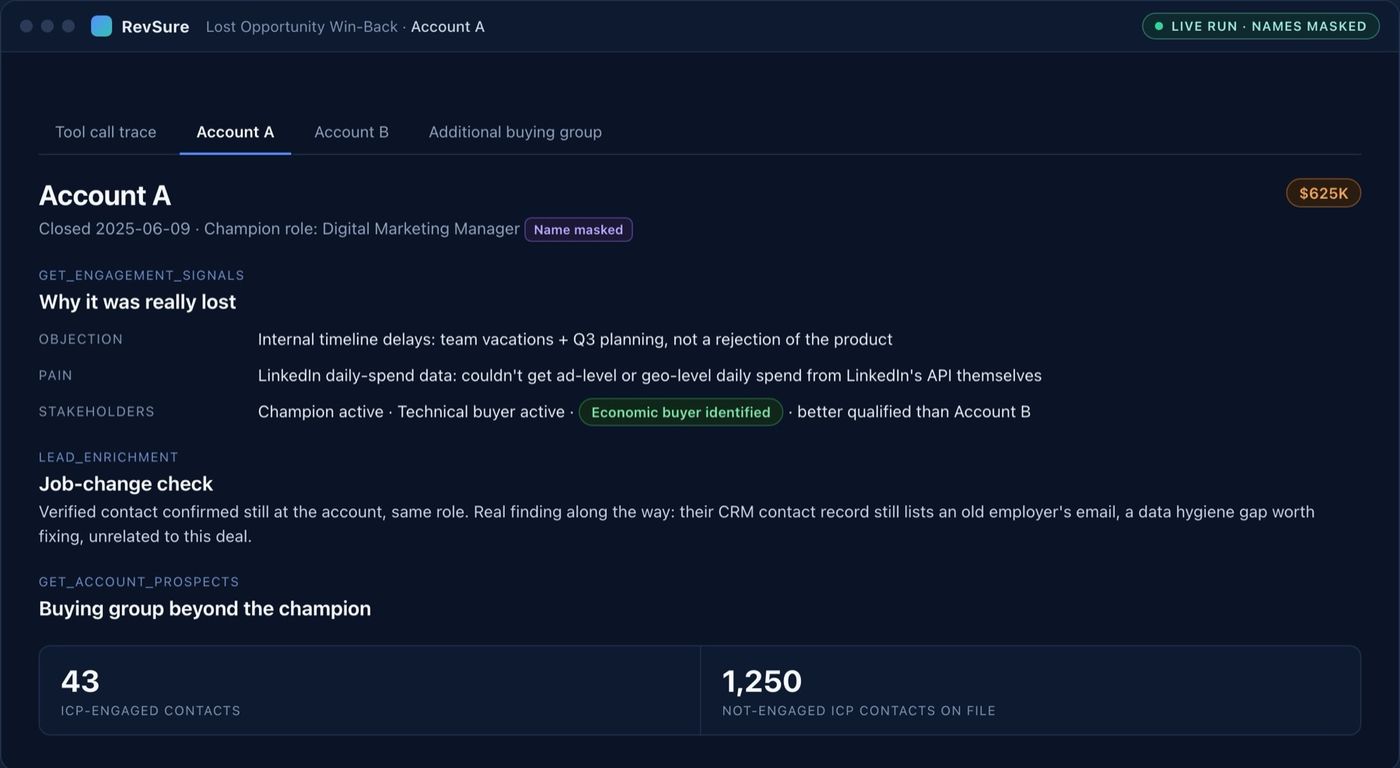
One lost deal, read as a buying group. The loss reason was timing, the economic buyer had been identified, and the account held 43 engaged ICP contacts with 1,250 more on file who had not engaged.
The 43 engaged ICP contacts show the account paying attention well beyond the champion, and the 1,250 not-engaged ICP contacts show how much of the fit audience nobody had reached. With a loss reason of timing rather than product, that turns a closed-lost record into a reason to go back.
Count coverage by role as well as by headcount. An account with 40 engaged contacts, all of them end users, still has no economic buyer engaged. Reviewed weekly for open opportunities, a per-account view of engaged fit contacts and empty roles shows single-threaded deals before they slip. RevSure's sales pipeline guide covers where those deals tend to stall by stage, and the Hot Accounts agent uses engagement across the group to rank accounts.
Where do digital workers help with buying groups?
Most of the steps above are repeatable reading work, which is the part RevSure's digital workers take on, with people deciding what happens next.
The Digital ABM Manager runs buying group discovery as one of its jobs. RevSure's page describes it as: "Map likely stakeholders, roles, coverage gaps and buying-committee engagement per account." The output is a buying-group map with role coverage and contact recommendations, and priority accounts get a mapped buying group before a play launches. Coordinating the play across the committee after that is covered in the post on the ABM Orchestration agent.
The Digital SDR works the same gap from the outbound side, identifying likely buying-group members and drafting outreach to them. The same lost-deal run shows what that output looks like: fit contacts at the account who were not part of the original deal, each with a drafted email.
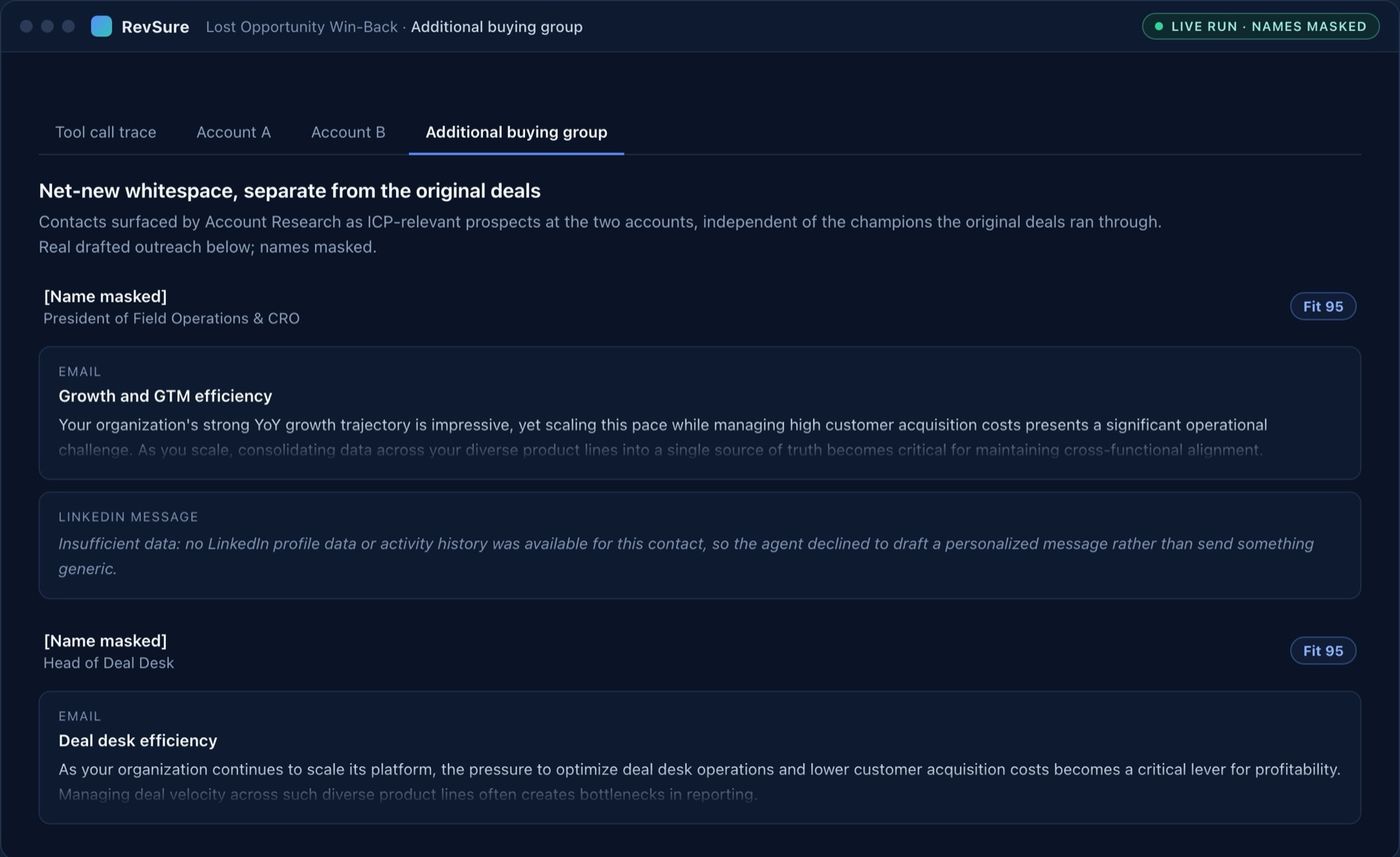
Drafted outreach waiting for a person to review. Where there was too little data to personalize a LinkedIn message, the agent said so and left the field empty.
Look at the empty LinkedIn field: with no profile data or activity history, the agent declined to write a message rather than send something generic. RevSure's Digital SDR page lists "relationship strategy and sensitive contact selection" among the things the customer's team keeps, and the Digital ABM Manager page says RevSure's GTM pod reviews every output before it ships. A rep reads the map and the drafts, decides who to contact and in what order, and edits the message in their own voice.
What a buying group view changes
The healthcare security software company is still in setup. RevSure is building account-level attribution, which reads the touches from every contact associated with the opportunity's account instead of only the contact on the deal, and placing it side by side with the method the company uses today: the lead source and primary campaign fields on the opportunity. The team asked for the comparison so they can check the new numbers against the ones they already report.
The first step is the same for any team: accepting that the opportunity record holds the deal and not the people. A buying group is a list of real people with roles, rebuilt from the data around the CRM and kept current as they engage, go quiet or change jobs. Once it exists, the lost deal in the review above stops being one name on a closed record and becomes 43 engaged people, and the team can decide which of them to call.
FAQs
What is a buying group in B2B sales?
A buying group is the set of people at one account who take part in a purchase decision. It usually includes a champion, an economic buyer, a technical evaluator, day-to-day users, an executive sponsor and reviewers in procurement, legal or security. Most members never fill in a form, so the group has to be mapped from several data sources.
What is the difference between a buying group and a buying committee?
Most teams use the two terms as synonyms. Where a distinction is drawn, a buying committee is the formal set of named evaluators and approvers, while a buying group also includes informal influencers, such as users or advisors, who shape the decision without a seat on the committee. Both describe people at one account and one deal.
How many people are in a buying group?
It depends on deal size, industry and product, and it changes during the deal as reviewers join late. Rather than plan for a fixed number, map the roles your deals need and measure how many of them have at least one engaged person.
Why don't CRMs show the full buying group?
Contacts are often not attached to opportunities, people sit in separate lead and contact records, records keep an old employer's email after a job change, and champions leave without the record being updated. The CRM tracks deals and stages well; the people around each deal have to be rebuilt from marketing, calendar, call and website data.
How do you measure buying group coverage?
For each account, count ICP contacts who are engaged against ICP contacts on file who are not, over a fixed window such as 90 days. Then check coverage by role: which roles have at least one engaged person and which are empty. Review it weekly for open opportunities to catch single-threaded deals early.
How does RevSure help map buying groups?
RevSure resolves leads, contacts and accounts across the CRM, marketing automation, conversations and website data in the Full Funnel Data Graph. Its Digital ABM Manager maps stakeholders, roles and coverage gaps per account, and the Digital SDR researches missing contacts and drafts outreach. People on the customer's team decide who is contacted and when.