On this page
Across this series, we’ve explored how the foundations of go-to-market execution are changing in the Agentic Era. We began by examining why many teams feel productive while still struggling with inconsistent results in “GTM Efficiency Is a Feeling. Cohesion Is a System.” We then looked at how Agentic AI shifts execution from task automation toward outcome orchestration, why governance has become the permission structure for autonomy, and howintegration provides the missing link between insight and action.
But before organizations can fully take advantage of these new capabilities, they often need to confront a more uncomfortable reality. Many GTM teams believe they are operating efficiently. In practice, most are not.
This does not mean teams lack effort or talent. In fact, the opposite is usually true. The reason many organizations appear efficient is precisely that skilled operators continuously compensate for the structural gaps in the systems around them.
Efficiency, in many GTM environments, is less a property of the system and more a reflection of human effort.
The Efficiency Paradox in Modern GTM
The RevSure’s 2026 State of Agentic AI in B2B GTM research highlights a striking contradiction.
When leaders are asked to evaluate their own go-to-market execution, 58% rate it as “very efficient,” and another 37% describe it as “somewhat efficient.” At first glance, this suggests that most organizations feel confident in their operational performance.
Yet when those same leaders are asked what prevents them from achieving better results, the answers reveal a very different picture.
Nearly 47% cite lead quality issues, and 47% point to data quality and unification gaps. More than a third report inconsistent sales follow-up, while many teams continue to struggle with fragmented content operations and disconnected funnel visibility.
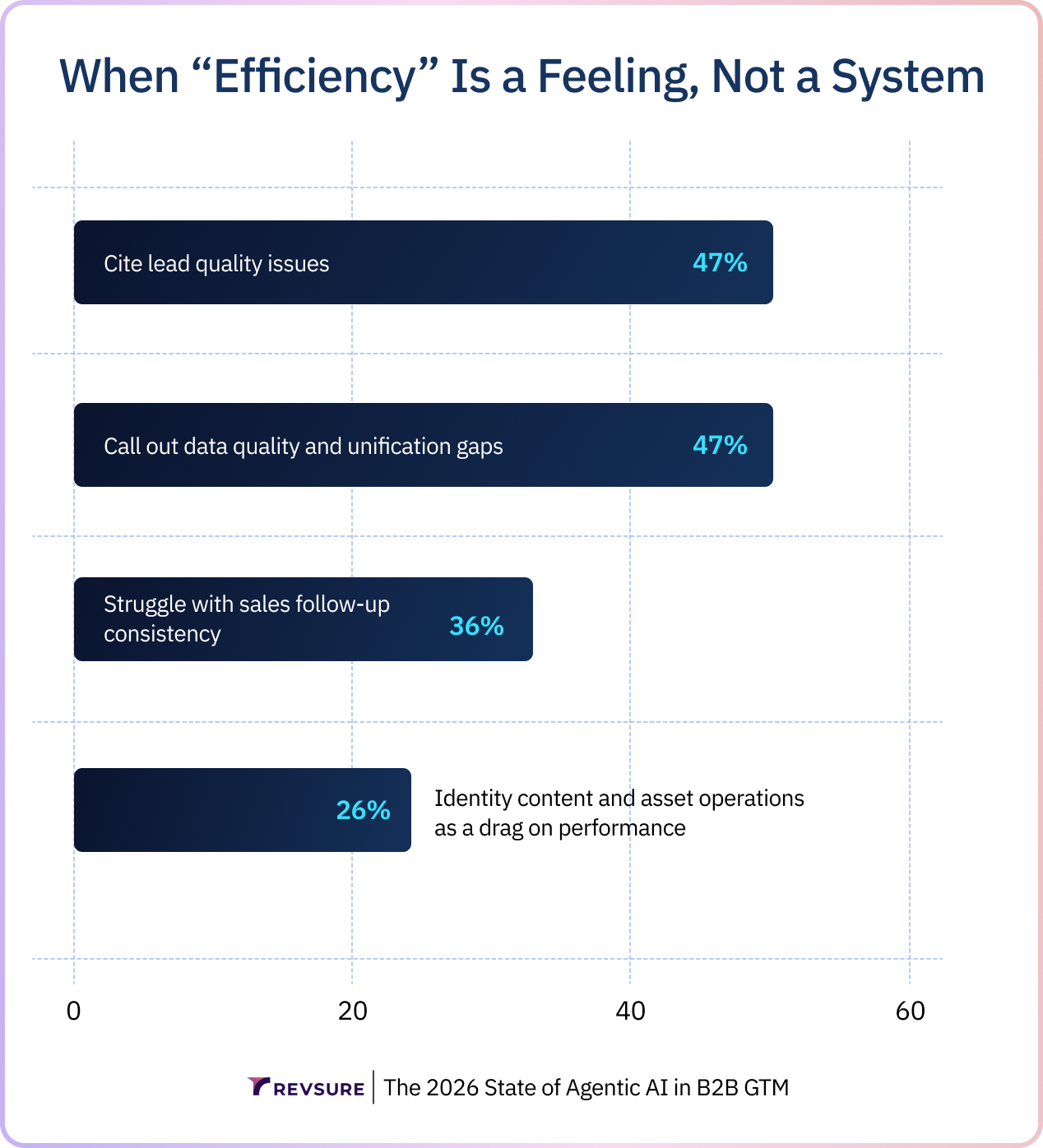
These barriers are not small operational inefficiencies. They point to structural friction across the entire GTM system. The contradiction suggests that what many teams experience as efficiency is actually the result of people compensating for fragmented infrastructure.
Why Activity Often Masquerades as Efficiency
One reason the illusion of efficiency persists is that activity levels in modern GTM organizations are extremely high. Campaigns launch constantly. Leads flow through marketing automation systems. Sales teams execute sequences and outreach. Dashboards display real-time metrics and pipeline updates. From the inside, the engine appears to be moving. But motion and coordination are not the same thing.
In many organizations, meaningful execution depends on manual intervention behind the scenes. Marketing operations teams reconcile campaign performance across multiple platforms. RevOps teams combine data from CRM, engagement systems, and analytics tools to produce coherent reports. Sales teams reinterpret lead scores and engagement signals to determine which accounts deserve attention. These adjustments keep the system functioning, but they also mask deeper structural inefficiencies.
The organization may feel efficient because experienced operators have learned how to navigate the gaps. But the system itself remains fragile.
Fragmentation Creates Hidden Drag
Over time, fragmented systems produce a type of operational drag that is difficult to detect but increasingly expensive to sustain. Signals generated by marketing campaigns may not translate clearly into sales priorities. Sales engagement may occur quickly, but target accounts that lack genuine buying intent. Customer teams may discover expansion opportunities or churn risk only after key signals have already passed through the system unnoticed.
Each of these moments appears small in isolation. But across hundreds or thousands of accounts, they accumulate. Pipeline velocity slows. Conversion rates become unpredictable. Forecast discussions shift from clarity to explanation. These are not simply execution problems. They are coordination problems.
This is why the conversation about efficiency is beginning to change.
Why Agentic AI Exposes the Gap
Agentic AI does not create fragmentation. It reveals it. Traditional automation systems could function within fragmented environments because they executed narrow tasks within predefined workflows. Human teams still provided interpretation and coordination. Agentic AI raises the bar.
When AI agents begin interpreting signals and taking action across systems, they require shared definitions, unified data, and coordinated execution rules. Without those foundations, autonomous systems cannot operate reliably.
This is why so many leaders see full-funnel context as the key to unlocking AI’s potential. In the research, 96% of leaders say AI agents with full-funnel visibility would significantly improve GTM execution. The implication is clear. Organizations are not lacking signals. They are lacking the cohesion required to act on them consistently.
Moving From Perceived Efficiency to System Cohesion
High-performing GTM organizations do not simply move faster. They move together. Marketing, sales, RevOps, and customer teams operate from shared definitions of pipeline readiness and success metrics. Systems provide consistent context across signals and actions. AI agents and human teams interpret the same information and pursue the same outcomes. In these environments, efficiency is no longer dependent on constant human intervention. It becomes a property of the system itself.
This is the transition many organizations are beginning to make as Agentic AI becomes more embedded in execution.
—
Agentic AI is revealing where GTM execution is truly efficient, and where it is simply held together by human coordination. The organizations that succeed will be those that replace fragmented workflows with cohesive systems capable of acting on shared intelligence. To explore the research behind these insights, download The 2026 State of Agentic AI in B2B GTM report.