On this page
An MCP server is software that exposes a product's data and actions to AI assistants through Model Context Protocol, an open standard from Anthropic, so any compliant assistant can call them without a custom integration. RevSure runs an MCP server against its Full Funnel Data Graph, which is the difference between a server that only answers questions and one that can research an account and draft the outreach.
The comparison people reach for is a USB-C port: one interface for many devices, no adapter per pairing. That is accurate as far as it goes.
What makes an MCP server interesting is the second order effect. Connecting the wire is easy. What you point it at is the whole question.
Why a plumbing standard became a strategic question
In March 2026, Gartner published its top predictions for data and analytics. One of them: by 2030, universal semantic layers will be treated as critical infrastructure, alongside data platforms and cybersecurity. Rita Sallam, Distinguished VP Analyst at Gartner, described the pace of change as each year feeling like a new chapter of a science fiction novel. The prediction underneath the framing is unglamorous and specific. The layer that tells a machine what your data means becomes as load bearing as the layer that stores it.
MCP is the wire. The semantic layer is what has to be on the other end of it for the wire to be worth anything.
How an MCP server actually works
An MCP server works through three steps, and the architecture behind them is deliberately simple: a server advertises its tools, and any client that speaks the protocol can discover and call them.
Discovery. The server publishes a list of tools it offers, each with a name, a description, and a schema for the arguments it accepts. The assistant reads that list. Nobody hardcodes anything.
Invocation. Mid conversation, the assistant decides a tool is relevant, calls it with arguments, and gets structured data back. The user sees the result inside the conversation.
Composition. Because the assistant can call many tools in sequence and reason over the results, a question that would have taken four separate queries and a spreadsheet becomes one request.
MCP server vs API: what actually changes
An MCP server differs from a REST API in one place that matters: who does the integration work. A REST API needs a developer to read the docs, write code, handle authentication, and ship a release for every new capability. An MCP server describes itself, and any compliant client can use it right away. The cost of adding a capability drops to roughly the cost of writing a good description.
An API is a door a developer has to cut a key for. An MCP server is a door that hands the assistant a labelled keyring on the way in.
Why most MCP servers stop at read-only
Most MCP servers are read-only. They wrap a product's existing read endpoints and stop there. You can ask questions, but you cannot change anything.
Search for a Salesforce MCP server, a HubSpot MCP server, or a Snowflake MCP server and you will find plenty of them. Most wrap one system's read endpoints, so they can report what that single system already knows, and no more.
There is a good reason for the caution. A server that can only fetch data cannot send an email to the wrong person, write a bad value into a CRM field, or spend money. Every failure mode of a read-only server is a wrong answer, which a human catches.
The ceiling is that a read-only server produces analysis, and most revenue teams already have plenty of analysis. What they lack is the sequence between noticing something and doing something about it, and that sequence usually runs through four tools and two people.
A revenue leader once told RevSure's CEO she would rather use a spreadsheet than log into one more dashboard. Not RevSure's, any dashboard. Her objection was not data quality. It was that every filter is a decision and every dropdown is a context switch, sitting between her question and her answer. A read-only MCP server removes the drop-downs and leaves the rest of the sequence where it was.
What RevSure's MCP server exposes
RevSure's server covers the full revenue data model, and it goes past reading. The capability clusters, roughly:
Entity intelligence. Lookup and filtering across leads, accounts, opportunities, and visitors, by attribute, stage, persona, score, company size, activity, or date range. Account level engagement journeys. Meeting and chat intelligence, including sentiment, stated problems, objections, MEDDPICC coverage, and buying group coverage. LinkedIn profile and activity data for both people and companies.
Attribution and campaign analytics. Multi touch attribution across first, last, linear, U-shaped, and custom models. Campaign performance with and without attribution applied. Lift analysis, which is statistical significance testing on whether a channel actually moved conversion rather than correlating with it. Conversion path and journey analysis. Deep funnel generation and leakage attribution broken out by channel.
Marketing mix modeling. Response curves showing diminishing returns and saturation on spend. ROI and marginal ROI by channel. Spend reallocation recommendations that shift budget from underperformers to top performers without changing the total. Quarter over quarter channel movement.
Marketing mix modeling is normally a data science deliverable measured in weeks and priced accordingly. Asking for a response curve in a sentence and getting one back is a real change in who can reach that analysis.
Funnel and cohort intelligence. Full funnel health metrics across a wide KPI set, cohort based stage progression and movement, pacing against target, and pipeline generation and progression trend lines with projections.
Engagement signals. Meeting and chat intelligence through conversation intelligence integrations, buying group coverage, product usage signals, and account and lead journey timelines that blend campaign touches, activities, and stage movements into one sequence.
Actions. Triggering and monitoring RevSure's own agents. Managing Reli configuration, including ICP definitions and playbooks. Prospecting, enrichment, sequence creation, and email through the Apollo.io integration, chained against RevSure's own account and contact data. LinkedIn actions through Unipile, including connection requests, messages, post engagement, and pulling a prospect's recent activity for personalisation.
The difference between asking and doing
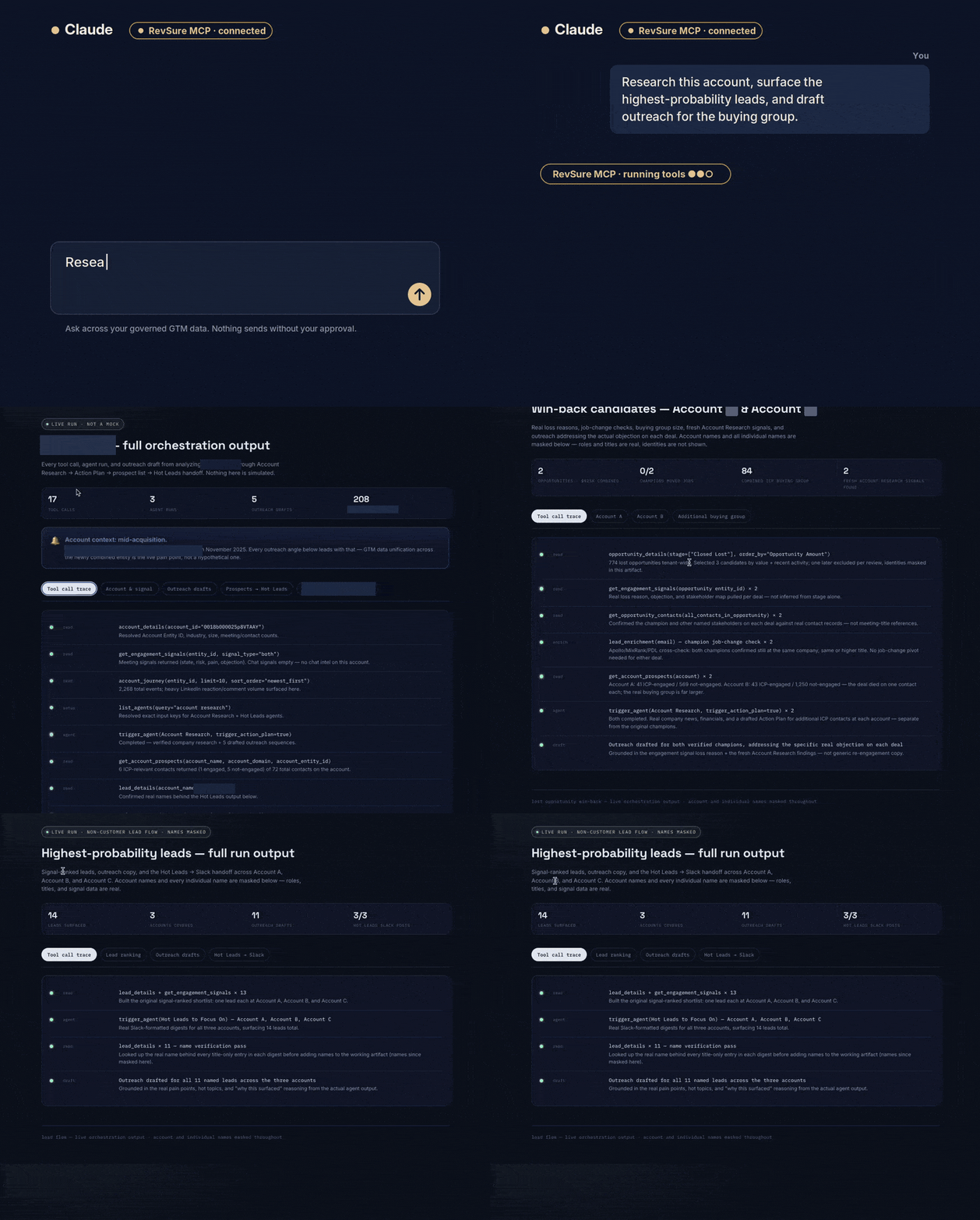
Here is the sequence the action cluster makes possible in one conversation.
Pull an account's current funnel stage and engagement history. Read what was said in recent meetings, including the objections raised. Check what the champion has posted on LinkedIn in the past month. Identify the rest of the buying group through ICP matched prospecting. Enrich the contacts that are missing details. Draft outreach that references the actual objection and the actual LinkedIn post. Present the sequence for approval.
Every one of those steps exists in some tool today. The work is in the seams: the copy paste between the CRM and the enrichment tool, the tab switch to LinkedIn, the re typing of context into the sequencing platform. That connective work is where most of a rep's research hour goes, and it produces nothing a customer ever sees.
Nothing in that sequence sends without a person approving it. Sending email, activating a sequence, and messaging on LinkedIn all need explicit human confirmation in the product flow. The agent assembles the work. A person decides whether it ships. Anyone promising fully autonomous outbound is either describing something that does not exist or something you should not want. That approval step is part of the harness every deployed agent needs.
Why the data underneath decides everything
Two MCP servers can expose identical tool lists and give completely different answers, because the tools are only as good as the model behind them.
Ask a CRM backed server which channel drove last quarter's pipeline and it reads the lead source field, a single value written once at creation, usually by a form, often wrong. Ask a server backed by a harmonised data graph and it runs an attribution model across the actual touch sequence, tells you which model it used, and lets you compare models.
Both answers arrive in the same format and sound equally confident. One of them is defensible in front of a CFO.
This is where the Gartner semantic layer prediction lands. The assistant is interchangeable. Claude today, something else next year, and the same MCP server serves both. What is not interchangeable is whether the thing on the other end knows that a Marketo program, a Salesforce campaign, and a LinkedIn ad set are three names for one initiative, that the same buyer shows up as three records, and that a stage change on Tuesday was caused by a webinar three weeks earlier.
RevSure spends most of its engineering effort on exactly that: resolving the same buyer across systems, harmonising the data, and building the attribution model that turns a pile of events into an answer a CFO will accept. MCP is how that work becomes reachable from wherever a revenue team is working. That harmonised model is the context layer an agent reads before it acts.
Getting started
The RevSure MCP server runs against your tenant with your permissions. Data governance and user level authentication apply exactly as they do inside the product, a user reaching RevSure through an assistant sees what they would see logged in, and PII masking is on by default.
Availability of specific tool categories varies by tenant and plan. Talk to your RevSure contact about which clusters are enabled for your account.
Frequently asked questions
What is an MCP server?
An MCP server is software that exposes a product's data and capabilities to AI assistants through Model Context Protocol, an open standard created by Anthropic. The server publishes a list of tools with descriptions and schemas, and any MCP compliant assistant can discover and call those tools during a conversation without a custom integration being built first.
How is an MCP server different from an API?
An API needs a developer to read documentation and write integration code for each capability. An MCP server describes its own tools in a machine readable way, so an AI assistant discovers what is available at connection time and calls it directly, with no client side release needed to use a new capability.
What does MCP server architecture look like?
The architecture is a client and a server that share one protocol. The server advertises its tools with names, descriptions, and schemas. The client, an AI assistant, discovers that list at connection time, calls the tools it needs, and reasons over the structured results. There is no per capability integration code, which is what separates it from a traditional API.
Is there an MCP server for Salesforce, HubSpot, or Snowflake?
There are many, and most are read only wrappers around a single system's data. A Salesforce, HubSpot, or Snowflake MCP server can report what that one system already knows. RevSure's server sits on a harmonised full funnel data graph that unifies those sources, resolves the same buyer across them, and runs attribution across the combined touch sequence, which a single system server cannot do on its own.
Can an MCP server take actions, or only read data?
Both are possible, and most published MCP servers are read only. RevSure's server includes action tools that trigger agents, manage Reli configuration, run prospecting and enrichment through Apollo.io, and perform LinkedIn actions through Unipile. Any action that reaches a prospect needs explicit human confirmation before it executes.
Is my data safe when an AI assistant connects through MCP?
Access follows your existing permissions. A user connecting through an assistant sees the data they are entitled to see inside the product, authentication is user level, and PII masking is applied by default. The assistant does not get a broader view of the data than the person using it.
Related reading: MCP for GTM covers what a revenue team actually connects and in what order. Agentic RAG explains the retrieval loop that runs behind an assistant once it can call tools, and RAG vs context graph sets out why retrieval alone does not give an agent a model of the buyer.