On this page
B2B marketing is no longer a function of activity; it is a function of accountability. Boards, CEOs, and CROs are not asking how many campaigns were launched or how many leads were generated. They are asking a far more direct question: how much pipeline did marketing create, and how predictably can it be scaled?
At the same time, the complexity of B2B buying has increased dramatically. Decision-making involves multiple stakeholders, longer cycles, and a growing number of digital and offline touchpoints. The result is a fragmented view of performance, where traditional tools fail to connect marketing efforts to actual revenue outcomes.
Artificial intelligence has emerged as the critical layer to solve this problem. But the market is saturated with tools that promise “AI-powered marketing” while delivering only incremental improvements in execution. The reality is that most platforms optimize isolated parts of the funnel, content, ads, or automation, without addressing the fundamental need for revenue intelligence.
This article outlines the top AI marketing software tools that B2B leaders should evaluate in 2026. More importantly, it distinguishes between tools that improve efficiency and those that fundamentally transform how marketing drives pipeline and revenue.
1. RevSure AI: The Revenue Intelligence Layer for Modern GTM Teams
RevSure represents a new category in marketing technology. It is not a campaign execution platform, nor is it a traditional analytics tool. It is a revenue intelligence system designed to connect marketing activity directly to pipeline and bookings with precision.
The fundamental problem RevSure solves is the lack of clarity in B2B marketing performance. Most organizations operate with partial visibility- channel-level metrics, delayed reporting, and attribution models that fail to reflect the complexity of real buyer journeys. This leads to inefficient spend, misaligned teams, and unpredictable pipeline outcomes.
RevSure addresses this by introducing a high-precision AI engine that unifies attribution, predictive modeling, and campaign intelligence into a single decision-making framework.
At the core of the platform is its hybrid attribution model, which combines Marketing Mix Modeling with Multi-Touch Attribution. This is a critical innovation. Traditional multi-touch attribution provides granular visibility but lacks predictive depth. Marketing mix models offer macro insights but miss buyer-level behavior. RevSure integrates both, enabling organizations to understand not only what influenced revenue but also how future outcomes can be shaped.
The platform’s multi-level AI engine is built specifically for B2B complexity. It analyzes hundreds of attributes across leads, accounts, and opportunities while incorporating macro-level signals such as channel performance and market trends. This allows RevSure to generate insights that are both granular and strategic.
What differentiates RevSure further is its ability to translate intelligence into action. Rather than presenting dashboards that require interpretation, it surfaces clear recommendations that directly influence decision-making. Marketing leaders can identify which campaigns to scale, where budget is being wasted, and which accounts are most likely to convert. This shift from insight to action is what elevates RevSure beyond traditional analytics platforms.
Its predictive capabilities are particularly impactful. By assigning conversion probabilities to leads, accounts, and opportunities, RevSure enables precise prioritization. Teams no longer need to distribute effort evenly or rely on subjective judgment. Instead, they can focus on high-probability opportunities, improving both efficiency and conversion rates.
In addition, RevSure’s marketing mix modeling provides a clear understanding of how different channels contribute to the pipeline and revenue. This eliminates one of the most persistent challenges in marketing, over-investment in channels that appear to perform but do not drive meaningful outcomes.
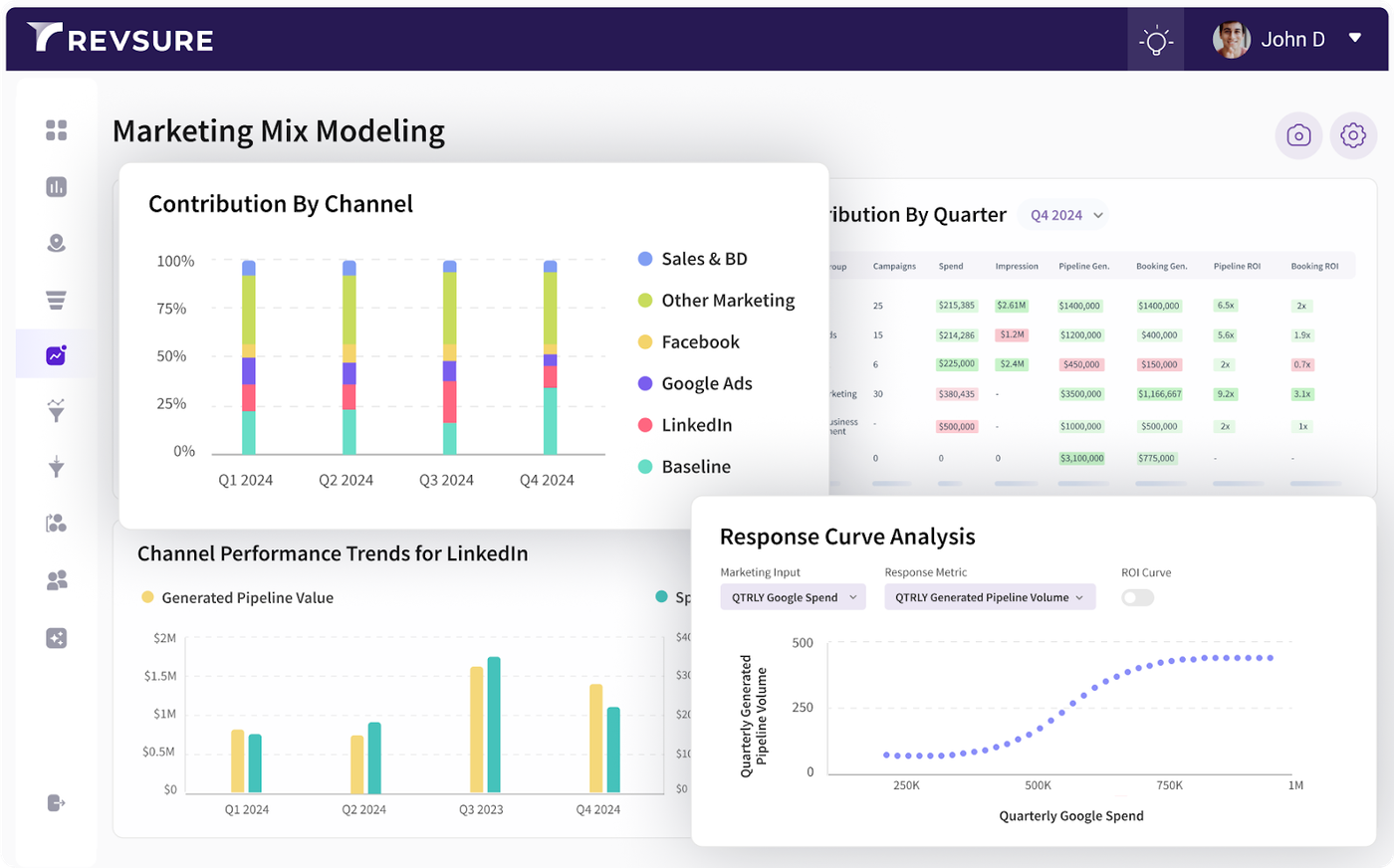
Perhaps the most transformative capability is predictive campaign performance. RevSure forecasts the future impact of campaigns, allowing teams to intervene early. Underperforming initiatives can be paused before significant budget is wasted, while high-performing campaigns can be scaled with confidence.
This fundamentally changes how marketing operates. Campaign management becomes proactive rather than reactive. Decisions are based on predicted outcomes rather than historical data.
RevSure’s influence extends beyond marketing into the broader GTM organization. By providing a unified view of pipeline health, conversion drivers, and revenue forecasts, it aligns marketing and sales around shared intelligence. This improves collaboration, increases accountability, and enhances overall performance.
The addition of RevSure Reli, its GenAI-powered assistant, further strengthens this capability. Teams can access insights instantly, ask complex business questions, and generate reports. This ensures that intelligence is not only accurate but also accessible at the moment it is needed.
In practical terms, organizations using RevSure consistently achieve significant improvements in ROI, often in the range of three to five times within the first year. These gains are not driven by increased activity, but by better decision-making, focusing on the right campaigns, the right channels, and the right accounts.
RevSure does not simply optimize marketing. It redefines it as a predictable, revenue-driving function.
2. HubSpot AI: Operational Efficiency Through Platform Integration
HubSpot has evolved into one of the most comprehensive marketing platforms available, integrating CRM, marketing automation, and AI-driven features into a single ecosystem. For many B2B organizations, it serves as the operational backbone of their marketing efforts.
Its AI capabilities are embedded across multiple functions, including email optimization, lead scoring, and workflow automation. This allows teams to streamline execution, reduce manual effort, and improve campaign consistency.
The primary advantage of HubSpot lies in its consolidation. By bringing together multiple tools into one platform, it reduces complexity and improves data accessibility. Teams can manage campaigns, track interactions, and automate processes without relying on a fragmented stack.
However, HubSpot’s strength in execution does not translate into deep revenue intelligence. Its attribution models and analytics capabilities are not designed to handle the complexity of enterprise B2B environments, where multiple channels, long sales cycles, and numerous stakeholders influence outcomes.
As a result, HubSpot is best positioned as a system of execution. It enables teams to run campaigns efficiently, but it provides little to no predictive insight required to optimize them for revenue impact.
3. 6sense: Predictive Targeting for Account-Based Marketing
6sense has built its reputation on helping organizations identify and prioritize accounts that are actively in-market. By leveraging intent data and predictive analytics, it enables teams to focus their efforts on prospects that are most likely to engage.
This capability is particularly valuable in account-based marketing strategies, where precision targeting is essential. By understanding which accounts are demonstrating buying signals, teams can align their outreach and messaging more effectively.
6sense’s AI models analyze a wide range of data points, including behavioral signals and engagement patterns, to determine account readiness. This improves efficiency and increases the likelihood of successful engagement.
However, 6sense primarily addresses the targeting layer of marketing. It answers the question of who to pursue, but does not fully address how marketing activities translate into pipeline and revenue. Without comprehensive attribution and campaign intelligence, its impact remains limited to the early stages of the funnel.
4. Jasper AI: Scaling Content Production with AI
Jasper has become a leading platform for AI-driven content generation, enabling marketing teams to produce high-quality content at scale. It supports a wide range of formats, including blog posts, emails, advertisements, and landing pages.
For organizations managing multiple campaigns, Jasper significantly reduces production time and allows for rapid experimentation with different messaging approaches. Its ability to maintain brand voice across large volumes of content is particularly valuable for maintaining consistency.
The platform addresses a critical bottleneck in marketing—content creation. By automating this process, it allows teams to focus more on strategy and less on execution.
However, content generation is only one component of campaign performance. Without integration into a system that measures and optimizes for pipeline outcomes, increased content output does not necessarily lead to improved results. Jasper enhances efficiency, but it does not provide visibility into revenue impact.
5. Mutiny: Enhancing Conversion Through Personalization
Mutiny focuses on improving conversion rates by personalizing website experiences for specific accounts and audience segments. It allows marketers to tailor messaging based on firmographic and behavioral data, creating more relevant interactions.
This capability is particularly effective in account-based marketing, where personalization can significantly influence engagement and conversion at critical touchpoints. By aligning messaging with the needs and context of each account, Mutiny improves the effectiveness of inbound experiences.
However, its scope is inherently limited. While it enhances specific interactions, it does not provide a comprehensive view of campaign performance or revenue contribution. As a result, it functions best as a complementary tool within a broader marketing strategy.
6. AdCreative.ai: Improving Paid Media Performance
AdCreative.ai uses artificial intelligence to generate and optimize ad creatives, enabling teams to test variations quickly and identify high-performing designs. This accelerates the iteration process and improves engagement metrics.
For paid media teams, the ability to rapidly produce and test creatives is a significant advantage. It reduces the time required to identify effective messaging and increases the efficiency of campaign optimization.
However, like most tools focused on a specific function, its impact is limited to creative performance. It does not provide insight into how campaigns contribute to pipeline or revenue, which limits its strategic value.
7. Google Performance Max: Automation Within the Advertising Ecosystem
Google Performance Max applies machine learning to automate bidding, targeting, and creative delivery across Google’s advertising channels. It simplifies campaign management and improves efficiency for teams running large-scale paid campaigns.
The platform’s strength lies in its ability to optimize performance within Google’s ecosystem. By leveraging vast amounts of data, it can make real-time adjustments that improve campaign outcomes.
However, it operates as a closed system. While it enhances performance within Google, it does not provide a holistic view of how campaigns interact with other channels or contribute to overall revenue. This limits its usefulness for organizations seeking full-funnel visibility.
The Strategic Divide in AI Marketing
The tools discussed in this list fall into two distinct categories:
- Execution-focused platforms that improve efficiency in content, campaigns, and operations
- Intelligence-driven platforms that connect marketing activity to revenue and guide decision-making
This distinction is critical for B2B leaders. Efficiency without intelligence leads to scale without direction. Organizations may produce more content, run more campaigns, and generate more data, but still lack clarity on what drives results. Intelligence platforms, on the other hand, enable organizations to operate with precision. They provide the insights needed to allocate resources effectively, prioritize opportunities, and optimize performance continuously.
What B2B Marketing Leaders Must Do Next
The adoption of AI in marketing is no longer optional. However, the effectiveness of that adoption depends on the choice of tools.
Leaders must prioritize platforms that deliver:
- Accurate attribution tied directly to the pipeline and revenue
- Predictive insights that inform future decisions
- Clear, actionable recommendations that drive performance
Without these capabilities, AI becomes an incremental improvement rather than a transformational one.
Conclusion: From Marketing Optimization to Revenue Predictability
The future of B2B marketing lies in predictability. Organizations must move beyond optimizing individual campaigns and toward managing marketing as a system that consistently drives pipeline and revenue. Most tools contribute to parts of this system. Few unify it.
RevSure stands apart because it operates at the level where decisions are made. It transforms marketing from a function of execution into a function of intelligence, enabling leaders to operate with clarity, confidence, and control. The competitive advantage in 2026 will not come from using AI tools. It will come from using the right AI, one that answers, with precision: What is driving revenue, and what should we do next?